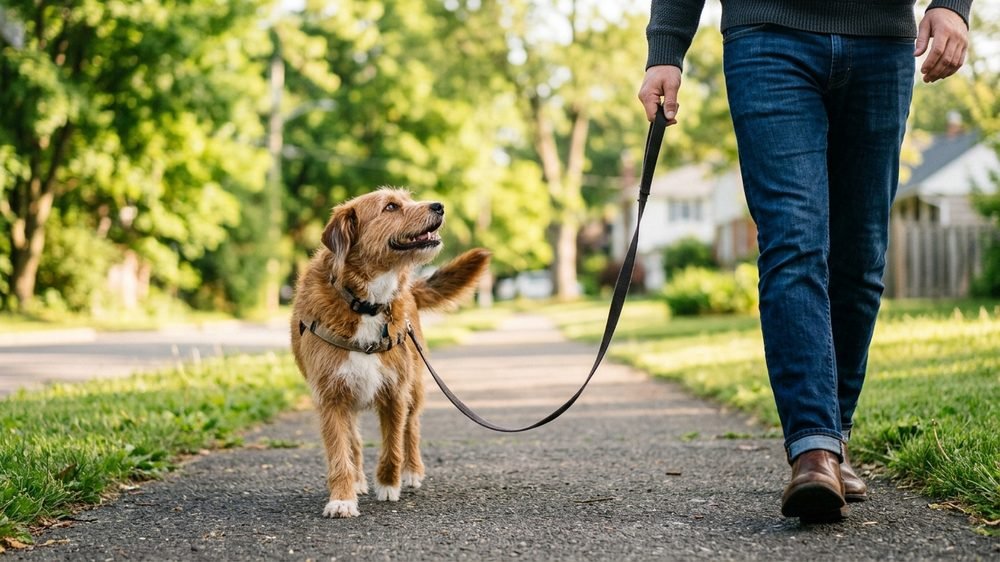
Learning how to stop a dog from pulling on the leash on walks is one of the most valuable skills any dog owner can develop. A dog that drags you down the street turns what should be a relaxing outing into a daily battle of sore shoulders and frayed nerves. The good news: pulling is not a personality flaw or a sign of a “bad” dog. It is a learned habit, and like any habit, it can be replaced with a better one. In this guide, you will learn why dogs pull, the eight proven steps trainers use to build calm loose-leash walking, which gear actually helps, and the mistakes that keep pulling alive.
Why Dogs Pull on the Leash in the First Place
Dogs do not pull to dominate you or out of stubbornness. They pull for reasons that make complete sense from a dog’s point of view:
- Opposition reflex. When pressure is applied to the body, the automatic physical response is to push against it. Yank back on the leash and your dog’s body leans forward and pulls harder. The harder you pull, the harder most dogs pull. It is biology, not defiance.
- Speed mismatch. A healthy dog naturally walks about four times faster than a human’s comfortable pace. Your dog is not trying to escape; it is walking at the speed that feels normal, constantly throttling back unless staying close has been made worthwhile.
- Pulling works. This is the biggest reason. Every time your dog pulls and you follow, the dog gets exactly what it wanted: forward motion toward the interesting smell or the other dog. Pulling has a perfect success rate, so why would the dog stop?
- Excitement. New smells, fresh air, and pent-up energy all peak in the first minutes of a walk — which is exactly when pulling is worst.
Understanding these causes changes the approach. You cannot punish away an opposition reflex. Instead, change the equation: make pulling stop working, and make walking on a loose leash the most rewarding choice available.
8 Proven Steps to Stop Leash Pulling
These eight steps form a complete training plan for puppies, adults, and seniors that have pulled for years. Follow them in order and be patient — you are rebuilding a habit, not flipping a switch.
Step 1: Start Training Where Distractions Are Low
Do not begin on a busy sidewalk. Start in your backyard, a quiet hallway, or an empty lot. The goal of the first sessions is simply to teach the basic idea: staying near you with a loose leash earns good things. Dogs do not generalize well — a dog that walks beautifully indoors may act like it has never seen a leash at the park. That is normal. Rushing this stage is the top reason training stalls.
Step 2: Make a Loose Leash Pay
Reward your dog every few steps whenever the leash has slack. Carry small, soft, high-value treats and use a marker word like “yes!” the instant you see that loose leash, delivering the treat near your leg so your dog learns the area beside you is the money zone. Reward generously at first, then stretch the distance between treats as the behavior becomes reliable. This mirrors the no-punishment philosophy in our guide on how to keep a dog from barking at the mailman, no punishment — progress comes from rewarding the right choice, not correcting the wrong one.
Step 3: Be a Tree — Stop the Moment the Leash Tightens
This classic method attacks the root cause: pulling works. The instant the leash goes tight, stop dead. Plant your feet, say nothing, and do not yank back. Simply wait. The moment your dog creates any slack — shifting weight, turning its head, stepping back — mark it with “yes!” and walk forward again. Forward motion is the reward. Your dog learns the new rule: a tight leash stops the walk, a loose leash continues it. The first sessions will feel ridiculous — five minutes to travel half a block is fine. Every person who walks the dog must follow the same rule, because one person who lets the dog drag them forward teaches the dog that pulling sometimes works.
Step 4: Change Direction to Break the Habit
For dogs that forge ahead, add direction changes. The moment your dog surges past you, cheerfully turn and walk the other way. You are not jerking the dog; you are simply going somewhere else, and the leash guides the dog to follow. This teaches the dog to watch you instead of locking onto whatever is ahead. Combined with Step 3, most dogs start glancing back regularly within a few sessions — and that check-in is what loose-leash walking looks like.
Step 5: Keep Sessions Short
Keep dedicated training to five to ten minutes, two or three times a day. Dogs learn best in short, successful bursts, and a frustrated dog learns nothing. Always end on a win. Note that training walks and exercise walks are different things: a five-minute session does not replace real exercise. Give high-energy dogs a play session first, because a dog bursting with unspent energy cannot focus. Ten focused minutes of training can tire a dog as much as a much longer stroll.
Step 6: Raise Difficulty One Distraction at a Time
Once your dog walks nicely in a quiet area, level up gradually:
- Quiet backyard or indoor space
- Quiet street at an off-peak hour
- The same street when neighbors are out
- A park, at a distance from the action
- Closer to other dogs, people, and wildlife
Move up only when your dog succeeds about eight times out of ten. If it falls apart at a new level, you climbed too fast — drop back, rebuild success, and retry later. Distance is your best friend: everything distracting is easier from farther away. Puppies often mouth the leash itself during early training; redirect to a toy and keep it upbeat. If mouthiness extends beyond the leash, our guide on how to stop a puppy from biting shoes and clothes for good covers that habit with the same reward-based approach.
Step 7: Handle Strong or Reactive Dogs Safely
A large dog that lunges is a safety issue. A well-fitted front-clip harness gives steering control without pain, and some owners of very strong dogs clip the leash to both a front-clip harness and a flat collar for extra security. For reactive dogs that bark or lunge at triggers, the same steps apply but at much greater distances with shorter sessions — teach the dog that noticing a trigger and looking back at you earns a reward. Never punish a reaction; punishment suppresses warning signs without changing the underlying emotion. If barking is also a problem at home, the desensitization method in our guide on how to stop a dog from barking at the doorbell in 7 steps uses the same gradual approach you will use on walks. Smart management helps too: cross the street before your dog reacts, make cheerful U-turns, and walk at quieter times while training.
Step 8: Know When to Get a Professional Trainer
Most pulling is fixable with the steps above, but get professional help if your dog shows aggression on walks, is too fearful or over-aroused to take treats outdoors, shows no improvement after several consistent weeks, or you feel unsafe. Look for a certified trainer (such as CPDT-KA) who uses positive-reinforcement methods. Avoid anyone who guarantees instant results or reaches for punishment tools first. A good trainer coaches you as much as the dog, since you hold the leash every day.
Choosing the Right Gear: Front-Clip Harness vs Collar
Gear does not train your dog, but the right equipment makes training easier and safer:
Front-Clip Harness
The leash attaches at the chest, so when the dog pulls, the body gently turns back toward you — pulling becomes self-defeating. Pros: excellent steering control with no neck pressure or pain; great for strong dogs. Cons: some dogs need days to adjust to the chest strap; a poor fit can chafe; it manages pulling rather than teaching, so training is still required.
Back-Clip Harness
Pros: comfortable, easy to put on, no neck pressure. Cons: the back attachment can encourage pulling — it is the same setup sled dogs wear. Fine for an already-polite walker, but not ideal while fixing pulling.
Flat Collar
Pros: simple, holds ID tags, fine for dogs that already walk politely. Cons: all pulling force lands on the neck, risking trachea damage in hard pullers; offers the least control. The worst choice during training for a dog that pulls hard.
Head Halter
Pros: maximum control with minimal force — where the nose goes, the body follows; excellent for very large dogs while training progresses. Cons: most dogs need a careful, treat-heavy conditioning period first; a sudden lunge on a long leash can strain the neck.
What to skip: choke chains, prong collars, and shock collars work through pain and fear. They may suppress pulling short-term but never teach the dog what to do instead, and they risk injury and damaged trust. Think of no-pull gear as training wheels: a front-clip harness or head halter manages the problem humanely while your training builds the real skill.
5 Mistakes That Keep Your Dog Pulling
- Yanking the leash. Leash corrections trigger the opposition reflex, so the dog pulls harder — and learns the leash predicts unpleasant surprises.
- Using a retractable leash. It teaches dogs that constant leash tension is normal, the opposite of what you want. The thin cord can also cause burns or snap. Use a standard four-to-six-foot leash for training.
- Letting pulling “work” sometimes. The deadliest mistake. If pulling succeeds even occasionally, you have put it on an intermittent reinforcement schedule — the same schedule that keeps people pulling slot machine handles — making the habit incredibly persistent. Everyone who walks the dog must follow the same rules.
- Only training when you are in a hurry. Walks with a deadline are the worst time to train. Do dedicated sessions separately from must-get-there walks.
- Quitting rewards too soon. Once the dog walks nicely, owners often stop rewarding entirely and the behavior fades. Keep paying for loose-leash walking intermittently for life.
Frequently Asked Questions
How long does it take to stop a dog from pulling on the leash?
Most dogs show noticeable improvement within two to three weeks of consistent daily practice, and many walk reliably on a loose leash within two to three months. Puppies often learn faster than adults with years of pulling practice. The biggest variables are consistency across every walk and every family member, and starting at the right difficulty level.
Is a harness or a collar better to stop pulling?
For a dog that currently pulls, a well-fitted front-clip harness is better: steering control without neck pressure, and pulling becomes physically unrewarding. A flat collar is fine once the dog walks politely and is where ID tags should live. Avoid training a hard puller on a collar alone because of trachea and neck injury risk.
Should I let my dog sniff on walks?
Yes — sniffing is mentally enriching and a tired brain pulls less. Make sniffing a reward you grant rather than something the dog seizes by dragging you. Walk on a loose leash between sniff spots, then use a release cue like “go sniff.” Structured sniff breaks improve loose-leash walking because the dog learns staying with you leads to the good stuff.
Why does my dog pull at the start of the walk but walk nicely on the way home?
Excitement and unspent energy peak at the start, and everything smells new. On the way home the dog is calmer and the novelty has worn off. Reduce the opening frenzy with brief play before leaving, a few minutes of “be a tree” practice right outside your door, and calmer routes for the first stretch.
Are retractable leashes bad for training?
Yes. They maintain constant tension, teaching the dog that a tight leash is normal — directly contradicting loose-leash training. They also give poor control near traffic and the thin cord can cause injuries. Use a fixed four-to-six-foot leash for training.
Can an older dog learn to stop pulling?
Absolutely — it is never too late. Senior dogs may need more patience if they have rehearsed pulling for years, but the steps are identical, and many learn quickly because they are calmer than they were as adolescents. Use soft treats for older teeth and enjoy the process.
Stopping leash pulling comes down to a simple formula: make pulling stop working, make walking beside you pay well, and practice in easy settings before hard ones. Start with the right gear, keep sessions short and positive, get the whole household on the same page, and give it a few consistent weeks. The reward is every walk from here on out — calm, enjoyable, and something you both look forward to.