
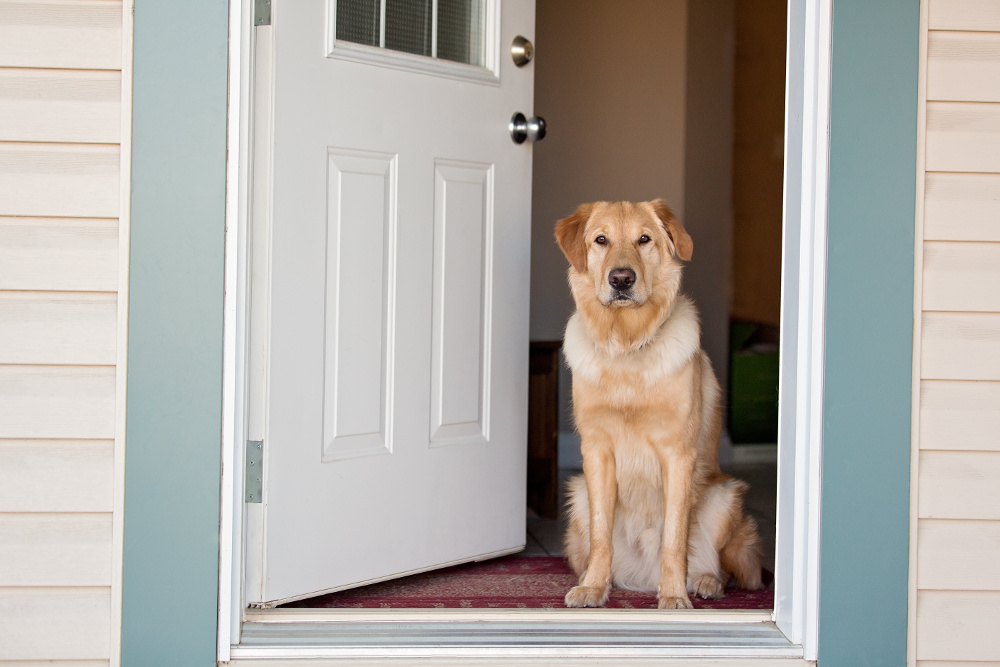
Learning how to stop a dog from barking at the doorbell can transform daily life if every visitor triggers a frantic barking explosion. Doorbell barking is one of the most common behavior complaints dog owners have — and one of the most fixable. Your dog is not being “bad.” Barking at the doorbell is a deeply natural behavior: alert barking warned the pack of approaching strangers long before doorbells existed. The good news is that you can retrain this response humanely, without punishment, shock collars, or yelling. Here is a complete plan that works.
Why Dogs Bark at the Doorbell
Understanding the motivation makes the training obvious. Doorbell barking is usually a mix of several drives:
- Territorial instinct: Someone is approaching the den. Barking is the dog’s ancient job description.
- Alarm and arousal: The sudden sound spikes adrenaline. A highly aroused dog cannot think clearly, which is why calm commands fail in the moment.
- Reinforcement history: The dog barks, the “intruder” eventually leaves (the visitor goes away or comes inside and the excitement ends). From the dog’s perspective, the barking worked. Every repetition strengthens the habit.
- Owner behavior: Rushing to the door, shouting “quiet!”, or getting tense yourself all confirm to the dog that doorbell = emergency.
Notice that punishment is not on this list as a solution — because it does not address any of these causes. Yelling “quiet” just adds your barking to theirs. The effective approach is to change what the doorbell predicts: instead of “intruder alert,” it becomes “go to your spot and good things happen.”
What You Need Before You Start
- High-value treats: Small, soft, smelly treats your dog only gets during training (cheese, chicken, freeze-dried liver). Doorbell training competes with adrenaline, so kibble will not cut it.
- A “place” spot: A mat, bed, or rug that becomes the dog’s designated station. Place training is the backbone of this method.
- A helper: A family member or friend who can ring the bell on cue while you train. Alternatively, record your doorbell sound on your phone and play it at low volume.
- A leash: For early sessions, a leash prevents self-rewarding (charging the door) while the new habit forms.
- Patience for 2-4 weeks: Most dogs show real improvement within a couple of weeks of consistent practice. Older dogs with years of rehearsed barking may take a bit longer.
Step 1: Teach a Rock-Solid “Place” Command
Before touching the doorbell, your dog needs a job to do instead of barking. “Place” (go to your mat and stay there) is the perfect incompatible behavior — a dog lying calmly on a mat cannot simultaneously sprint to the door barking.
Train it away from the doorbell first: lure your dog onto the mat with a treat, mark and reward the moment all four paws are on it, then gradually add duration (reward for staying 5 seconds, then 10, then 30) and distance (you step one foot away, then across the room). Practice in short, fun sessions until your dog runs to the mat eagerly when you say “place.” This foundation makes everything else possible.
Step 2: Desensitize the Doorbell Sound
Right now the doorbell triggers an adrenaline spike. Desensitization lowers that spike by exposing the dog to the sound in controlled, non-threatening doses.
Play your recorded doorbell sound at a very low volume — so quiet your dog notices but does not react. Immediately treat. Repeat 10-15 times per session: sound, treat, sound, treat. Over days, gradually increase the volume, but only as long as your dog stays under threshold (relaxed, taking treats easily). If the dog starts barking or will not take treats, the volume is too high — drop back down. You are rewriting the emotional response: doorbell sound now predicts treats, not intruders. Most dogs progress through this surprisingly fast when the volume ladder is respected.
Step 3: Combine Doorbell With the Place Cue
Now merge the two skills with your helper. Have the helper ring the actual doorbell once while you cue “place” before the dog erupts — timing is everything in the early sessions. The moment your dog moves toward the mat, mark and reward generously. The sequence you are building is: doorbell rings → dog goes to mat → amazing treats rain down.
Keep the dog leashed at first so charging the door is not an option. Reward calm behavior on the mat heavily in the first week — you want the mat to become the best place in the house when the bell rings. Practice 3-5 short sessions per day rather than one long one.
Step 4: Add Duration and Real-Life Realism
Once your dog goes to the mat reliably on cue after the bell, make it real:
- Extend the stay: Have your helper ring, send the dog to place, then wait 10 seconds, 30 seconds, a minute before releasing with a reward. Build up to the dog staying on the mat while you actually open the door.
- Vary the helper: Use different people, and eventually real visitors. Tell guests in advance: ignore the dog completely until it is calm on its mat, then they can greet it.
- Practice the full sequence: Bell rings → dog to place → you answer the door → dog stays → release and reward. This is the real-world skill, so rehearse it exactly as it will happen.
- Fade the treats gradually: Once the behavior is reliable, shift from treating every time to intermittent rewards, then to occasional praise. Never fade to zero entirely — an occasional jackpot keeps the habit strong for life.
Step 5: Teach a “Quiet” Cue as a Backup
Place training handles the doorbell scenario, but a “quiet” cue is useful for the occasional slip and for other barking triggers. The humane way to teach it: wait for a natural pause in barking (even a one-second breath), mark it with “yes!” and treat. Add the word “quiet” just before you expect the pause. Over sessions, your dog learns that silence — not barking — earns the reward.
Important: never teach “quiet” by shouting it over barking. If you are louder than the dog, you have joined the barking choir. The cue only works if it was trained during calm moments and proofed gradually.
Step 6: Manage the Environment During Training
While you train, prevent rehearsal of the old habit — every unpracticed barking explosion sets you back:
- Temporarily change the doorbell: Switch to a knock, a text message (“I’m here!”), or a wireless doorbell with adjustable volume/chime that you can keep low during the training weeks.
- Block visual triggers: If your dog also barks at visitors seen through windows, use frosted window film or baby gates during the training period. Fewer triggers mean faster learning.
- Exercise before expected visitors: A dog that has had a good walk or play session has lower baseline arousal and learns calm behavior much faster.
- Stay boring yourself: When the bell rings, move calmly. No rushing, no shouting, no apologizing to the visitor while tense. Your calm is contagious — and so is your panic.
Step 7: Proof, Maintain, and Troubleshoot
Training is not done when it works twice. Proof the behavior against variations: different times of day, different ringers, the dog in different rooms, you answering the door differently. Then maintain with occasional refresher sessions — a two-minute practice once a week keeps the habit sharp indefinitely.
Common troubleshooting
- Dog will not take treats when the bell rings: The dog is over threshold. Go back to lower-volume desensitization and greater distance from the door.
- Dog goes to the mat but keeps barking there: Reward only quiet moments on the mat. Mark and treat the instant there is a pause in barking. The mat plus quiet is the goal.
- Great in training, terrible with real visitors: Real visitors are more exciting. Recruit friends for realistic practice and instruct them to be boring — no eye contact, no talking to the dog until it is settled.
- Regression after weeks of success: Normal. Just run a few refresher sessions at an easier level. Regression is not failure; it is part of learning.
If your dog’s barking comes with lunging, snapping, or genuine aggression toward visitors — not just noisy excitement — that is beyond a DIY training plan. Consult a certified professional dog trainer or a veterinary behaviorist. Safety first, always.
What NOT to Do
- Do not use shock, citronella, or ultrasonic bark collars: These punish the symptom without teaching an alternative, and they frequently increase anxiety and aggression. Many also trigger on other dogs’ barking, punishing your dog for nothing.
- Do not yell “quiet” or “no”: To an aroused dog, your shouting sounds like you are barking along. It raises arousal instead of lowering it.
- Do not punish the dog after the visitor leaves: Dogs cannot connect delayed punishment to the barking. You will only teach them that visitors predict scary owner behavior.
- Do not expect instant results: A habit rehearsed daily for years will not vanish in three sessions. Consistency over weeks is the entire game.
- Do not skip the management phase: Training while the dog practices the old behavior 10 times a day between sessions is like dieting between meals. Prevent rehearsal while you retrain.
A Sample 3-Week Training Schedule
Week 1: Foundations
- Days 1-3: Train “place” to fluency away from the door (multiple short sessions daily).
- Days 4-7: Begin doorbell desensitization at low volume, pairing sound with high-value treats.
Week 2: Combining
- Days 8-10: Helper rings the real bell; cue “place” before reaction; heavy rewards on the mat.
- Days 11-14: Add duration on the mat; practice with the dog leashed; begin opening the door while the dog holds place.
Week 3: Real life
- Days 15-17: Practice with different helpers; start using real visitors with instructions to ignore the dog.
- Days 18-21: Begin fading treat frequency; proof against variations; switch back to the normal doorbell.
Most owners see dramatic improvement by the end of week two, with reliability building through week three and beyond. If progress stalls at any stage, simply spend more days at that stage — there is no deadline.
FAQ
How long does it take to stop doorbell barking?
With consistent daily practice, most dogs show clear improvement within 2 to 3 weeks, and reliable behavior within a month or two. Dogs with years of rehearsed barking or high baseline anxiety may take longer — patience and consistency matter more than speed.
Will a bark collar work faster?
It may suppress barking temporarily, but it does not teach the dog what to do instead, and it risks increasing fear and aggression. Dogs also learn to bark through the discomfort or bark when the collar is off. Training an alternative behavior is slower but permanent and humane.
My dog only barks at the doorbell, not knocks. Why?
Dogs learn very specific triggers. The doorbell has a unique sound paired with hundreds of repetitions of exciting arrivals. Knocks simply never built the same association. The same desensitization approach works for any specific trigger sound.
Should I get rid of my doorbell entirely?
Temporarily switching to a knock or text message during training is smart management, but permanently removing the doorbell just avoids the problem. Training through it gives you a dog that stays calm no matter what rings.
Can old dogs learn this?
Absolutely. Older dogs can learn new behaviors just as well as young ones — they may even learn faster because they have better impulse control. The only difference is that a longer rehearsal history may need a few extra weeks to overwrite.
What if I live alone and have no helper?
Record your doorbell on your phone and play it from another room, use a remote-controlled wireless doorbell, or ask a neighbor for two 10-minute sessions a week. Many owners train successfully with just a phone recording for the desensitization phase.
Doorbell barking feels like a personality trait, but it is really just a habit — and habits can be rewritten. If your dog’s barking extends to other triggers too, these same principles apply to challenges like barking at the mailman, and the desensitization approach works for other pets as well, as shown in this guide on stopping early-morning wake-up calls from cats. Start today with “place” training and low-volume sound pairing, stay consistent for a few weeks, and enjoy the deeply satisfying sound of a doorbell followed by… nothing.













1 thought on “How to Stop a Dog From Barking at the Doorbell (7 Steps)”
Comments are closed.