
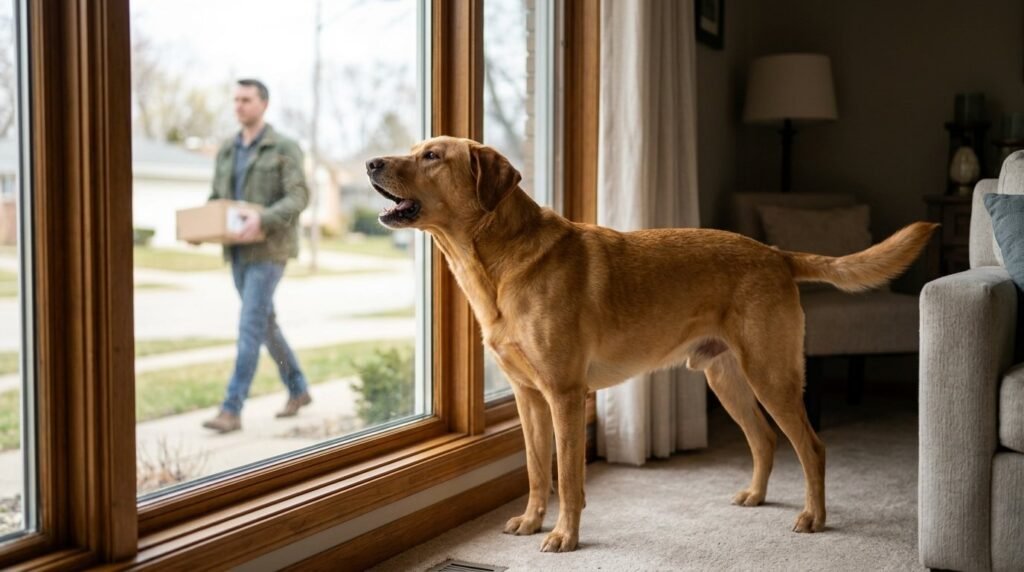
Learning how to keep a dog from barking at the mailman without punishment solves one of the most common — and most stressful — behavior problems dog owners face. Every day, like clockwork, the mail carrier approaches, your dog erupts, and the whole house shakes. You may have tried yelling “quiet,” and discovered that shouting at a barking dog just sounds like you are barking along with them.
Here is the encouraging truth: mailman barking is one of the most fixable behavior problems in dogs, and you never need punishment to fix it. The barking is not disobedience or dominance — it is a normal, self-rewarding habit built on a simple misunderstanding. Once you understand why your dog does it and retrain the underlying emotional response, the daily explosion stops. This guide walks you through the complete force-free approach, step by step.
Why Dogs Bark at the Mailman: It Is Not Personal
Your dog does not hate your mail carrier. What is actually happening is a perfect storm of canine instincts and accidental training:
Territorial instinct. Dogs are wired to alert their family to approaching strangers. A person walking up to the house, onto the porch, and to the door is, from your dog’s perspective, an intruder entering their territory. Barking is the alarm system doing its job.
The mailman always “retreats.” This is the critical piece. Your dog barks furiously — and then the mail carrier leaves. From your dog’s point of view, the sequence is clear: I barked, and the scary stranger went away. My barking works. Every single delivery reinforces the behavior. Your dog believes they are successfully defending the house, day after day.
Arousal and routine. Dogs thrive on routine, and the mail’s arrival becomes a highly anticipated event. The sound of the truck, footsteps on the porch, the mail slot clanking — each cue ramps up arousal. By the time the carrier reaches the door, your dog is at peak excitement, and barking is how that energy discharges.
Barrier frustration. Being behind a door or window while an exciting stimulus approaches creates frustration, which amplifies vocalization. Fence-running and window barking follow the same pattern.
Understanding this changes the training approach completely. You are not fighting a “bad” dog — you are unwinding a habit that your dog finds deeply satisfying and that has been rewarded hundreds of times. That takes patience, but it is entirely doable without any punishment.
Why Punishment Backfires
Before the method, a word on why aversive approaches — yelling, spray bottles, shake cans, bark collars — tend to fail or make things worse:
- Yelling sounds like joining in. Dogs do not understand English scolding; a shouting human reads as an excited pack member adding to the alarm chorus.
- Startling increases arousal. Aversive interruptions spike stress hormones. A stressed, aroused dog barks more, not less — you may suppress one bark and get three back.
- Punishment does not teach an alternative. Even if you startle your dog quiet for a moment, they still have no idea what you want them to do instead. The next delivery starts the cycle over.
- It damages trust. Being punished for acting on protective instinct confuses dogs and can create anxiety around the door generally — new problems replacing the old one.
- Fallout risk. Dogs punished for alarm barking sometimes redirect frustration into worse behaviors: scratching doors, destroying blinds, or escalating to genuine aggression toward visitors.
The force-free approach below does the opposite: it changes how your dog feels about the mail carrier’s arrival, and gives them a specific, rewarded job to do instead of barking. Calm behavior gets paid; barking simply stops paying.
The Foundation: Management First
Training takes weeks. Management protects your progress starting today by preventing rehearsal — every unaddressed barking session while you train is another repetition strengthening the habit:
- Block visual access. Close curtains or blinds on windows facing the street, or use frosted window film on the lower panes. Much mailman barking starts with seeing the carrier approach; removing the visual trigger cuts arousal dramatically.
- Muffle the sound cues. A white noise machine or calming music near the front of the house softens the trigger sounds of footsteps and mail slots.
- Create distance. During the usual delivery window, keep your dog in a back room with a stuffed Kong or chew — far from the front door, happily occupied. This is not avoidance; it is preventing practice of the unwanted behavior while you build the new one.
- Secure the environment. Use baby gates or keep the dog leashed indoors during training sessions near the door, so excitement cannot turn into door-dashing.
Management is not “giving up” — professional trainers consider it half the program. Every quiet delivery your dog experiences weakens the old pattern while you build the new one.
The Core Method: Change the Emotion, Then the Behavior
The gold-standard force-free approach has two phases. Phase one changes your dog’s emotional response to the mail carrier (from “intruder alert!” to “oh good, treats happen”). Phase two teaches a specific alternative behavior to perform instead of barking.
Phase 1: Desensitization and Counter-Conditioning
The goal: mail carrier cues predict wonderful things, gradually and at low intensity.
Step 1: Find your dog’s threshold distance. Notice at what point your dog first alerts — the mail truck two houses away? Footsteps on the walk? Start training at a distance or intensity below that trigger point, where your dog notices but does not explode.
Step 2: Pair the trigger with high-value rewards. The instant your dog notices the low-level trigger (ears perk, body tenses — before barking), deliver a stream of exceptional treats: real chicken, cheese, freeze-dried liver. The sequence must be trigger appears → treats rain from the sky, every single time. You are not rewarding barking — you are building an association at an intensity where barking has not started yet.
Step 3: Trigger ends → treats stop. When the mail carrier leaves, the treat party ends. This contrast teaches your dog that the carrier’s presence is what makes the good stuff happen.
Step 4: Gradually decrease distance. Over sessions spanning days and weeks, work closer to the real trigger intensity — nearer the door, with more realistic sounds. If barking erupts, you moved too fast: increase distance again and rebuild. Progress is not linear, and that is normal.
Real deliveries are unpredictable, so stage practice sessions with a helper playing mail carrier: they walk up, drop something in the mailbox, and leave, while you run the treat protocol inside. Three to five short sessions per week beats one long frustrating session.
Phase 2: Teach an Incompatible Alternative Behavior
A dog cannot bark frantically and perform a calm trained behavior at the same time. Give them a job:
The “place” or mat behavior. Train your dog to go to a specific mat or bed and lie down on cue — first with no distractions, then with mild ones, building up over weeks. Pay generously: this needs to be the best-paying job in your dog’s life. Once reliable, cue “place” the moment you hear the mail truck, then reward the calm down-stay through the delivery. The mail carrier’s arrival becomes the cue for a highly rewarded relaxation exercise.
The “thank you, quiet” protocol. For dogs who alert-bark briefly: acknowledge the alert calmly (“thank you”), then cue the alternative behavior. This respects the dog’s instinct to notify you while giving the barking a clear off-switch. Never punish the initial one or two alert barks — a dog who is allowed a brief alert and then settles is a realistic, humane goal.
Retrieval redirection. For play-motivated dogs, keeping a special toy by the door works wonders: mail arrives → you produce the toy → dog grabs it and carries it proudly instead of barking. A dog holding a toy has a full mouth and a busy brain.
Exercise, Enrichment, and the Arousal Bucket
Training works far better on a dog whose overall arousal is managed. Think of your dog as having an arousal bucket: exercise, mental stimulation, and rest keep the level low; boredom and pent-up energy fill it to the brim. A dog with a full bucket barks at everything. A tired, enriched dog can think through the mail carrier’s arrival instead of just reacting.
- Adequate daily exercise matched to the breed — a sniffy decompression walk before the usual delivery time works better than a frantic game of fetch that spikes arousal
- Mental enrichment — puzzle feeders, snuffle mats, training games, and chew time burn mental energy that would otherwise fuel barking
- Predictable rest — overtired dogs are reactive dogs, just like overtired toddlers; protect nap time
- Sniffing opportunities — nose work is uniquely calming for dogs; scatter feeding in the yard is a simple daily option
If your dog also struggles with other impulse-control issues, the foundations overlap — our guide on stopping puppy biting covers the same reward-based impulse-control principles applied to mouthing.
Working With Your Actual Mail Carrier
Your mail carrier can be an ally. Most are happy to help for thirty seconds if you explain:
- Ask them to toss a treat (that you provide in a container by the mailbox) when they deliver — carrier becomes treat dispenser in your dog’s mind
- Ask them to avoid direct eye contact or reaching toward the dog, which reads as confrontational
- If safe and your dog is securely managed, a brief calm greeting ritual — carrier says hello, you treat the dog for calm behavior — can defuse the “stranger danger” framing over time
A small sign on the door (“Dog in training — please don’t knock, treats in box, thank you!”) prevents well-meaning visitors from undoing your work with surprise knocks.
Common Mistakes That Stall Progress
Training only during real deliveries. Real mail arrival is full-intensity and unpredictable — too hard for early training. Staged practice at low intensity is where learning happens; real deliveries are the final exam.
Using boring treats. Kibble will not compete with the thrill of defending the house. This job requires the good stuff — real meat, cheese, whatever your dog loses their mind for. Treat value must match trigger intensity.
Inconsistency between family members. If one person trains calmly while another yells at the dog daily, the dog gets mixed signals and progress stalls. Get everyone on the same protocol.
Expecting overnight results. A habit reinforced hundreds of times over months or years unwinds over weeks to months, not days. Track small wins: barking duration dropping from three minutes to one is massive progress.
Skipping management. Every unprotected real delivery between training sessions is a full rehearsal of the old behavior. Management during the training period is not optional — it is what makes the training stick.
Punishing the alert entirely. A dog who may never make a sound can become anxious or find sneakier outlets. Aim for a brief alert followed by a trained settle — a realistic, kind goal.
When to Get Professional Help
Most mailman barking resolves with the program above, but call in a certified force-free trainer or veterinary behaviorist if:
- The barking includes genuine aggression — lunging, snapping, or attempting to bite through barriers
- Your dog shows extreme anxiety — panting, drooling, trembling, or inability to eat treats even at low trigger intensity
- There has been no improvement after six to eight weeks of consistent work
- The behavior is generalizing — now all visitors, all passersby, all noises trigger the same explosion
A professional can assess whether anxiety medication (via your veterinarian) might help lower your dog’s baseline arousal enough for training to take hold. There is no shame in this — some dogs need that support, just as some people do. If you are introducing new pets into the mix as well, our guide on introducing a new cat to a dog safely covers managing multi-pet arousal with the same calm, gradual principles.
Frequently Asked Questions
How long does it take to stop a dog barking at the mailman?
With consistent daily management and several short training sessions per week, most owners see meaningful improvement in three to six weeks and reliable calm behavior in two to four months. Dogs who have practiced the habit for years take longer than young dogs with a short history.
Will my dog ever stop barking at the mailman completely?
A realistic goal is a brief alert bark followed by settling on cue — not total silence. Dogs are wired to notice approaching strangers, and a single “heads up” bark is normal communication. The problem to solve is the prolonged, frantic barking, and that is very fixable.
Are bark collars effective for mailman barking?
Bark collars may suppress barking temporarily through startle or discomfort, but they do not change the underlying emotional response and often increase anxiety or redirect the behavior into worse problems like aggression or destruction. Force-free counter-conditioning addresses the root cause instead of just muting the symptom.
Why does my dog only bark at the mailman and not other visitors?
The mail carrier follows a uniquely provocative script from your dog’s perspective: approach the territory, linger at the boundary, make noise, then “retreat” when barked at. No other visitor repeats this exact sequence daily, which is why the behavior becomes so specifically attached to mail delivery.
Should I let my dog meet the mailman to get used to them?
Only under controlled conditions and with the carrier’s willing cooperation. A forced greeting with an aroused dog can go badly. Structured desensitization — where the carrier’s presence predicts treats from a safe distance — builds positive associations far more reliably than a single high-stakes meeting.
My dog barks at every delivery driver, not just mail. Does this still apply?
Yes — the same territorial mechanism and the same training protocol apply to package carriers, food delivery drivers, and anyone else who approaches and leaves. Train the general pattern (stranger approaches door → go to mat, get rewarded) rather than one specific uniform, and the calm behavior will generalize.













3 thoughts on “How to Keep a Dog From Barking at the Mailman, No Punishment”
Comments are closed.