
Introduction
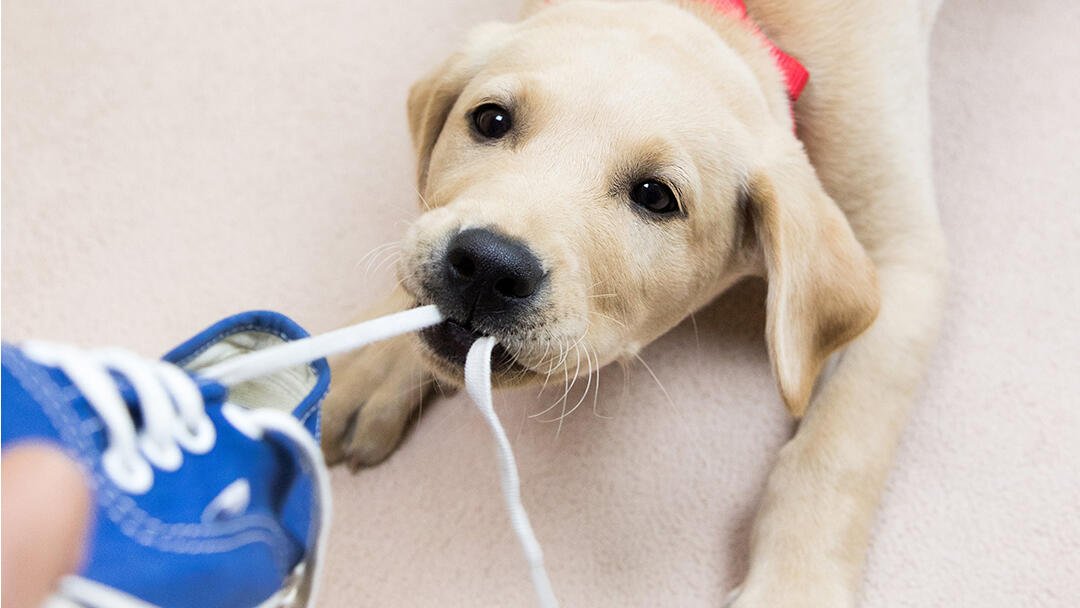
Learning how to stop a puppy from biting shoes and clothes is one of the first lessons every new dog owner needs, because nearly every puppy does it. Those sharp little teeth are not a sign of aggression. Puppies explore the world with their mouths the way toddlers explore it with their hands, and anything that moves, dangles, or smells interesting — like your sneakers or your pant leg — becomes an irresistible target.
The good news is that this habit is completely normal and fixable. With consistent redirection, a little puppy-proofing, and some basic training, your puppy will outgrow the shoe-chomping phase. This guide walks you through why puppies bite clothes and shoes, and gives you a practical step-by-step plan to stop it for good.
Why Puppies Bite Shoes and Clothes
Before you can fix the problem, it helps to understand what is driving it. Puppies are not biting your shoes to be naughty. There are four main reasons behind the behavior, and your training approach should address all of them.
Teething pain
Puppies go through two rounds of teething. Their baby teeth come in early, and later those fall out to make room for permanent adult teeth. Chewing on something firm — like the sole of a shoe — relieves the aching and pressure in their gums. Your shoes are simply at mouth level and always available.
Exploration
For the first several months of life, a puppy’s mouth is its main tool for investigating the world. Shoes carry fascinating smells from outside, clothes carry your scent, and both have interesting textures. Biting is how your puppy is getting to know you and its surroundings.
Play behavior
Puppies play with their littermates by wrestling, chasing, and mouthing each other. When your pant legs move as you walk, they trigger the same chase-and-grab instinct. Pulling your foot away quickly looks like a game of tug, which is why yanking away often makes the biting worse.
Attention-seeking
If biting your sleeve is the one thing that reliably gets you to look at your puppy, talk to it, or interact with it, then biting your sleeve is what your puppy will keep doing. Even scolding is a form of attention, and for a bored puppy, any attention beats none.
Redirection Training: Teach Your Puppy What to Chew Instead
The single most important technique for stopping shoe and clothes biting is redirection. You cannot simply tell a puppy to stop chewing — chewing is a genuine physical need during teething. Instead, you teach the puppy that chewing toys earns praise and play, while chewing your belongings gets a boring reaction.
Step 1: Stock up on the right chew toys
Give your puppy appealing legal alternatives. Different puppies prefer different textures, so offer variety:
- Rubber chew toys (like a classic hollow rubber toy) that can be stuffed with food for extra appeal
- Rope toys for puppies who love to tug
- Soft plush toys for gentle mouthing and comfort
- Frozen chew items, such as a wet washcloth twisted and frozen, or a rubber toy filled with wet food and frozen — the cold soothes sore teething gums
- Edible dental chews sized appropriately for your puppy’s age and weight
Rotate the toys every few days so they stay novel and exciting.
Step 2: Redirect every time
The moment your puppy’s teeth touch your shoe, pant leg, or sleeve, calmly trade the forbidden item for an approved toy. Hold the toy near the puppy’s mouth, wiggle it to make it interesting, and when the puppy takes it, praise warmly: “Good chew!” The key word is every time — consistency is what turns a lesson into a habit.
Step 3: Make the toy more rewarding than the shoe
If your puppy keeps dropping the toy and going back to your shoe, the shoe is winning the competition. Up your game: squeak the toy, drag it along the floor like prey, or smear a tiny bit of xylitol-free peanut butter on it. You want your puppy to believe the toy is the best thing in the room.
Step 4: Reward calm moments
When your puppy lies near your shoes without touching them, quietly drop a small treat or offer soft praise. Ignoring your belongings should pay off too.
Puppy-Proof Your Home and Manage the Environment
Training works best when you also make the wrong choices harder. A puppy cannot chew a shoe it cannot reach. Smart management prevents most biting incidents before they start, which means fewer bad habits get reinforced.
- Put shoes away. This is the simplest and most effective step. Keep shoes in a closet, on a high shelf, or behind a closed door — never on the floor by the door where a puppy can self-reward.
- Wear “puppy clothes.” During the worst teething weeks, avoid flowy sleeves, dangling drawstrings, and loose scarves around the puppy. Wear jeans instead of loose lounge pants at home.
- Use baby gates and playpens. Give your puppy a safe, puppy-proofed area with toys, water, and a comfortable bed. This prevents unsupervised chewing sprees when you cannot watch closely.
- Supervise actively. A puppy loose in the house should be under your eyes. If you cannot watch, use the pen or crate. Most shoe destruction happens in the two unsupervised minutes nobody noticed.
- Keep laundry off the floor. Socks and underwear are classic puppy targets. A lidded hamper ends that game instantly.
Teach “Leave It” and “Drop It”
These two commands give you a polite, trained way to interrupt the behavior without chasing, yelling, or prying anything out of the puppy’s mouth.
How to teach “leave it”
- Hold a treat in your closed fist and let your puppy sniff and paw at it. Say nothing yet.
- The moment the puppy pulls its nose away from your fist — even for a second — say “Yes!” and reward with a different treat from your other hand.
- Repeat until the puppy reliably looks away from the closed fist. Then add the cue: say “leave it” just before presenting the fist.
- Gradually increase difficulty: treat on the floor with your hand covering it, then uncovered, then practice with a shoe on the floor on a leash for safety.
Always reward leaving the item with something better — never with the forbidden item itself.
How to teach “drop it”
- Give your puppy a toy and let it hold it in its mouth.
- Hold a high-value treat right at the puppy’s nose and say “drop it.”
- The instant the toy falls from the puppy’s mouth, say “Yes!”, give the treat, then give the toy back.
- Practice with increasingly tempting items. Returning the toy teaches the puppy that dropping things does not mean losing them forever.
A reliable “drop it” means you never have to chase your puppy around the house wrestling a shoe out of its jaws — which, as every owner learns, only turns the shoe into the greatest prize of all.
Teach Bite Inhibition: Softer Mouths for Life
Bite inhibition is a puppy’s ability to control the force of its bite. It is one of the most important lessons a dog ever learns, and puppyhood is the prime window for it. A dog with good bite inhibition that accidentally mouths a hand in adulthood will barely apply pressure; a dog that never learned it can cause real injury.
Puppies naturally learn bite inhibition from their littermates — when one puppy bites too hard, the other yelps and stops playing. You can continue that lesson:
- When your puppy mouths your hand or clothes too hard during play, let out a calm, high-pitched “ouch” and immediately stop all play. Turn away or stand still for 15–20 seconds.
- Resume play. If the puppy bites hard again, repeat. After two or three hard bites in one session, end playtime entirely for a few minutes.
- Keep your reaction calm and brief. You are not punishing — you are teaching the puppy that hard biting makes fun things stop.
For clothes and shoes specifically, the same principle applies: the instant teeth grab fabric, all movement and interaction stops. Stand still like a tree, wait for the puppy to release, then redirect to a toy. Puppies learn fast that grabbing clothes ends the game.
Exercise and Mental Stimulation Reduce Chewing
A tired puppy is a well-behaved puppy, and an under-stimulated puppy will invent its own entertainment — usually involving your wardrobe. Much destructive chewing is simply excess energy with nowhere to go.
Physical exercise
Give your puppy age-appropriate daily exercise: short walks, gentle fetch, and supervised play. Young puppies tire quickly, so several short sessions beat one long one.
Mental stimulation
Mental work tires puppies out even faster than physical play:
- Food puzzle toys that make the puppy work for its meals
- Short training sessions (5 minutes, a few times a day) teaching sit, down, come, and tricks
- Sniff games — scatter treats in the grass or hide them around a room for the puppy to find
- New experiences — safe socialization outings, different surfaces, new friendly people and vaccinated dogs
Many owners are amazed at how much shoe-biting drops once the puppy’s brain and body are properly tired each day.
What NOT to Do
Good intentions can backfire if the method is wrong. Avoid these common mistakes:
- Do not yell or scream. Loud reactions excite most puppies and sound like play. To others, yelling is frightening and damages trust without teaching anything.
- Do not use physical punishment. Hitting, muzzle-grabbing, nose-flicking, or pinning a puppy down can create fear and defensive aggression — the opposite of what you want. It also does nothing to teach the puppy what to chew instead.
- Do not play rough games that reward mouthing. Wrestling with your hands, letting the puppy “win” tug games with your sleeve, or wiggling your fingers like prey all teach the puppy that human bodies and clothes are chew toys.
- Do not chase the puppy to retrieve a shoe. Chasing turns the stolen item into a thrilling game and teaches the puppy to grab things and run. Instead, trade for a treat or toy.
- Do not expect overnight results. Teething is a developmental stage, not a discipline problem. Progress is measured in weeks, and consistency from every person in the household matters.
Puppy Teething Timeline: What to Expect
Knowing the teething stages helps you stay patient. Timelines vary a little by breed and size, but the general pattern is:
- 3–4 weeks: Baby teeth begin coming in.
- 6–8 weeks: The full set of 28 baby teeth is in. This is when most puppies go home — and when the mouthing of everything begins.
- 12–16 weeks: Baby teeth start falling out and adult teeth push through. This is typically the peak of chewing intensity and shoe destruction.
- 4–6 months: The 42 adult teeth are mostly in. Chewing urges ease off noticeably for many puppies.
- 6–12 months: Adolescent chewing can flare up again, especially in larger breeds, but it is milder and responds well to the redirection habits you have already built.
The hardest weeks are usually between three and five months. If you survive those with consistent redirection and good management, you are through the worst of it.
When to Seek a Professional Trainer
Normal puppy mouthing improves steadily with training. But some situations call for professional help. Contact a certified professional dog trainer or a veterinary behaviorist if:
- The biting is getting harder or more intense with age instead of softer
- Your puppy bites with stiff body language, growling, or guarding behavior around food or toys
- The puppy is breaking skin regularly past the young teething stage
- You have been consistent with redirection and management for several weeks with zero improvement
- Anyone in the household is frightened of the puppy
Look for a trainer who uses positive, reward-based methods and holds a recognized certification. Avoid anyone who recommends punishment-based tools for a mouthy puppy — harsh methods suppress symptoms while building fear.
Also mention persistent, extreme chewing to your veterinarian at your puppy’s regular checkups. Occasionally, excessive mouthing can be linked to nutritional gaps, gastrointestinal discomfort, or anxiety that deserves a medical look.
Frequently Asked Questions
Why does my puppy only bite my shoes and clothes and not my family members’?
Your puppy has learned that you react the most — you move, you talk, you engage. Ask everyone in the household to respond the same boring way (freeze, redirect to a toy), and the puppy will stop singling you out.
Will my puppy stop biting shoes on its own when teething ends?
The intense chewing urge fades as adult teeth come in, but habits practiced for months do not vanish by themselves. A puppy that was allowed to rehearse shoe-chewing for half a year often keeps doing it out of habit. That is why consistent redirection during teething matters — it shapes what the adult dog considers normal.
Is it okay to let my puppy chew old shoes I do not care about?
No — this is one of the most common mistakes. Puppies cannot tell the difference between an “okay” old sneaker and your brand-new running shoes. Giving them any shoe teaches them that all shoes are fair game. Offer chew toys instead.
How long does it take to stop a puppy from biting clothes?
With consistent redirection, management, and daily training, most owners see major improvement within two to four weeks, and the habit largely resolves as teething finishes. Inconsistent responses — sometimes laughing, sometimes scolding — can stretch the phase out for months.
Should I use bitter apple spray on my shoes?
Taste deterrent sprays can help as a backup for specific items, but they are not a training plan on their own. Many puppies chew right through the taste or move to an unsprayed target. Use a deterrent only alongside redirection training and puppy-proofing, and test it on a hidden spot first to make sure it does not stain.
My puppy bites my children’s clothes and it scares them. What should I do?
Supervise all puppy-child interactions closely, and teach children to “be a tree” — stand still, fold their arms, and look away when the puppy mouths their clothes. Keep play sessions short and always have a toy in the child’s hand to offer the puppy. If the mouthing is intense or the children are frightened, bring in a professional trainer sooner rather than later.
The Bottom Line
Figuring out how to stop a puppy from biting shoes and clothes comes down to a simple formula: manage the environment, redirect to better options, and reward the choices you want to see again. Your puppy is not being bad — it is teething, exploring, and playing exactly the way puppies are supposed to. Meet those needs with great chew toys, solid training, and plenty of exercise, and the shoe-chomping phase will pass. Stay consistent, and enjoy watching your puppy grow into a polite adult dog that walks right past your shoes without a second glance.