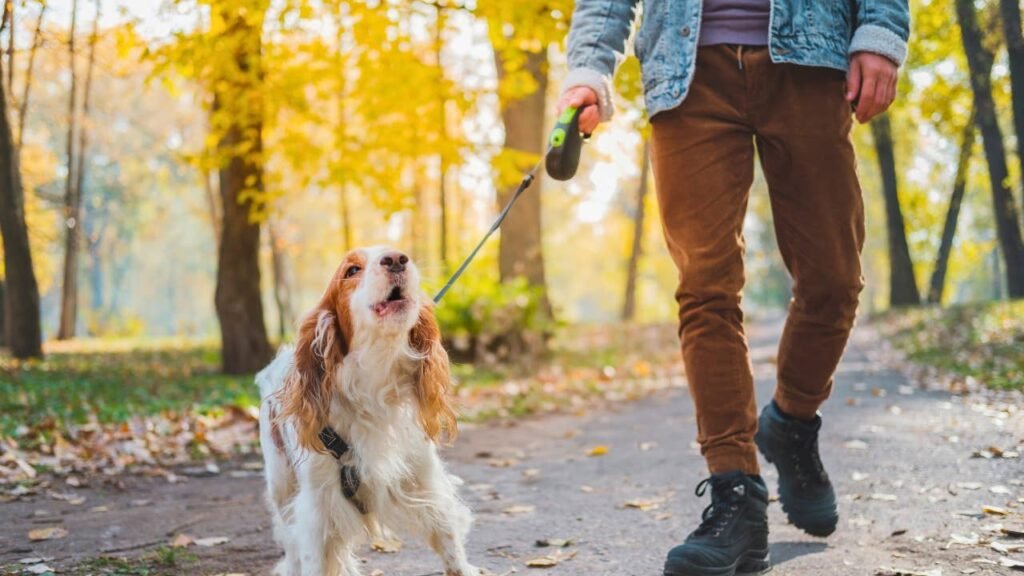
Learning how to stop a dog from barking at strangers on walks without treats is entirely possible, and for many dogs it works better than a pocket full of snacks. Treat-based training has its place, but some dogs get so excited about food that they can barely think, and others lose interest in treats the moment a stranger appears. The good news is that you can change how your dog feels about strangers using distance, movement, play, and calm leadership instead of food rewards. This guide walks you through a practical plan that builds a quieter, more confident walking partner step by step.
Why Dogs Bark at Strangers on Walks
Barking at strangers is rarely about disobedience. Most dogs bark because strangers trigger a strong emotion: excitement, fear, frustration, or a protective instinct. An under-socialized dog may find unfamiliar people genuinely alarming, while a friendly, excitable dog may bark because it desperately wants to say hello and is frustrated by the leash holding it back. Both look similar from the end of the leash, but they need slightly different handling, so it helps to watch your dog’s body language. A fearful dog tucks its tail, lowers its body, and may try to back away between barks. An excited dog pulls forward, wags broadly, and strains toward the person.
Understanding the emotion matters because barking is self-rewarding. Every time your dog barks and the stranger passes by, your dog learns that barking made the scary or exciting thing go away. That cycle strengthens with repetition, which is why simply scolding rarely works: it adds stress to an already stressed dog without teaching a better response. The goal of treat-free training is to break that cycle by changing the emotion underneath the barking, not just suppressing the noise.
Step 1: Find Your Dog’s Comfort Distance
Every reactive dog has a threshold distance: the range at which it notices a stranger but can still think and respond to you. Inside that distance, barking takes over and learning stops. Your first job is to find that distance and work just outside it. On a quiet street, watch for the moment your dog’s ears prick up or its body stiffens at the sight of a stranger. That is your starting line. If your dog is already barking, you are too close, so calmly turn and walk away until the barking stops, then note roughly how far away the stranger was.
Once you know the threshold, plan your walks around it. Choose wide paths, open parks, and quiet streets where you can create space. When you see a stranger approaching, arc away early rather than waiting until you are nose to nose on a narrow sidewalk. Crossing the street, stepping onto a driveway, or ducking behind a parked car are all fair moves. There is no shame in creating distance; it is the single most effective tool you have, and it costs nothing.
Step 2: Teach a Focus Cue Without Food
A focus cue gives your dog something to do instead of barking. Choose a short word such as “watch” or “eyes” and pair it with a reward your dog values that is not food: a favorite toy, a quick game of tug, praise, or simply permission to keep walking and sniffing. Start indoors where there are no distractions. Say the cue, and the moment your dog glances at your face, mark it with an enthusiastic “yes” and start a brief play session or give a chest scratch. Repeat in short sessions until the glance becomes automatic.
Next, practice in the yard, then on quiet streets, and only then near strangers at a comfortable distance. When your dog looks at a stranger and then turns back to you on its own, that is a huge win: reward it with whatever your dog loves most. Some dogs light up for a squeaky toy, others for a game of chase, and many are thrilled simply by your happy voice and a good ear rub. The reward must matter to your dog, not to you, so experiment until you find what makes your dog’s eyes light up.
Step 3: Use Movement to Break the Stare
A dog that is staring hard at a stranger is a dog about to bark. Movement breaks that fixed stare better than any command. The moment you see your dog lock onto someone, change direction smoothly: turn and walk the other way, loop in a wide circle, or step off the path and let the stranger pass while you play a quick game. U-turns are especially powerful because they physically remove your dog from the trigger and give its brain a reset.
Practice U-turns at home first so they become a fun habit rather than a panicked yank. Walk, say “this way” in a bright voice, turn, and jog a few steps while praising your dog for following. Many dogs start to enjoy the game and will happily spin around with you. On real walks, a well-timed U-turn often prevents barking entirely, because your dog never gets the chance to build up to it. Over time, your dog learns that seeing a stranger predicts a fun turn rather than a confrontation.
Step 4: Let Your Dog Observe Calmly From a Distance
Once your dog can notice strangers without barking at a comfortable distance, you can begin teaching it that strangers are boring. Find a spot with a good view of a path or sidewalk, such as a park bench set well back from foot traffic. Sit with your dog on a loose leash and simply watch people go by. When your dog looks at a stranger calmly, praise softly and let it keep watching. If it tenses up, increase the distance or leave. The lesson is simple: strangers appear, nothing bad happens, and nothing exciting happens either.
Keep these sessions short, around five to ten minutes, and end while your dog is still calm. Doing this a few times a week gradually shrinks the threshold distance, because your dog’s emotional response changes. This is slow work, and progress is rarely a straight line: a bad day after a week of good days is normal and does not mean the training has failed. Consistency over weeks matters far more than any single session.
Step 5: Build Confidence Through Play and Enrichment
A tired, confident dog barks less than a bored, anxious one. Daily play that lets your dog use its brain and body reduces the arousal that spills over into barking on walks. Tug games, fetch, flirt poles, and nose games that hide toys or scents around the yard all burn energy in healthy ways. Puzzle feeders at mealtimes give your dog a job to do, which builds frustration tolerance and focus.
Confidence also comes from successful experiences. Short, positive outings in calm places teach your dog that the world is manageable. Avoid flooding your dog with busy environments before it is ready: a single overwhelming trip to a crowded market can undo days of careful progress. Instead, increase difficulty gradually, one variable at a time: a little more foot traffic, a slightly narrower path, or a busier time of day, but never all three at once.
Handling Surprise Encounters
Even with the best planning, a stranger will occasionally appear around a corner at close range. When that happens, stay calm and keep moving. Tightening the leash and tensing up tells your dog that you are worried too, which confirms that the stranger is a problem. Instead, keep your leash loose, walk briskly past with a cheerful voice, and give your dog something to focus on: a quick turn, a jog, or a favorite game the moment you are clear. If your dog does bark, do not scold or drag it; simply keep moving until you are far enough away for your dog to settle, then carry on as if nothing happened.
It also helps to manage the environment on your side. A front-clip harness gives you better steering without pain, and a longer leash in open areas lets your dog move naturally instead of feeling trapped. Avoid retractable leashes in busy areas, since they make it hard to create distance quickly. A well-fitted harness and a standard leash are the simplest, most reliable setup for reactive-dog walks.
Mistakes That Make Barking Worse
The most common mistake is punishing the bark. Yelling, leash jerks, and spray collars may interrupt barking for a moment, but they raise stress and can make a fearful dog more fearful or a frustrated dog more frustrated. Another mistake is flooding: forcing your dog to stand near strangers in the hope it will “get used to it.” Flooding usually makes reactivity worse, not better. A third mistake is inconsistency between family members: if one person lets the dog rush up to strangers while another holds it back, the dog gets mixed signals and progress stalls.
Avoiding walks altogether is another trap. It feels easier in the short term, but an under-exercised, under-exposed dog usually becomes more reactive, not less. Short, well-planned walks in calm places beat no walks at all. And remember that setbacks are part of the process: a dog that barked today after a quiet week is not back to square one. Note what was different, adjust, and keep going.
When to Get Professional Help
Most stranger barking improves with patient, consistent work, but some dogs need expert guidance. If your dog’s barking comes with lunging, snapping, or biting, if it cannot settle even at a large distance, or if its anxiety seems to be getting worse despite weeks of careful training, consult a certified professional dog trainer or a veterinary behaviorist. They can assess whether pain, anxiety, or a medical issue is contributing, and they can tailor a plan to your dog. There is no shame in asking for help; reactivity is one of the most common reasons owners seek professional training.
For dogs whose main issue is pulling rather than barking, the skills overlap considerably: loose-leash work and calm focus help both problems, as explained in guides such as how to stop a dog from pulling on the leash without a choke collar. And if barking at visitors at home is the bigger issue, the same distance and calm-observation principles apply indoors, much like the approach in how to stop your dog from barking at the mailman without punishment.
A Simple Weekly Plan to Start
Put it together into a realistic routine. Three or four times a week, take a fifteen-minute walk in a quiet area and practice U-turns and focus games at a comfortable distance from strangers. Twice a week, spend ten minutes sitting at a distance watching people pass calmly. Every day, add a play or enrichment session at home to burn energy and build confidence. Keep a simple note of your dog’s threshold distance so you can see it shrink over time. Most owners notice real improvement within a few weeks, and many dogs become dramatically calmer within a couple of months. The key is patience: you are changing how your dog feels, not just what it does, and feelings take time to change.
Frequently Asked Questions
Can I really stop barking without using any treats?
Yes. Treats are one kind of reward, but play, toys, praise, sniffing, and movement are rewards too. The method works as long as the reward you use genuinely motivates your dog and you pair it consistently with calm behavior around strangers.
How long does it take to see results?
Many owners see fewer outbursts within two to three weeks of consistent practice, but lasting change usually takes one to three months. Fear-based reactivity often takes longer than excitement-based barking, and progress is rarely linear.
Should I let strangers pet my dog to help it get used to people?
No, not during training. Forced greetings put pressure on a reactive dog and often increase barking. Let your dog observe strangers from a distance first, and only allow greetings much later, when your dog is relaxed and can walk away freely.
Is it okay to use a toy as a distraction on every walk?
Yes, if it works for your dog. A toy is a legitimate reward and a focus tool. Over time, many dogs need the toy less often as calm behavior becomes a habit, but there is nothing wrong with keeping it as part of your walk routine.
What if my dog only barks at certain people, like men or people in hats?
That is common and usually comes from limited early exposure. Use the same distance-based approach, starting with the specific trigger type at a comfortable range, and gradually close the gap as your dog stays calm. Patience is especially important with specific triggers.
Does neutering or spaying stop barking at strangers?
Not on its own. Barking at strangers is driven by emotion and learned behavior, not hormones. Training and gradual exposure are what change it, although a calmer overall routine helps any dog.