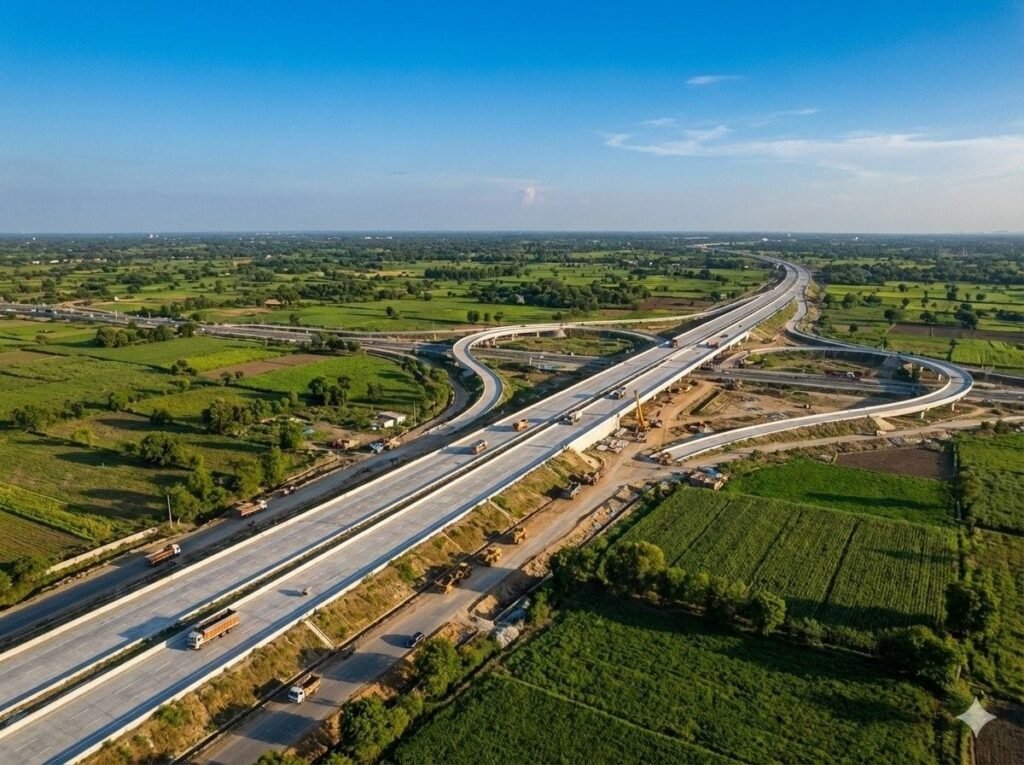
India plans to develop ring roads and highway bypasses around cities and towns as fully access-controlled corridors with distance-based tolling, under a revised urban decongestion policy finalised by the Ministry of Road Transport and Highways (MoRTH), according to a Mint report.
The policy mandates that every national highway project taken up for urban decongestion must be built as a minimum four-lane, fully access-controlled corridor with closed tolling facilities — meaning vehicles pay according to the distance they travel. The twin aims are to preserve highway speeds of 100 to 120 kmph and to separate long-distance passenger and freight traffic from local movement, keeping such corridors dedicated to through traffic as cities expand.
Why Earlier Ring Roads Choked
Earlier ring roads and bypasses were planned without specific provisions for access control. Over time, unregulated ribbon development sprang up along them — shops, settlements and local traffic merged with through traffic, congestion returned, and the benefits of the investment were lost. The revised policy is designed to break that cycle, preventing uncontrolled roadside development from eroding the returns on public investment.
“Wherever a ring road is constructed, we would go for closed tolling, which would mean that vehicles would have to pay for the distance travelled on such roads, which would also be access-controlled,” a person aware of the government’s plans told Mint.
A Planning Horizon of 50 Years
According to the policy document, which media outlets have reviewed, corridor planning will take a horizon of up to 50 years, accounting for urban expansion, demographic growth and long-term mobility needs. Service roads will be developed on the city side of bypasses so local traffic can move without impeding through traffic, while states will notify a 15-metre development control zone on either side of new corridors to keep fresh construction off the alignment. Such long-range planning echoes the push for strategic road connectivity across the Northeast, where ongoing highway projects in Arunachal Pradesh and long-running border infrastructure programmes show how carefully planned corridors can reshape regional mobility.
What It Means for Commuters
For commuters and truckers, the promise is steadier high-speed travel, lower logistics costs and less pollution from idling traffic. Whether the access-control rules hold firm against development pressure once a corridor becomes operational remains the policy’s real test, analysts note. If enforced as written, India’s next generation of ring roads could stay congestion-free for decades rather than choking within a few years.
#RingRoad #UrbanDecongestion #MoRTH #NationalHighways #IndiaInfrastructure #UrbanPlanning