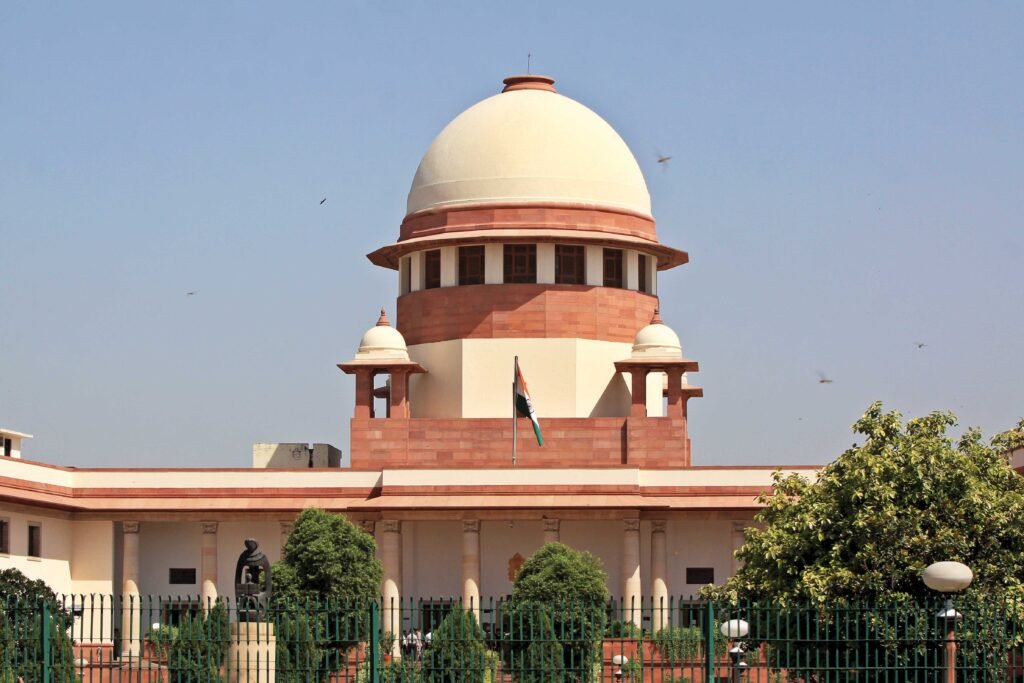
The Supreme Court has questioned the Election Commission of India over why voters deleted from Delhi’s draft rolls should be asked to register as new voters, when many of them were already on the electoral list. A bench comprising Chief Justice Surya Kant and Justices Joymalya Bagchi and V Mohana was hearing a writ petition raising issues in the Delhi Special Intensive Revision (SIR) of electoral rolls.
The Court’s question stems from the fact that Form 6 is submitted by first-time voters to get their names registered on the electoral roll. The bench observed that address changes and unavailability during the Delhi SIR may be the reason many voters failed to fill out enumeration forms, and that they should be asked to submit Form 8 instead of Form 6. Form 8 is used to show a change of address, while Form 6 requires a declaration that the applicant has not voted before and is registering as a new voter.
The petitioners’ objection
Advocate Prashant Bhushan, appearing for the petitioners, said all that affected voters can do is fill Form 8, which is meant for shifted voters, but that the Election Commission was directing them in the SIR to fill Form 6 to be included in the draft roll. He argued that this makes people fill up a false declaration that they have not voted before.
The bench also said the “logical discrepancy” category had been permitted in West Bengal only as an interim arrangement, with its legality still undecided.
Scale of the Delhi dispute
Reports put the number of voters deleted from Delhi’s draft rolls at more than four million, marked as absent, shifted or dead during the revision process. The Court noted that, since there is no immediate election in Delhi, the Commission need not rush through the process with short deadlines, and that it should adopt a more human-centric and transparent approach.
The Court directed the Commission to publicise excluded names in Hindi and English and in simple local languages, explaining the consequences of not responding. The Commission told the Court it will consider accepting late enumeration forms and extending the claims deadline if needed, and the Court gave it two weeks to reconsider its approach and propose a simpler verification process.
Why the form matters
The stakes are direct: a voter forced into the wrong form risks a false declaration, while a voter who misses a deadline risks losing a place on the roll. The Supreme Court’s earlier direction for a CBI probe into contracts linked to a state leader’s family and the Centre’s assurance to the Court on airfare rules show a court regularly testing executive claims against procedure.
#SupremeCourt #ElectionCommission #DelhiSIR #VoterRolls #Form6 #Form8 #SuryaKant