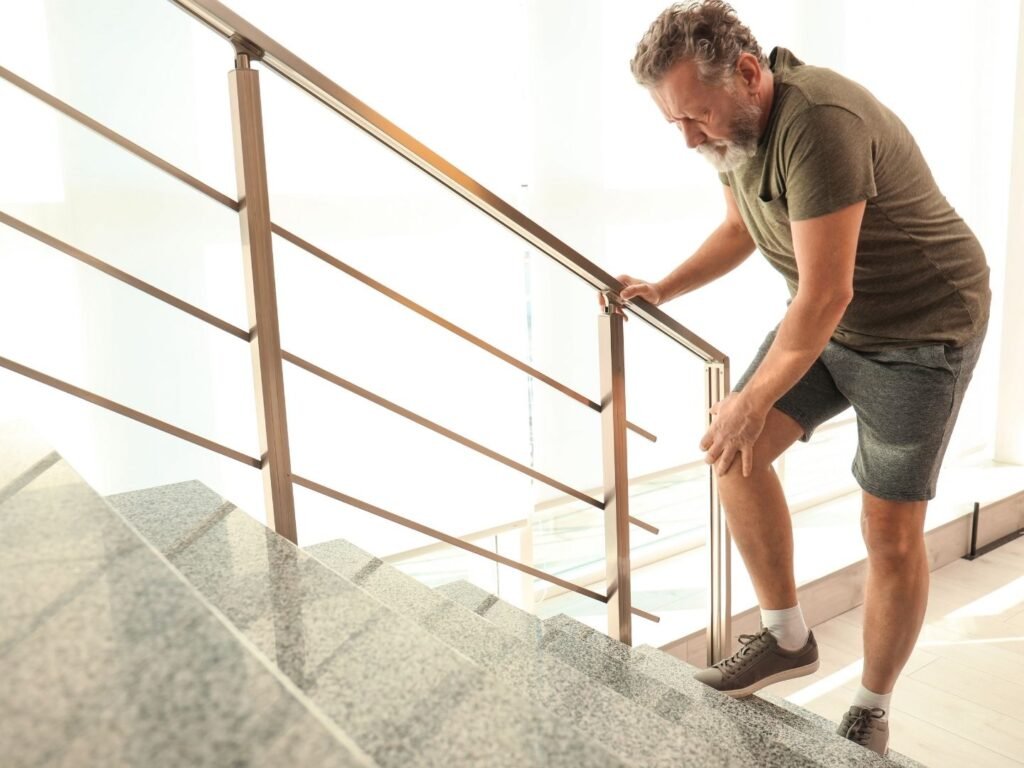
If your knees ache every time you face a flight of stairs, you are far from alone. Stair climbing places two to four times your body weight of force on the knee joint, so it is often the first activity to reveal weakness, tightness, or wear around the knee. The good news is that learning how to relieve knee pain when climbing stairs without surgery is usually a matter of technique, targeted strengthening, and small lifestyle changes rather than drastic interventions. This guide walks you through practical, evidence-informed strategies you can start using today.
This article is for informational purposes only and is not medical advice. Consult a qualified professional.
Why Do Stairs Hurt Your Knees So Much?
Walking on flat ground distributes your weight evenly through the leg, but climbing stairs changes the mechanics dramatically. As you step up, the knee bends deeply while bearing load, which compresses the cartilage behind the kneecap (the patella). If the muscles around the knee are weak or the kneecap is not tracking smoothly in its groove, that compression translates into pain, especially felt as a dull ache or sharp twinge behind or around the kneecap.
Common contributors include weak quadriceps and glutes, tight calves and hamstrings, excess body weight, worn cartilage, and poor movement patterns such as letting the knee cave inward. Understanding that the pain is usually a signal about load and mechanics — not necessarily permanent damage — is the first step toward fixing it.
Step Correctly: The Footwork That Protects Your Knees
Before adding exercises, fix how you actually climb. The way your foot lands and your knee tracks can cut pain almost immediately.
Use the “whole foot” rule
Place your entire foot flat on each step rather than climbing on your toes or letting your heel hang off. A full-foot landing spreads the force and lets the calf and thigh muscles share the load instead of hammering the knee.
Step through the heel
When going up, press through your heel as you straighten the leg. This activates the glute of the stepping leg, taking pressure off the front of the knee. Think of driving the step from your hips rather than pulling yourself up with your quads.
Keep knees over toes
Watch that your knee tracks directly over your second toe as you climb. A knee that collapses inward multiplies joint stress. If you notice your knees drifting inward, consciously push them outward slightly on every step until the pattern becomes automatic.
Lead with your stronger leg going up, weaker leg going down
Going up, step first with the less painful leg; going down, step first with the more painful leg. The stepping leg bears the most load, so this simple pattern reduces peak force on the sore knee. The mnemonic many therapists teach is “good leg goes up to heaven, bad leg goes down to hell.”
Use the handrail
There is no prize for toughing it out. Lightly pulling on the handrail unloads a meaningful percentage of your body weight from the knee. If your staircase has only one rail, alternate sides or consider adding a second one.
Strengthening Exercises That Target Stair-Climbing Muscles
Strong muscles are shock absorbers. These four exercises specifically build the muscles that protect the knee during stair climbing. Start with body weight, do them two to three times per week, and stop if any exercise causes sharp pain.
1. Sit-to-stands (mini squats)
Sit on a sturdy chair and stand up without using your hands, then sit back down slowly. Keep your knees tracking over your toes. Start with 2 sets of 8 and build to 3 sets of 12. This directly trains the exact movement pattern used on stairs.
2. Step-ups
Place one foot on a low step or sturdy platform and press through the heel to bring the other foot up, then step down slowly. The slow lowering (the eccentric phase) is what builds control. Do 2 sets of 6 per leg, holding a rail for balance if needed.
3. Glute bridges
Lie on your back with knees bent and feet flat. Squeeze your glutes and lift your hips until your body forms a straight line from shoulders to knees. Hold for 3 seconds. The glutes are the knee’s best friends — strong glutes keep the knee from caving inward. Aim for 3 sets of 10.
4. Straight-leg raises
Sit or lie with one leg bent and the other straight. Tighten the thigh of the straight leg and lift it about a foot off the floor, hold 3 seconds, and lower slowly. This builds the quadriceps without bending the knee under load, making it ideal when knees are currently very sore. 2 sets of 10 per leg.
Stretch and Loosen the Muscles Around the Knee
Tight muscles pull the knee into poor positions. A five-minute daily routine can make stairs noticeably easier within a couple of weeks.
- Calf stretch: Place both hands on a wall, step one foot back, and press the back heel into the floor. Hold 30 seconds per leg. Tight calves force the knee to compensate by bending deeper on stairs.
- Standing quad stretch: Hold a rail or wall, grab your ankle behind you, and gently pull the heel toward your glute. Keep your knees close together. Hold 30 seconds per leg.
- Hamstring stretch: Sit on the edge of a chair, extend one leg straight with the heel on the floor, and hinge gently forward at the hips until you feel a mild stretch behind the thigh. Hold 30 seconds per leg.
- Foam rolling the IT band and quads: Spend one to two minutes per side rolling the outer thigh and front thigh. This is uncomfortable at first but improves how smoothly the kneecap tracks.
Many people find that pairing a gentle stretching routine with good general joint habits works well — for example, the same consistency that helps with a stiff neck from sleeping wrong applies here: small daily sessions beat occasional long ones.
Everyday Habits That Reduce Knee Strain
Manage body weight gradually
Every extra pound of body weight adds roughly four pounds of force on the knee with each step. Even modest, sustainable weight changes compound over thousands of daily steps. Focus on gentle, long-term habits rather than crash approaches.
Warm the knees before long climbs
If you are about to climb several flights — in a subway station or parking garage — do ten gentle marching-in-place steps and a few sit-to-stands first. Warm muscles absorb load better than cold, stiff ones.
Choose the right footwear
Worn-out shoes or completely flat unsupportive flats change your leg alignment and increase knee stress. Replace athletic shoes before the cushioning dies, and consider supportive insoles if you spend long hours on hard floors. People who manage sore feet after standing all day learn the same lesson: footwear is foundational.
Ice after aggravation
If a particular day leaves your knees hot or swollen, apply a cold pack wrapped in a towel for 15 minutes. Ice calms the inflammatory response; heat is better saved for chronically stiff (but not swollen) joints before activity.
Alternate stairs with alternatives when flaring
On days when pain is sharply elevated, take the elevator or ramp without guilt. Protecting a flaring knee for a day or two prevents a minor irritation from becoming a longer setback.
Pros and Cons of Common Knee Aids
Supportive products can help, but it is worth knowing what each one actually does.
- Knee sleeves: Provide warmth, compression, and a sense of stability. Pros: easy to wear, good for daily stairs. Cons: do not fix underlying weakness; the compression effect fades if the sleeve is too loose.
- Patellar straps (knee bands): Sit just below the kneecap and redirect force during bending. Pros: inexpensive, targeted relief for front-of-knee pain. Cons: uncomfortable for some, must be positioned correctly.
- Cane or trekking poles: Pros: genuinely unload the joint and improve balance on stairs. Cons: inconvenient to carry everywhere; needs the correct height and hand (opposite the sore knee).
- Knee braces (hinged): Pros: maximum support after injury. Cons: bulky, expensive, and over-reliance can weaken muscles if worn all day without a strengthening program.
Common Mistakes to Avoid
- Resting completely: Total rest weakens the muscles that protect the knee, making stairs worse when you resume. Gentle, pain-respecting movement is almost always better.
- Skipping straight to deep squats or lunges: These load the bent knee heavily. Master sit-to-stands and step-ups first.
- Masking pain with anti-inflammatories and ignoring the cause: Medication can be part of a plan, but it does not strengthen anything. Discuss any regular medication use with a qualified professional.
- Ignoring balance: Many stair falls happen because of poor balance, not just weak knees. Practice standing on one leg (with a wall nearby) for 30 seconds per side.
- Climbing too fast: Rushing stairs increases impact force. Slow, deliberate steps with the handrail are kinder and safer.
- Assuming surgery is inevitable: Many people manage stair pain successfully for years with conservative measures. But if pain is severe, constant, causes instability, or does not improve after several weeks of consistent effort, get evaluated by a qualified professional rather than pushing through.
Frequently Asked Questions
Is it okay to climb stairs with knee pain?
Generally yes, if the pain is mild to moderate and does not worsen afterward. Modify your technique, use the rail, slow down, and strengthen the surrounding muscles. Avoid stairs only when pain is sharp, causes swelling, or makes the knee feel unstable.
Why does going downstairs hurt more than going up?
Descending requires the quadriceps to control your body weight while lengthening (an eccentric contraction), which generates higher forces across the kneecap than climbing up. Step down slowly, lead with the sorer leg, and keep your full foot on each step.
How long does it take to see improvement?
Many people notice technique changes help within days. Strength gains from the exercises typically translate into easier stairs within three to six weeks of consistent practice, two to three sessions per week.
Should I wrap my knee before climbing stairs?
A knee sleeve or patellar strap can provide comfort and confidence during climbs. They work best as a complement to strengthening, not a replacement — aim to rely on them less as your muscles get stronger.
Does walking on flat ground help or hurt?
Flat-ground walking is one of the best things you can do: it builds endurance in the knee muscles without the deep-bend loading of stairs. Pair it with the strengthening exercises above for a complete approach. Just as poor sleep posture affects back pain, your daily movement habits quietly shape how your knees feel.
When should I see a doctor about stair knee pain?
Seek evaluation if pain is severe or sudden, the knee locks, buckles, or swells significantly, you cannot bear weight, or several weeks of consistent technique and strengthening work bring no improvement. A qualified professional can check for issues that self-care cannot fix.