Learning how to pack toiletries for international travel without leaks or spills is one of those travel skills that pays off on every single trip. A burst shampoo bottle can ruin a suitcase full of clothes, stain an expensive bag, and leave everything smelling like conditioner for the rest of your journey. The good news: leaks are almost always preventable. With the right containers, a smart packing method, and a few simple habits, you can land with every bottle intact and every shirt clean.
This guide walks you through the complete process — from choosing leak-proof bottles to packing for carry-on rules and checked luggage — so your toiletries arrive exactly the way they left home.
Why Toiletries Leak on International Flights
Leaks are not just bad luck. There are specific physical reasons toiletries burst, ooze, or seep during international travel, and understanding them helps you prevent every one.
The biggest culprit is cabin pressure change. In a pressurized aircraft cabin, the air pressure is lower than at ground level. Air trapped inside a half-full bottle expands as pressure drops, pushing liquid out through any weak point — the cap threads, a pump mechanism, or a flip-top lid. This is why a bottle that sat perfectly sealed on your bathroom counter for months suddenly leaks the moment it flies.
The second cause is rough handling. Checked luggage gets thrown, stacked, and compressed. Bags shift in the cargo hold, and heavy objects press against toiletry containers for hours. A cap that was “tight enough” on your counter can loosen under vibration and pressure.
Temperature swings add a third factor. Cargo holds can get cold, then hot on the tarmac. Some products expand and contract, and pump bottles in particular can self-dispense when compressed by other items in your bag.
Finally, many leaks are simply operator error: caps screwed on crooked, flip-tops not fully snapped shut, or pump heads left unlocked. Every one of these is fixable with a two-second check before you zip your bag.
Step-by-Step: How to Pack Toiletries Without Leaks or Spills
Step 1: Decant Into Smaller, Leak-Proof Bottles
Do not travel with full-size bottles unless you have to. Decant what you need into small, well-designed travel bottles — ideally 3.4 ounces (100 milliliters) or less, which also keeps you compliant with carry-on liquids rules worldwide.
Look for bottles made specifically for travel, with features like:
- Wide-mouth openings so you can fill them without a funnel and clean them easily between trips
- Secure screw caps or flip-tops with silicone seals, not flimsy snap lids
- Soft, squeezable bodies so you can push air out before sealing (more on this below)
- Clear labeling — either writable labels or color-coded caps, so you never pour conditioner on your toothbrush by mistake
Fill each bottle only about 80 to 90 percent full. Leaving a little room matters less than the next step, but it prevents pressure buildup from forcing product past the seal.
Before sealing, squeeze out the excess air and then cap the bottle. With less air inside, there is less air to expand at altitude — one of the simplest and most effective anti-leak tricks there is.
Step 2: Add a Barrier Under Every Cap
This is the single most reliable leak-prevention trick travelers swear by. Unscrew the cap, place a small square of plastic wrap or cling film over the bottle opening, then screw the cap back on over it. The plastic creates an extra gasket between the cap threads and the bottle neck.
It works on screw caps, flip-tops, and disc caps. It takes five seconds per bottle. It is especially effective on products with thin formulas — toners, serums, liquid foundation, and contact lens solution — which find their way through the tiniest gaps.
For bottles with pump dispensers, this trick does not apply, so handle pumps separately: lock the pump (most twist to lock), or remove the pump entirely, seal the bottle with a flat screw cap, and pack the pump alongside it. Pumps are the number one leak source in travel bags because they get pressed accidentally under the weight of other items.
Step 3: Seal Everything in a Second Layer
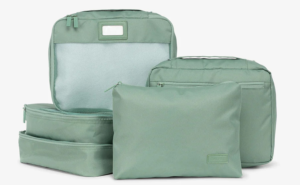
Even perfect bottles deserve a backup. Place your toiletry containers inside a resealable, leak-proof pouch before they go into your toiletry bag. If something does fail, the mess stays inside one small pouch instead of spreading across your suitcase.
For carry-on travel, this pouch doubles as your transparent liquids bag for security screening. For checked luggage, any sturdy zip-top bag works, though purpose-made waterproof pouches with double seals offer better protection and last for many trips.
Consider double-bagging your highest-risk items — oils, serums, and anything with a pump you could not remove. One small zip bag around the individual bottle, then the whole group inside the larger pouch. It sounds excessive until you have cleaned sunscreen out of a suitcase lining.
Step 4: Pack Smart Inside the Bag
How bottles sit in your bag matters as much as how they are sealed:
- Caps up, always. Store bottles upright with caps facing up so gravity works with you, not against you. Leaks flow downward — do not give them a head start.
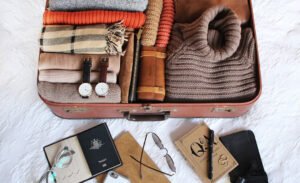
- Center, not edges. In a hard-shell suitcase, place your toiletry bag in the middle, cushioned by soft clothing on all sides. The edges of a suitcase take the hardest impacts.
- Keep liquids together. Do not scatter toiletries through different pockets and corners. One contained zone means one contained mess if the worst happens.
- Separate from electronics and documents. Your laptop, chargers, passport, and important papers should never share a compartment with liquids.
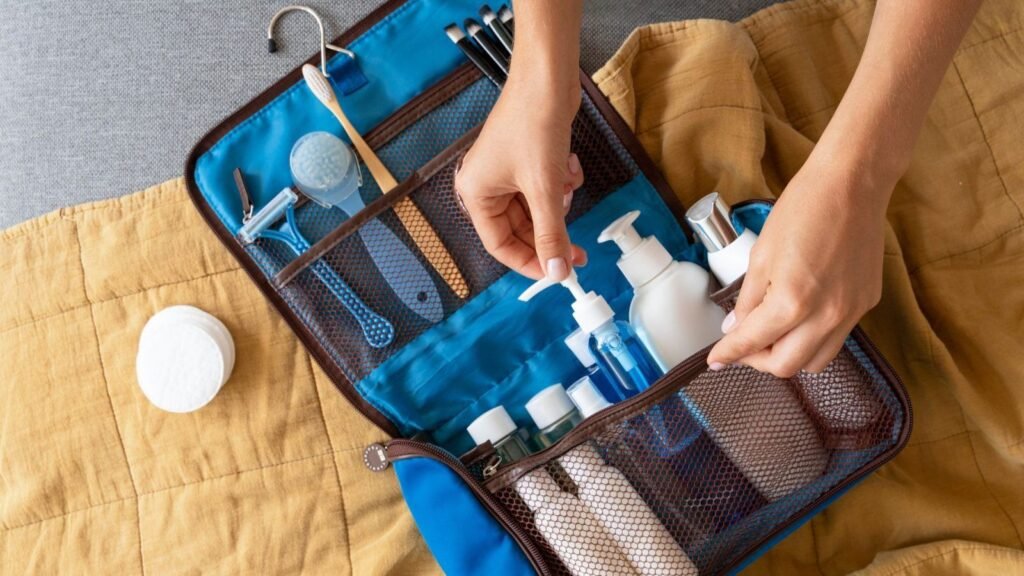
- Use a hanging toiletry organizer with individual pockets. Individual pockets keep bottles upright and separated so they cannot knock against each other and loosen caps.
If you are traveling with only a carry-on, these same principles apply — and a well-organized packing strategy makes the whole bag work better. For more on fitting everything into one bag, see our guide on how to pack a carry on for two weeks without checking a bag.
Step 5: Go Solid Where You Can
The ultimate leak prevention is removing liquids from the equation entirely. A growing range of solid toiletries performs just as well as liquid versions:
- Shampoo and conditioner bars — one bar often outlasts a bottle, and they cannot leak, spill, or count against liquids limits
- Bar soap and solid body wash in a ventilated travel case
- Toothpaste tablets — chew, brush with a wet brush, done
- Solid deodorant instead of gels or sprays
- Solid perfume and solid sunscreen sticks
Solids are exempt from liquids rules, so they also free up space in your carry-on liquids bag. Store them in small tins or ventilated cases, and let bars dry before packing them to avoid a soggy mess.
Carry-On Liquids Rules for International Travel
When you fly with only a carry-on, toiletries must follow liquids rules at security. The framework is nearly universal, though exact details vary by country:
- Each liquid, gel, cream, paste, or aerosol container must be 3.4 ounces (100 milliliters) or smaller
- All containers must fit in one clear, resealable, quart-sized (roughly one-liter) bag
- The bag must be removed and placed separately in the screening tray at most checkpoints
- One bag per passenger
This is commonly called the 3-1-1 rule in the United States, and most countries follow an equivalent standard. Some airports have begun relaxing these rules with new CT scanners, but the safe assumption is that the classic limits still apply — pack to the old rule and you will never have a problem.
Exceptions worth knowing: prescription medications, baby formula, and breast milk are generally allowed in larger quantities, but declare them at screening and keep them easily accessible. Duty-free liquids purchased after security are fine as long as you stay airside; if you have a connecting flight, keep them sealed in the tamper-evident bag with the receipt.
Anything over the limit in your carry-on will be confiscated — including expensive serums and full-size sunscreen. When in doubt, put it in checked luggage.
How to Pack Toiletries in Checked Luggage
Checked bags have no liquids size limit, but they face the roughest handling. This is where leak prevention matters most:
- Use the full-size original packaging for products you will need a lot of — full-size bottles are sturdier than decanted travel bottles
- Remove or lock every pump and apply the plastic-wrap-under-the-cap trick to every screw cap
- Wrap glass bottles individually in clothing or bubble wrap — perfume bottles and glass serum jars crack under impact
- Place the sealed toiletry pouch in an interior pocket, away from the outer walls of the suitcase, cushioned by clothes
- Keep a change of clothes in your carry-on as insurance. If your checked bag is delayed, you will still have essentials — and this pairs well with smart carry-on planning like our two-week carry-on guide
One more checked-luggage tip: take a quick photo of your toiletry bag before you close the suitcase. If a leak happens, you will know exactly which bottle failed without unpacking everything at the hotel.
The Leak-Proof Travel Kit: What Actually Works
You do not need expensive gear, but a few purpose-built items make leak-free travel much easier:
- Silicone travel bottles with leak-proof valves — the squeezable kind with no-drip valves outperform cheap hard-plastic bottles every time
- A hanging toiletry organizer with a hook, clear pockets, and a water-resistant interior that wipes clean
- A quart-size clear pouch for carry-on liquids (reusable silicone versions last far longer than disposable bags)
- Small zip-top bags in a couple of sizes for double-bagging high-risk items
- Plastic wrap squares — tear off a few before each trip and tuck them in your toiletry kit permanently
- Solid shampoo and conditioner bars in ventilated tins to cut your liquid count
Buy bottles once and reuse them for years. Cheap single-use travel bottles from the drugstore are the ones most likely to crack, leak, or have caps that cross-thread.
Common Mistakes That Cause Spills
Overfilling bottles to the brim. Liquid needs a little room, and air needs to be squeezed out before sealing. A bottle filled to the top with trapped air is a leak waiting for altitude.
Leaving pump bottles unlocked. Pumps self-dispense under pressure from neighboring items. Lock them, remove them, or bag them separately.
Screwing caps on crooked. Cross-threaded caps feel tight but do not seal. Take the extra second to align the cap properly — you will feel it seat correctly.
Packing glass without padding. A cracked perfume bottle does not just leak; it shatters. Wrap glass in soft clothing or a padded sleeve.
Forgetting about heat. Aerosols, nail polish, and some sunscreens can expand or degrade in a hot car or on a sunny tarmac. Keep them out of direct heat whenever you can.
Scattering toiletries through the bag. Loose bottles migrate, collide, and loosen. One organized, contained toiletry zone beats five convenient pockets.
What to Do If Something Leaks Anyway
Even with perfect packing, the unexpected happens. If you open your bag to a spill:
- Contain it first. Do not pull everything out at once — lift out the sealed pouch or bag containing the mess as a unit.
- Identify the failed bottle and seal it in its own bag before it contaminates anything else.
- Wipe, do not rinse, inside the suitcase. Most suitcase linings clean up fine with damp cloths and a little soap; check the care instructions for your bag.
- Wash affected clothes promptly. Sunscreen and oils can stain permanently if left to set, so treat them as soon as you can.
- Air everything out. Strong fragrances fade faster with ventilation than with repeated washing.
For long trips where a mid-journey spill would be especially painful — say, a multi-country itinerary — consider splitting toiletries between your carry-on and checked bag. Redundancy is its own form of insurance, and it is a principle that applies to trip planning generally, as we discuss in our weekend road trip planning guide.
Frequently Asked Questions
How do I stop shampoo bottles from leaking when flying?
Decant shampoo into a quality silicone travel bottle, fill it only 80 to 90 percent, squeeze out excess air before capping, place plastic wrap under the cap, and store the bottle upright inside a sealed pouch. This combination addresses pressure expansion, cap failure, and containment all at once.
Can I bring full-size toiletries in checked luggage internationally?
Yes. Checked luggage has no 100-milliliter limit, so full-size bottles are fine. Pack them with the same leak precautions — plastic wrap under caps, pumps locked or removed, glass padded, and everything inside a sealed pouch cushioned by clothing.
Do solid toiletries count toward the liquids limit?
No. Shampoo bars, conditioner bars, bar soap, solid deodorant, and toothpaste tablets are not liquids, so they are exempt from the quart-bag rule. They also cannot leak, which makes them one of the best strategies for international travel.
Why do my toiletry bottles leak only on planes?
Cabin pressure is lower than ground-level pressure, so trapped air inside bottles expands and pushes liquid past seals. Squeezing air out before sealing and leaving a little headspace in each bottle prevents most altitude-related leaks.
What is the best way to pack perfume for international travel?
Decant perfume into a small travel atomizer rather than bringing the full glass bottle. If you must bring the original, wrap it in soft clothing or a padded sleeve, keep it upright in the center of your suitcase inside a sealed pouch, and never pack glass in an outer pocket.
Should I put plastic wrap under every toiletry cap?
For screw caps and flip-tops on international trips, yes — it takes seconds and dramatically reduces leaks. Skip it for pump bottles (lock or remove the pump instead) and for solid products that cannot leak.