The first question most viewers ask after watching Nitesh Tiwari’s Ramayana Part 1 is also the simplest one: where exactly does it stop? The film is the first half of a two-part retelling of Valmiki’s epic, and the makers chose a very specific cut-off point — one that turns the entire first film into a slow build towards a single event, and leaves the war everyone associates with the Ramayana for Part 2, planned for Diwali 2027. This article explains the story Part 1 covers, in order, what it changes from the original epic, and why the ending works the way it does.
The short answer is this: Part 1 covers the first half of the epic, from the ancient conflict between gods and demons and the rise of Ravana, through Rama’s birth, his training under the sage Vishwamitra, his marriage to Sita, the exile that follows Kaikeyi’s demand, and the events in the forest that end with Ravana abducting Sita. It stops there, on a cliffhanger, with Rama’s search for Sita and the war with Lanka saved entirely for the second film. The director has said the film is meant to end on a cliffhanger in the way Baahubali did, so that audiences want the sequel straight away — and the structure of the film is built around that promise.
The Opening: Ravana’s Rise Comes First
The most surprising choice in Part 1 is where it begins. The film does not open in Ayodhya, and it does not open with Rama. It opens with the gods and the asuras, and then follows the defeated asuras into Lanka — the story of how Ravana rose to power. Viewers see his penance, the boon he wins from Brahma, his defeat of Indra, and his takeover of Lanka from Kubera, his half-brother and the kingdom’s previous ruler. It is a long prologue, and it is deliberate: this is a film in which the villain is introduced before the hero, and his kingdom is established as a real place before Rama ever picks up a bow.
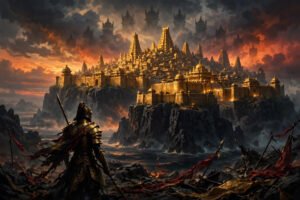
That choice also explains something about the film’s casting and marketing. Yash, who plays Ravana, is introduced as a character with a history of his own — a scholar-king who conquered the three worlds and built a golden city — rather than as a villain who simply appears when the story needs one. Our guide to Yash as Ravana covers his look and his role as co-producer in detail. The opening also sets up the film’s central visual contrast: the golden, fortress world of Lanka against the earth and forest world Rama will inhabit for the rest of the film.
There is a real difference here from Valmiki’s epic, and it is worth knowing. In the original, Ravana’s birth, family and boons are not told at the start at all — they are told after his death, in the Uttara Kanda, a book widely held to be a later addition to the epic. In Valmiki’s telling, Ravana first appears in person only when his sister Surpanakha reaches Lanka, deep into the forest chapters. The film moves his whole backstory to the front, because a two-part film needs its antagonist established early. It is a structural change, not a detail, and it shapes everything that follows.
Rama’s Birth and Early Life in Ayodhya
After the prologue, the story shifts to Ayodhya, where Vishnu is born as Rama in the household of King Dasharatha. Ranbir Kapoor enters the film as Rama — reportedly around forty minutes in, according to one early review, because the film spends its opening stretch on the world and on Ravana’s rise first. Rama is the eldest of four princes: Bharata is born to Queen Kaikeyi, and Lakshmana and Shatrughna to Queen Sumitra. The film follows Rama’s upbringing in the palace, his bond with his brothers, and the affection of the court, before the story moves out of Ayodhya for the first time.
For how Kapoor approached the role — the physical transformation, the reported dual role, and what he has said about playing Ram — see our guide to Ranbir Kapoor as Lord Ram. The early-life section of the film is deliberately unhurried. It establishes Rama as a prince who is loved, capable and dutiful, so that what happens later — the loss of the throne, the exile, the abduction — lands as the undoing of a life, not just a plot turn.
With Vishwamitra: Tadaka, Ahalya and the Bow
The first great movement of the story begins when the sage Vishwamitra arrives in Ayodhya and asks Dasharatha for Rama’s help. Demons are disrupting his sacred yajna in the forest, and he needs the young prince to guard it. Dasharatha refuses at first, then consents, and Rama and Lakshmana leave with the sage. It is Rama’s first step out of the palace and into the world — and the film treats it as the beginning of his education as a warrior and a protector.
In the forest, Rama kills Tadaka, the demoness who has been terrorising the region, and defeats the demons Subahu and Maricha who attack the yajna. The film also includes the redemption of Ahalya, the wife of the sage Gautama, freed from her curse by Rama’s touch. Here, too, there is a detail worth knowing for viewers who grew up with the popular retellings: in Valmiki’s original, Ahalya is not turned to stone. That version of the story comes from later retellings, and the film follows the older telling.
From the forest, Vishwamitra takes the brothers to Mithila, the kingdom of King Janaka, where the great bow of Shiva is kept. At the swayamvara — the ceremony in which Sita will choose her husband — Rama strings the bow and breaks it, winning Sita’s hand. The film stages this as the great set piece of its first half: a hall full of kings, a bow no one else can lift, and a young prince who does it almost without effort. The weddings follow — Rama to Sita, and his brothers to Sita’s sisters — and the film returns to Ayodhya in celebration. For the full cast around these scenes, see our complete Ramayana cast list.
One scene that viewers familiar with the Ramcharitmanas may expect is absent, or at least changed: in Valmiki’s original, the quarrel with Parashurama happens on the road after the weddings, not in the wedding hall, and the confrontation in the hall itself comes from the later Ramcharitmanas. Ranbir Kapoor is reported to play Parashurama as well as Rama, a dual role the film has not fully explained — that thread is one of the things Part 2, or later revelations, may clarify.
Kaikeyi’s Boons and the Exile
The turning point of Part 1 arrives back in Ayodhya, and it arrives through a character the film has been quietly building: Kaikeyi. Dasharatha, having had a dream about his own death, decides to hand the throne to Rama. The coronation is being prepared when Manthara, Kaikeyi’s maidservant, poisons her mistress against Rama. She reminds Kaikeyi of two boons Dasharatha owes her from long ago — and Kaikeyi invokes them: Bharata must be made king, and Rama must be exiled to the forest for fourteen years.
Dasharatha tries to resist, but he is bound by his promise. Rama accepts the exile without protest — and the scene in which he does so is the emotional anchor of the film’s first half. Sita refuses to stay behind. Lakshmana, furious with Kaikeyi, is stopped by Rama from acting rashly, and refuses to let Rama and Sita go alone; he joins them in exile. Lara Dutta plays Kaikeyi, and Arun Govil plays Dasharatha — Govil, who played Ram himself in the 1987 television Ramayan, now playing the father. The casting is one of the film’s quiet gestures to the epic’s screen history, and it lands hardest in exactly these scenes.
Soon after the three leave, Dasharatha dies. Bharata, returning to Ayodhya, takes his father’s ashes to the forest so Rama can perform the final rites as the eldest son, and begs him to return. Rama refuses to break his promise to his late father. Bharata answers with a promise of his own: he will guard the throne until Rama’s exile is complete, rather than take it for himself. It is a scene about duty answering duty, and it closes the Ayodhya chapters of the film. From here, the story belongs to the forest.
The Forest: Panchavati, Surpanakha and the Golden Deer
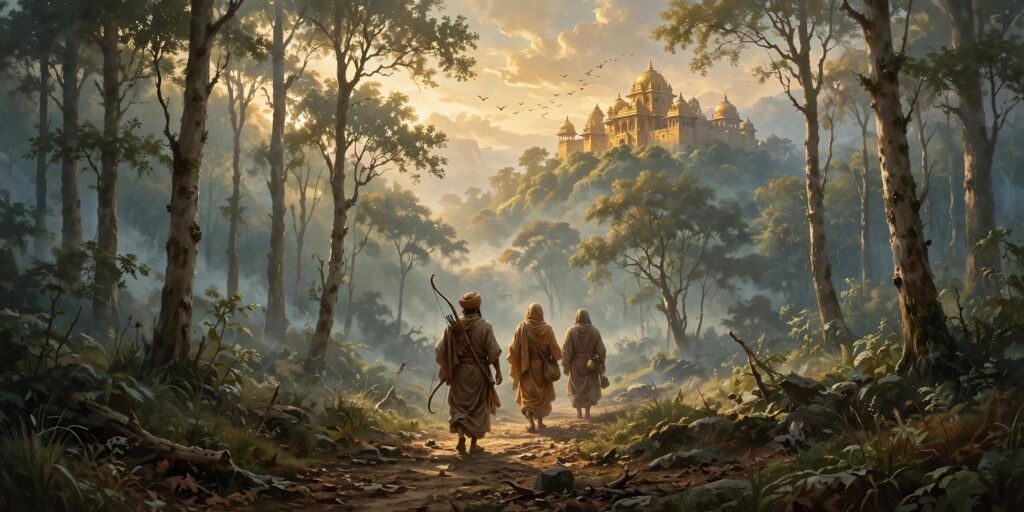
The second half of Part 1 moves to the Dandaka forest, and to Panchavati, where Rama, Sita and Lakshmana build their life in exile. The film slows down here. The forest is not a backdrop; it is the world the three of them now live in, and the film spends time on its rhythms — the hut, the river, the daily life — before the story turns again.
The turn comes with Surpanakha, Ravana’s sister, played by Rakul Preet Singh. She encounters Rama in the forest and is humiliated — and in the film, as in the epic, her humiliation sets off the chain of events that ends the first film. She reaches Lanka and tells Ravana about Sita, and Ravana, with Maricha’s help, sends the golden deer to lure Rama away from the hut. It is one of the most famous sequences in the epic, and the film plays it as a trap the audience can see closing while the characters cannot.
A detail that surprises many viewers: in Valmiki’s original, there is no Lakshman Rekha — no line drawn around the hut that Sita must not cross. That line first appears in the Ramcharitmanas, not in Valmiki, and in the original Sita offers the stranger who comes to the hut a seat, water and food, as a guest. The film’s handling of the abduction follows the older telling, and it is worth watching for that reason: the scene plays differently when Sita is not disobeying a warning, but extending hospitality.
Where Part 1 Ends: The Abduction and the Cliffhanger
Ravana abducts Sita. The great bird Jatayu, played by Anupam Kher, fights Ravana’s chariot in the sky and falls, mortally wounded; Rama and Lakshmana find him, hear his last words, and perform his last rites. That is where Part 1 stops — on a cliffhanger, with Sita taken and Rama’s search not yet begun.
The ending is the film’s biggest structural gamble, and the director has acknowledged it: the film is meant to end on a cliffhanger in the way Baahubali did, so that audiences want the sequel straight away. A film that adapts the early and middle chapters of the epic and leaves the war for next year will not deliver the climax most viewers associate with the Ramayana. Instead, it delivers the moment that makes the war necessary. Everything Part 1 has built — Ravana’s kingdom, Rama’s exile, Sita’s abduction — is a reason for the war, not the war itself.
The reported runtime makes the shape of that choice clear: Part 1 runs a reported 195 minutes in India and 208 minutes overseas, and it spends that time on the world, the characters and the build-up rather than on the battle. Rama does not appear until well into the film, Ravana is established before him, and the two leads — whose conflict is the entire engine of the story — share no scenes in Part 1, according to reports of Yash’s comments. The film asks audiences to hold both men in their minds at once, and to wait for the meeting.
What Part 1 Changes from Valmiki — and What It Keeps
Putting the film beside the original epic, the changes fall into a clear pattern. The film moves Ravana’s backstory to the front; Valmiki tells it at the end. The film opens with gods and demons in conflict; Valmiki opens with the sage Narada telling the story to the poet. The film gives Ravana’s ten heads a psychological treatment — ten personalities inside one mind, each with a different voice — where the original treats them as a symbol of his immense learning. And the film compresses and reorders the forest chapters so that the abduction arrives as a single, clean cliffhanger.
What it keeps is the spine of the story: the boons, the exile, the forest, the golden deer, the abduction, Jatayu. It keeps the moral shape of the epic, too — a story in which the hero’s greatness is shown not in victory, which is still a film away, but in acceptance: Rama accepting exile, Bharata refusing the throne, Sita refusing to stay behind, Jatayu fighting a battle he cannot win. That is the film’s argument about the Ramayana. The war is the second film’s business. The first film is about what makes the war worth fighting.
What Part 2 Must Do
Part 2, planned for Diwali 2027, inherits a very specific set of promises. It must show Hanuman’s search for Sita, the crossing to Lanka, the building of the bridge, and the war with Ravana — the entire second half of the epic, including the meeting between Rama and Ravana that Part 1 deliberately withholds. It must also resolve the threads Part 1 opened and left hanging: the reported dual role of Parashurama, the ten-heads sequence, and the full scale of Ravana’s Lanka, which Part 1 established but barely entered.
That is the risk and the reward of the split. If Part 2 delivers the war with the same care Part 1 gave to the build-up, the two films together will read as one complete epic. If it does not, Part 1 will be remembered as a long first act without a climax. The cliffhanger is a promise, and like every promise in this story, it will be kept — or broken — by what comes next. For the latest on the sequel, see our guide to Ramayana Part 1, and our budget explained for what is at stake financially.
FAQs
What does Ramayana Part 1 cover?
Part 1 covers the first half of the epic: the rise of Ravana, Rama’s birth and early life, his training with Vishwamitra, the killing of Tadaka, the redemption of Ahalya, the swayamvara and his marriage to Sita, Kaikeyi’s demand and the fourteen-year exile, the forest life at Panchavati, Surpanakha, the golden deer, and Ravana’s abduction of Sita.
Where does Ramayana Part 1 end?
Part 1 ends on a cliffhanger after Ravana abducts Sita, with Jatayu’s fight and last rites closing the film. Rama’s search for Sita and the war with Ravana are saved for Part 2, planned for Diwali 2027.
Does Rama meet Ravana in Part 1?
No. According to reports of Yash’s comments, the two leads share no scenes in Part 1. Their first meeting is held back for Part 2, where the war takes place.
Why does the film start with Ravana instead of Rama?
The film opens with the gods-and-asuras conflict and Ravana’s rise — his penance, Brahma’s boon and his takeover of Lanka from Kubera — so the antagonist is established as a character with a history before the hero appears. In Valmiki’s original, Ravana’s backstory is told only after his death, in the Uttara Kanda.
How long is Ramayana Part 1?
The reported runtime is 195 minutes in India and 208 minutes overseas. The film is shot for IMAX and released in Hindi, Tamil, Telugu, Kannada and Malayalam.
Is the Lakshman Rekha in the film?
The Lakshman Rekha — the line drawn around the hut — does not appear in Valmiki’s original Ramayana; it first appears in the Ramcharitmanas. The film follows the older telling, in which Sita offers the stranger hospitality rather than crossing a forbidden line.
What happens to Dasharatha in Part 1?
Dasharatha dies soon after Rama, Sita and Lakshmana leave for exile. Bharata brings his father’s ashes to the forest for Rama to perform the final rites, begs Rama to return, and promises to guard the throne until the exile is complete.
Who plays Sita, Lakshmana and Hanuman?
Sai Pallavi plays Sita, Ravi Dubey plays Lakshmana, and Sunny Deol plays Hanuman. Anupam Kher plays Jatayu, the great bird who fights Ravana and dies telling Rama what happened.
When is Ramayana Part 2 coming?
Ramayana Part 2 is planned for Diwali 2027. It covers the search for Sita, the crossing to Lanka and the war with Ravana.
Who directed Ramayana and who wrote it?
Ramayana is directed by Nitesh Tiwari, from a screenplay he wrote with Shridhar Raghavan. It is produced by Namit Malhotra’s Prime Focus Studios in collaboration with DNEG and Yash’s Monster Mind Creations, and released internationally by Sony Pictures.