Of all the casting choices in Nitesh Tiwari’s Ramayana, the one that changed the film’s shape most is not a performance at all. It is the decision by Kannada superstar Yash to play Ravana — and to produce the film as well. Through his banner Monster Mind Creations, Yash is a producing partner on the two-part epic alongside Namit Malhotra’s Prime Focus Studios, which makes him the only lead actor in the film who also owns a share of it. He is the antagonist on screen and one of the architects off it, and that double position explains almost everything about how his Ravana has been built: the scale of the look, the freedom to experiment with the character, and the fact that his role, though measured in Part 1, is designed to dominate Part 2.
This article looks at Yash as Ravana in full: the look the makers revealed in his solo poster, the ten-heads sequence he has described as the most distinctive idea in the film, how much of him audiences actually see in Part 1, and why a star at the peak of his career chose to put his own production house behind a film in which he plays the villain.
From KGF to Lanka: Why Yash Took the Role
Yash, born Naveen Kumar Gowda, rose through Kannada television before becoming a film star, and then, with KGF: Chapter 1 in 2018 and KGF: Chapter 2 in 2022, a pan-Indian phenomenon. Rocky, his character in those films, made him one of the few actors in Indian cinema whose name alone can open a film across languages. That is the context in which the Ramayana offer arrived — and the context in which it was unusual. Yash was not being asked to carry a film as its hero. He was being asked to play its villain, in a two-part epic directed by someone else, opposite Ranbir Kapoor as Ram.
Industry reports describe a winding road to his agreement. He reportedly stepped away from the role at one stage, then returned — not simply as an actor, but as a co-producer through Monster Mind Creations — and agreed to play Ravana without a conventional fee, taking a producer’s share instead. Those fee details are reported, not officially confirmed, but the structure itself is not in doubt: Monster Mind Creations is credited as a producing partner on the film, and Yash has spoken publicly about wearing multiple hats on the production. For an actor who could have commanded any hero-led project after KGF, choosing to invest in a film where he plays the antagonist is a statement of intent. He did not want to be in Ramayana. He wanted to own a part of it.
There is also a creative logic to the choice. Ravana is not a conventional villain. In the epic, he is the king of Lanka, a devotee of Shiva, a scholar of the Vedas and a master of many disciplines — a ruler of immense learning whose flaw is not ignorance but ego. That complexity is what drew Yash to the part. He has said that what he enjoyed most was exploring Ravana’s internal world: what the character was thinking when he acted, what made him do what he did, and whether he would be the same in every situation. “What was he thinking when he did this? What made him do this? Would he be the same in every situation? Even if he had hatred or wanted to put somebody down, was it necessary for him to be angry there?” Those are not the questions of an actor playing a monster. They are the questions of an actor playing a man who happens to be the antagonist.
The Look: Seated Among Fallen Warriors, Spear in Hand
The first full reveal of Yash’s Ravana came with the film’s international campaign. The makers launched the international trailer alongside solo character posters of Ranbir Kapoor as Lord Rama and Yash as Ravana, with Sony Pictures Entertainment driving the global campaign. The unveiling took place at an event in Bengaluru hosted by Prime Focus Studios and Monster Mind Creations, and the two posters were designed as a deliberate contrast: Rama drawing his bow in a sunlit forest, and Ravana seated in the aftermath of war.
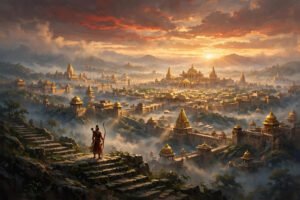
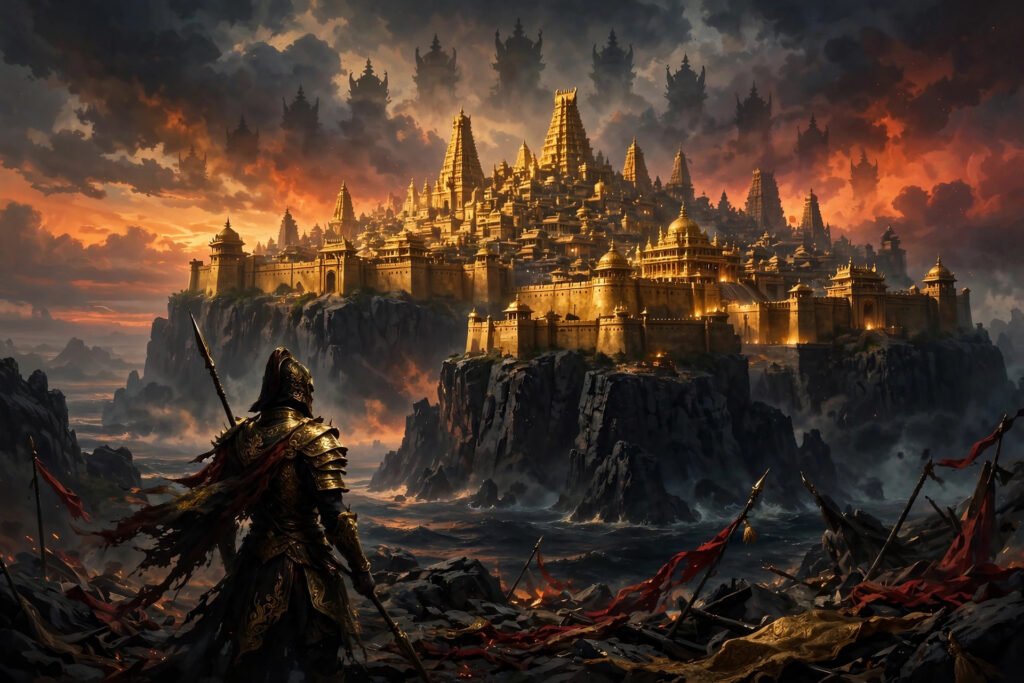
Yash’s poster shows the king of Lanka seated among fallen warriors, a spear in his hand, against the backdrop of an imposing palace. The look is battle-worn — armour, scars and the debris of a fight just ended — and it conveys authority rather than rage. Where the Rama poster is about focus and readiness, the Ravana poster is about a victory already won. The makers described the character through the caption “The ruler of all 3 worlds, Ravana,” and a later version of the poster carries the tagline, “He ruled all the 3 worlds, could not rule his own ego.” That second line is the whole character in one sentence: a king who conquered everything except himself.
The poster also sets up the film’s central visual contrast. The character posters released alongside it place Rama, Sita and Lakshmana in the simple world of the forest exile — the vanvas — against the golden Lanka of Ravana’s kingdom. One side of the film is earth, saffron cloth and a bow; the other is gold, fortress walls and a spear. That contrast runs through the entire production design, and Yash’s Ravana is its anchor: the golden city exists on screen because its king does.
Behind the look is a physical transformation of a different kind from Ranbir Kapoor’s. Where Kapoor rebuilt himself leaner for Rama, Yash’s Ravana is built for mass and menace. The first image from the set, shared as filming began, showed him in peak physical form — muscular, intense and immersed in the role. The action sequences built around his character are being choreographed by Hollywood stunt director Guy Norris, best known for Mad Max: Fury Road and The Suicide Squad, and the production has tailored large-scale action around Ravana specifically. According to production sources, Yash was expected to shoot for Ramayana Part 1 for nearly 60 to 70 days — a substantial schedule for a character whose screen time in the first film is deliberately measured.
The Ten Heads: One Character, Many Personalities
The most distinctive idea in Yash’s portrayal is also the one he has talked about most. Ravana is Dashanana, the ten-headed one, and the film treats that not as a visual effect but as a psychological idea. In an interview about his approach to the character, Yash revealed that exploring Ravana’s multiple personalities became central to shaping one of the film’s most distinctive sequences.
“No matter how we present ourselves, we have so many dilemmas in our head. Sometimes we are very strong, sometimes we are weak, doubtful about ourselves or overconfident. All these thought processes exist in everybody. We wanted our interpretation to be a very unique and special one,” he said. The idea, as he described it, was to give each of Ravana’s personalities a distinct identity — a different voice, a different way of looking, a different way of reacting. “I wanted to have a different voice. I could have played it in the same voice, but the idea was to imagine that each personality could speak or look differently.”
He credited his makeup artist Prashanth for helping translate those ideas onto the screen, and director Nitesh Tiwari for giving him the creative freedom to experiment. The sequence keeps certain traits already associated with Ravana through popular interpretations, but Yash also explored imaginative possibilities: how the character might react when disturbed, doubtful or conflicted. He found a personal connection in the idea, too. “All my friends say that it’s quite like my head. I do multiple jobs, I do multiple things. I like taking on new things and learning something new,” he said, adding that Ravana’s mastery across several disciplines gave him an interesting starting point for the character.
What he emphasised most was restraint. He spoke about Ravana’s sarcasm, his patience, and his ability to remain composed even in difficult conversations. “He’s got a lot of patience when somebody is talking. He’s just waiting for them to finish. Those are the kind of things which I enjoyed as an actor,” he said. And he was clear that the character’s presence should emerge organically from understanding him, rather than relying on a larger-than-life aura. “What we bring in as an actor is to understand the person who he was, and I think I had a blast in understanding Ravana.”
That approach matters because it separates this Ravana from the bellowing demon-kings of older screen versions. The ten heads, in Yash’s telling, are not ten faces shouting at once. They are ten ways of thinking inside one mind — confidence and doubt, strength and weakness, patience and fury — and the performance is built on letting each one surface at the right moment. It is the most actor-driven idea in a film otherwise defined by scale, and it is the one Yash himself chose to talk about first.
How Much of Ravana Is in Part 1?
Part 1 covers Rama’s early life, his marriage to Sita, and the events leading to the beginning of his exile. That is, by the structure of the epic, a story in which Ravana is present but not yet central. His abduction of Sita — the act that drives the second half of the epic — belongs to the story Part 2 will tell. So Yash’s role in Part 1 is deliberately introductory: the film establishes Ravana’s imperial majesty, his devotion to Shiva and the power of his kingdom, and then holds the full confrontation for the sequel.
Yash has said that he shares no scenes with Ranbir Kapoor’s Rama in Part 1, according to reports of his comments — which means the two leads of the film, whose conflict is its entire engine, do not meet on screen until the story reaches its second half. That is a bold structural choice, and it explains the shape of the marketing: two solo posters, two separate worlds, no shared frame. The film asks audiences to hold both men in their minds at once, and to wait for the meeting.
Filming for Yash began in February 2025, with the war sequences — the large-scale action that Guy Norris was brought in to choreograph — shot first. That order of shooting is itself revealing: the production built Ravana’s physical world before it built his quieter scenes, and the scale of the war material is what the first film’s action marketing leans on. In Part 2, planned for Diwali 2027, the balance reverses: the search for Sita and the war with Ravana take centre stage, and Yash’s role becomes the film’s driving force.
The Producer’s Chair: Monster Mind Creations
Yash’s second role on Ramayana is the one that makes the first possible. Monster Mind Creations, his production house, is a producing partner on the film alongside Prime Focus Studios, with DNEG handling the visual effects. That partnership gives Yash a seat at the table on casting, visual design and marketing decisions — a position no other actor on the film holds.
The banner’s involvement has also grown beyond production. Monster Mind Creations has taken charge of the film’s theatrical distribution in Karnataka through a newly launched distribution arm, expanding the company’s footprint from making films to releasing them. The film’s distribution map shows how wide the partnership network runs: Sony Pictures handles international distribution, Dharma Productions oversees North India, Dil Raju takes charge of Andhra Pradesh and Telangana, Think Studios manages Tamil Nadu, and E4 Entertainment handles Kerala. In Karnataka, the territory Yash knows best, his own company is the distributor.
That is a remarkable position for an actor who began in Kannada television. A decade ago, Yash was a regional star trying to break out. After KGF, he is a pan-Indian star who co-produces India’s most expensive film, distributes it in his home state, and plays its villain. The producer’s chair also explains the creative freedom he has described. When he talks about Tiwari giving him room to experiment with Ravana’s ten personalities, he is describing a relationship between collaborators, not an actor asking a director for permission. He helped build the film, so he gets to shape his character inside it.
It also explains why the budget conversation around Ramayana keeps circling back to him. The film’s production budget is reported at Rs 1,600 crore, with the combined figure including release and promotion reported at around Rs 4,000 crore — a figure Yash himself clarified in interviews. Our budget explained covers those numbers in detail. As a producer with a share in the film, Yash has a direct stake in whether those numbers are understood — and in whether the film earns them back.
Ravana the Scholar, Not Just the Villain
The version of Ravana that Yash is playing has roots that go deeper than the film. In the epic, Ravana is not a brute. He is a Brahmin scholar, a master of the Vedas, a devotee whose penance won him boons from Brahma, and a king who built Lanka into a golden city. His ten heads are traditionally read as a symbol of his immense knowledge — ten minds’ worth of learning in one man. His flaw, in the story, is not stupidity but arrogance: the belief that his learning and his power put him above the rules that bind everyone else.
That is why the poster’s tagline lands. “He ruled all the 3 worlds, could not rule his own ego” is not marketing copy invented for a poster. It is the story of Ravana in one line, and it is the story Yash has chosen to play: a man who mastered everything except himself. His performance, by his own account, is built on the patience and composure that make the character dangerous — a ruler who listens, waits, and only then acts. A Ravana who shouts is a cartoon. A Ravana who waits is a threat.
For the full cast around him — Ranbir Kapoor as Ram, Sai Pallavi as Sita, Sunny Deol as Hanuman, Ravi Dubey as Lakshmana and Arun Govil as Dasharatha — see our complete Ramayana cast list. For how Kapoor approached the other side of this conflict, see our guide to Ranbir Kapoor as Lord Ram, and for the story of how the film came to be made, our guide to Ramayana Part 1.
Why Yash’s Ravana Could Define the Two Films
Every two-part epic has a problem: the first film has to introduce a villain the second film will spend its whole running time defeating. If the villain is forgettable in Part 1, Part 2 has nothing to fight. Yash’s Ravana is designed to solve that problem before it starts. The poster, the ten-heads sequence, the war sequences shot first, the distribution in Karnataka, the producer’s stake — all of it is built to make Ravana loom over Part 1 even when he is barely in it.
That is the gamble of the casting, and it is also the gamble Yash himself has taken. He has put his company, his distribution network and his reputation behind a film in which he plays the man who loses. If the audience remembers his Ravana as a person — learned, patient, sarcastic, conflicted, dangerous — then Part 2 has its engine. If they remember him only as a poster, it does not. By his own account, he had a blast finding out which one it would be. The answer, like the war itself, arrives in the second film.
FAQs
Who plays Ravana in Ramayana?
Yash, the Kannada superstar known for KGF: Chapter 1 and KGF: Chapter 2, plays Ravana in Nitesh Tiwari’s Ramayana. He is also a co-producer on the film through his banner Monster Mind Creations.
Is Yash a producer on Ramayana?
Yes. Yash is a producing partner on Ramayana through Monster Mind Creations, in collaboration with Namit Malhotra’s Prime Focus Studios and DNEG. His banner has also taken charge of the film’s theatrical distribution in Karnataka.
What does Yash’s Ravana look like?
His solo poster shows Ravana seated among fallen warriors, holding a spear, against the backdrop of an imposing palace, with a battle-worn look in golden armour. The makers described him as “The ruler of all 3 worlds, Ravana,” and the poster carries the tagline, “He ruled all the 3 worlds, could not rule his own ego.”
What is the ten-heads sequence in Ramayana?
Yash has described a sequence built around Ravana’s ten heads as ten distinct personalities inside one mind. He said he gave each personality a different voice and appearance, working with makeup artist Prashanth and with creative freedom from director Nitesh Tiwari, to show Ravana’s strength, doubt, patience and conflict.
How much of Yash’s Ravana is in Ramayana Part 1?
Part 1 is introductory for Ravana: it establishes his power, his kingdom of Lanka and his devotion to Shiva, while the abduction of Sita and the war belong to Part 2. Yash has said he shares no scenes with Ranbir Kapoor’s Rama in Part 1, according to reports.
When did Yash start shooting for Ramayana?
Yash began shooting in February 2025, starting with the film’s war sequences, choreographed by Hollywood stunt director Guy Norris of Mad Max: Fury Road fame. According to production sources, he was expected to shoot for nearly 60 to 70 days on Part 1.
Who distributes Ramayana in Karnataka?
Yash’s Monster Mind Creations handles Karnataka distribution through its newly launched distribution arm. Sony Pictures handles international distribution, Dharma Productions oversees North India, Dil Raju handles Andhra Pradesh and Telangana, Think Studios manages Tamil Nadu, and E4 Entertainment handles Kerala.
What did Yash say about playing Ravana?
He said what he enjoyed most was exploring Ravana’s internal world — his patience, sarcasm and composure — and understanding the person behind the mythology. He described the role as a blast to understand, and said the aim was to keep Ravana grounded rather than relying only on a larger-than-life aura.
Who directed Ramayana and who produced it?
Ramayana is directed by Nitesh Tiwari, from a screenplay he wrote with Shridhar Raghavan. It is produced by Namit Malhotra’s Prime Focus Studios in collaboration with DNEG and Yash’s Monster Mind Creations.
When is Ramayana Part 2 coming?
Ramayana Part 2 is planned for Diwali 2027. It covers the search for Sita and the war with Ravana, where Yash’s role becomes central.