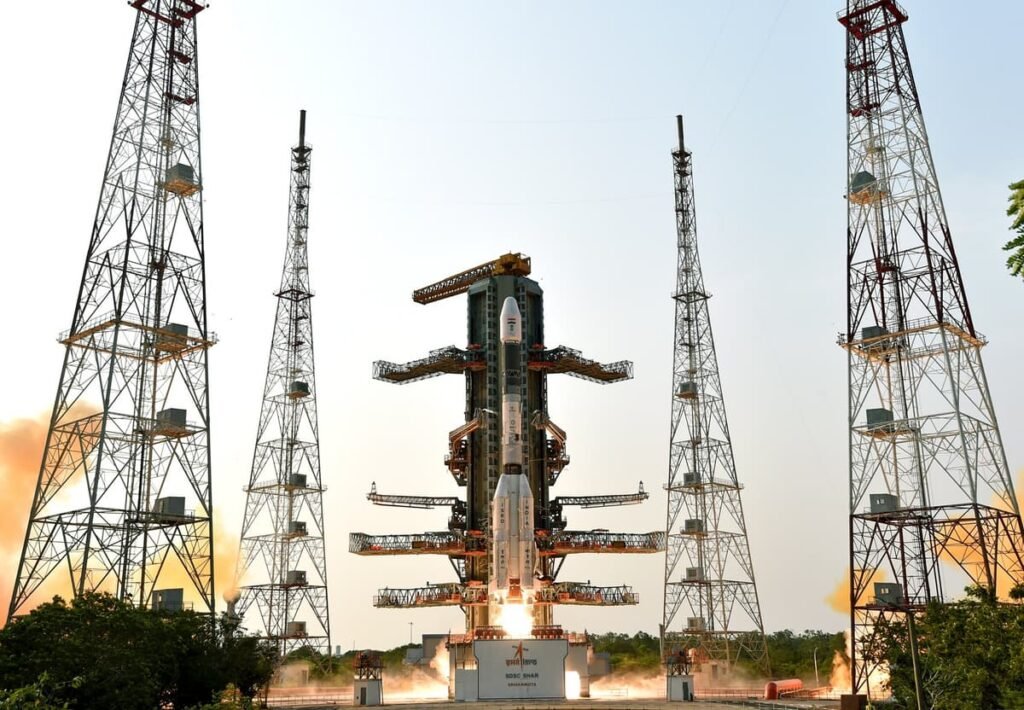
The Indian Space Research Organisation has successfully launched its next-generation navigation satellite NVS-03 aboard the GSLV-F18 rocket from Sriharikota, restoring India’s NavIC constellation towards the strength it needs for standalone positioning. The rocket lifted off at 11:51 pm from the Second Launch Pad at the Satish Dhawan Space Centre, and ISRO confirmed the outcome with the announcement: “Mission Success! GSLV-F18 has successfully placed NVS-03 in the intended orbit.”
The mission was the 20th flight of the Geosynchronous Satellite Launch Vehicle. The 50-metre-tall, three-stage GSLV-F18 carried the satellite, weighing more than 2,200 kg, into a geosynchronous transfer orbit, from which it will raise itself to its final slot.
Why NavIC needed a fourth satellite
NVS-03 is the third satellite of the second-generation NVS series, intended to augment the Navigation with Indian Constellation, India’s regional navigation system. NavIC provides accurate position, velocity and timing services across India and the region extending approximately 1,500 km beyond the Indian landmass, through a Standard Positioning Service for civilian users and a Restricted Service for authorised users.
The launch matters because NavIC has been short of satellites. The system was designed around seven first-generation satellites, but only three, IRNSS-1B, IRNSS-1I and NVS-01, now provide navigation services, against the four needed for standalone positioning. The government has said that with only three satellites, NavIC cannot offer standalone positioning, although timing services remain functional. NVS-02, launched in January 2025, suffered an engine malfunction and was left in a sub-optimal orbit, making the success of NVS-03 all the more important.
What NVS-03 carries
NVS-03 carries an indigenous atomic clock alongside procured atomic clocks, described by officials as the heart of the navigation payload. Precise timekeeping is what makes satellite navigation work, and an Indian-built clock reduces dependence on imported components for that critical function.
The satellite also transmits the L1 navigation signal in addition to the existing L5 and S-band signals, a band widely supported by commercial navigation chips that could make NavIC easier to use in phones and other everyday devices. Its planned final slot is at 32.5 degrees East, but orbit-raising, health checks and commissioning still lie ahead: only after those steps can NVS-03 begin contributing navigation services. Two more second-generation satellites are expected within 12 months.
For India’s space programme, the mission marks a recovery after the NVS-02 setback and a step towards a self-reliant navigation capability with strategic as well as civilian uses. Indian scientists keep pushing into challenging frontiers closer home, and technology programmes are expanding across the Northeast. NVS-03 now joins that story in orbit, with its real test, delivering reliable navigation signals to users, still to come.
#ISRO #GSLVF18 #NVS03 #NavIC #Sriharikota #NavigationSatellite #SpaceIndia