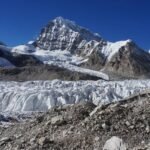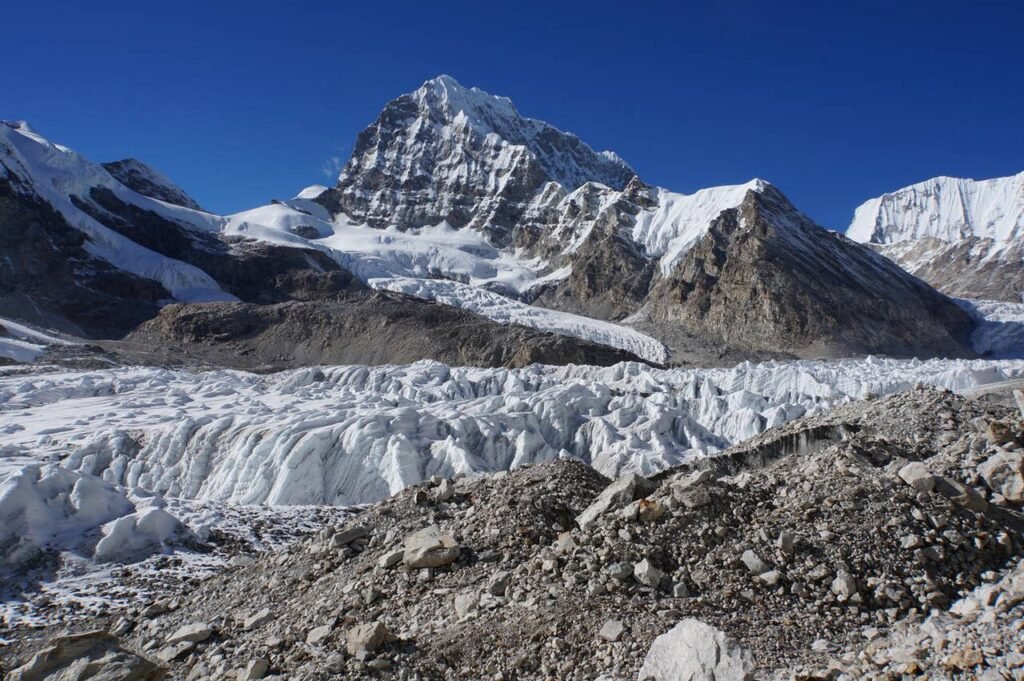
A joint scientific team has completed its sixth expedition to the Khangri Glacier in the Mago Chu Basin of Arunachal Pradesh — another milestone in a multi-year effort to understand how the Eastern Himalaya’s cryosphere is responding to a changing climate.
What the Team Did on the Ice
Experts from the National Centre for Polar and Ocean Research, the Centre for Earth Sciences and Himalayan Studies, and the North Eastern Regional Institute of Science and Technology led the work. The team set up a new HydroMAT monitoring site at the outlet of Sangnya Nekhu — the Blue Lake — and used a sonar-equipped Apache boat to run a bathymetric survey of the lake bed. The survey maps the lake’s depth and volume — key inputs for assessing how much water could be released if the lake’s natural dam were to fail. They measured surface ablation to gauge ice loss, and installed four bamboo stakes across the glacier surface to track future changes. The team also conducted aerial surveys of four lakes flagged by the National Disaster Management Authority as Risk Type A and B — categories that denote the danger of glacial lake outburst floods, a risk the state’s water planners have been tracking closely.
Four Years of Tracking Ice Loss
The investigations have now been running for four years. The programme tracks glacier mass, surface characteristics and how the high-altitude cryosphere reacts to climate change, with scientists working to improve the understanding of glacier dynamics. The latest trip marks a major milestone for the regional research programme, backed by the Ministry of Earth Sciences and the Arunachal Pradesh government.
Why Himalayan Glaciers Matter
Himalayan glaciers feed the rivers that sustain millions of people downstream, and their retreat carries implications for water security, flood risk and mountain ecology. Systematic monitoring of the kind carried out at the Khangri Glacier builds the long-term datasets scientists need to project how these ice reserves will behave in a warming world. Earlier assessments have warned that glacial lakes above Tawang could threaten villages below if they burst. The four-year dataset is also feeding into national efforts to classify high-risk glacial lakes and prioritise early-warning systems for downstream communities.
#KhangriGlacier #ArunachalPradesh #ClimateChange #Glacier #Himalayas #Tawang #GLOF #Science