

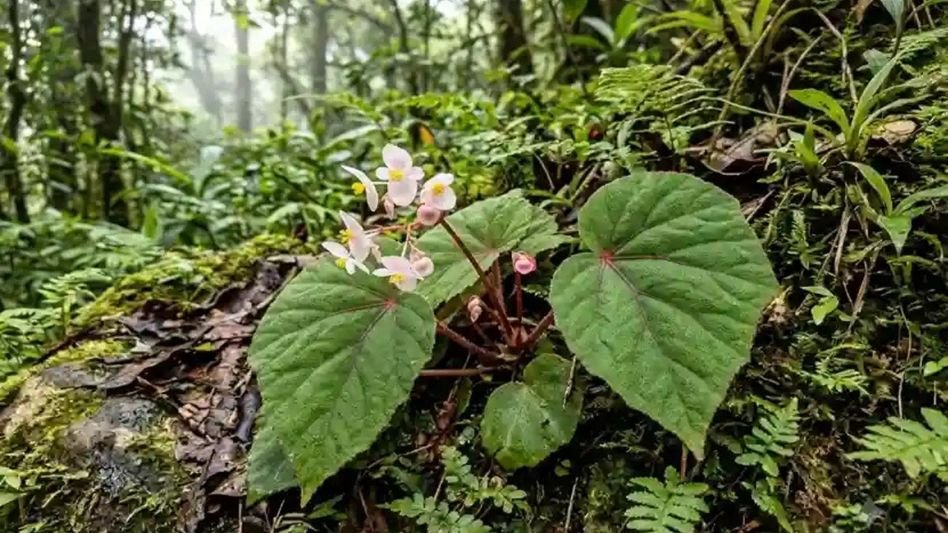
Deep in the misty river valleys of Arunachal Pradesh, clinging to a damp rock face above the Keyi River, a small flower had been living in quiet anonymity — completely unknown to science. Not anymore.
Researchers have officially identified a brand new species of Begonia in the Keyi Panyor district of Arunachal Pradesh, and the discovery has already made its way into Taiwania, a respected international peer-reviewed journal. The species has been named Begonia neelamorum — a name that carries both scientific weight and a meaningful cultural nod. It was discovered and documented by botanists Dipankar Borah, Madhusudhan Khanal, Momang Taram, and Neelam Gap, whose field expedition into this remote terrain was no easy feat.
The plant was found growing on steep, moisture-laden walls along the banks of the Keyi River, roughly 1,000 metres above sea level. That’s the kind of spot most people would walk past without a second glance — slippery, shadowy, and far off any beaten path. But botanists know that those are precisely the places worth paying attention to.
What makes Begonia neelamorum distinctive? It’s a small, tuberous plant bearing a single sessile light-green leaf and delicate white flowers — both male and female blooms. At first glance, it looks quite similar to Begonia prolifera, but the researchers were careful. The two plants differ in noticeable ways: the glandular hairs, the rounded stem, the shape of the leaves with their double-serrated margins, the structure of the flower clusters, and the length of the styles all set this new species apart. Science is often in the details, and here the details matter.
The name neelamorum is a tribute to the Neelam clan of the Nyishi community, whose members provided crucial assistance to the research team during their expedition. It’s a gesture worth appreciating — science rarely happens in isolation, and in this part of Arunachal, local knowledge and community support can make all the difference. Locally, the plant already has a name among the people who live alongside it: kobiirhopu baabrai.
As of now, the species is known to exist only within an area of roughly three square kilometres in Keyi Panyor district, which makes its future a matter of concern. The International Union for Conservation of Nature has provisionally classified it as “Data Deficient” — meaning researchers simply don’t yet have enough information to fully assess how at risk it might be. That designation isn’t reassuring, but it is honest. And it signals that more scientific attention to this pocket of Arunachal’s biodiversity is urgently needed.
With this find, the total count of Begonia species recorded from Northeast India climbs to 54. Globally, the Begonia genus spans around 2,200 accepted species, spread across tropical and subtropical regions of the world. Northeast India, it turns out, is punching well above its weight when it comes to floral diversity.
Arunachal Pradesh has long been considered one of India’s richest biodiversity hotspots — a status earned not just on paper but through discoveries exactly like this one. The forests, river gorges, and hillsides of this state have a habit of quietly holding onto things the rest of the world hasn’t found yet. Begonia neelamorum is just the latest reminder that there’s still so much left to look for — and even more reason to protect the landscapes where these secrets live.