Ramayana: Part 1 has done what its makers hoped it would do. Released in cinemas on 5 November 2026, it crossed Rs 1,000 crore worldwide in eight days, according to reported trade figures, becoming the 11th Indian film ever to reach that mark and the highest-grossing film of Ranbir Kapoor’s career so far. Our guide to the advance booking and box office has the full numbers. With the first film established as a historic success, the question every viewer is now asking is the same one: when does Part 2 arrive, what story will it tell, and how far along is it?
The short answer is that the wait will be longer than first announced. Part 2 was originally planned for Diwali 2027, a year after Part 1, but producer Namit Malhotra has now said the sequel needs an extra year to match the scale of the first film. Reports point to Diwali 2028 instead, although the makers have not announced an exact date. The shoot, meanwhile, is well advanced: the cinematographer says about 60 per cent of the film has already been shot, with the heaviest visual effects work still to come. This guide brings together everything verified so far about Ramayana Part 2 — the release date, the story, the shooting update, the cast and what happens next.
Ramayana Part 2 Release Date: Diwali 2028, Not Diwali 2027
When the two-part Ramayana was announced in November 2024, the plan was simple: Part 1 for Diwali 2026 and Part 2 for Diwali 2027, one year apart. That plan has now changed. Speaking around the release of Part 1, producer Namit Malhotra indicated that the sequel will take longer to reach cinemas, and that the team wants the extra time to do justice to the finale.
“So the idea was now that we’ve got so much excitement that the world has had, we want to take a little bit more time to make sure that when we present the grand finale, we have a little bit more time to do what we did in Part 1,” Malhotra said. “That extra year is what we genuinely believe we need to do justice for a film of this size.”
He added: “When you see Part 2 coming, that will be a whole other story. We didn’t want to do a rush job or get ahead of ourselves. We want to deliver the finale in the most grand way it deserves.”
The sequel is now expected to arrive in 2028, with reports pointing to Diwali 2028 as the release window, although an official release date is yet to be announced. One report has said a scene after the credits of Part 1 is intended to reveal the revised date, but the makers have not confirmed that, and no exact day has been announced. Until the makers confirm it, Diwali 2028 should be treated as the reported window rather than a locked date.
The delay is not a sign of trouble. It is the same logic that shaped the first film: a project of this scale is finished when it is ready, not when the calendar says so. Part 1 itself was announced two years before release, and the makers spent that time building the world of Ayodhya, the forests of exile and Lanka from scratch. Part 2 carries the war, which is the most effects-heavy part of the epic, and the makers have chosen to give it the time it needs rather than rush it out a year after Part 1.
Ramayana Part 2 Shooting Update: How Much Is Done?
Filming for Part 2 began in Mumbai in March 2026, about eight months after Part 1 wrapped its principal photography, and it has been running alongside the post-production of the first film ever since. The exact share of the sequel already shot depends on who is speaking and when, so the figures are worth setting out carefully.
Ranbir Kapoor said during the film’s promotional tour in the United States that filming on Part 2 was already about 50 per cent complete, with the sequel progressing alongside post-production work on the first film. That was the position before Part 1 reached cinemas. Cinematographer Pankaj Kumar gave the most recent on-record update in an interview with The Hollywood Reporter India, saying that 60 per cent of Part 2 has been shot. Another report, citing Kapoor, puts the figure higher, at around 80 per cent. The three figures do not agree, and the honest reading is that a substantial share of the film is in the can while a significant share — particularly the biggest action and effects sequences — remains to be shot.
What the makers agree on is where the remaining work lies. Kumar said that extensive visual effects and motion-capture work is still ahead, because the second part is going to be more grand than the first. “We have already shot 60 per cent of Ramayana: Part 2. A lot of VFX work, a lot of motion capture work is left because the second part is going to be more grand than the first part,” he said. The sequel will feature a larger number of CGI characters, including Hanuman and the whole vanar sena, the monkey army, which means far more detailed effects work than Part 1 required.
The care going into that work is visible in the preparation. Kumar said the team spent nearly a year finalising the pre-visualisation of each individual scene before shooting began — every shot planned in advance, so that the live-action filming and the effects work fit together. Reports also say shooting is set to resume in December, with the remaining schedules covering the war sequences that need the most preparation. Malhotra has said only about half of the sequel had been filmed at the time Part 1 opened, which fits with the picture of a film whose biggest set pieces are still to be shot.
That schedule is the reason for the extra year. The war in Lanka cannot be filmed quickly: it needs large sets, large numbers of performers and effects artists, and long post-production. Giving the sequel until Diwali 2028 means the makers can shoot the remaining material without rushing and then spend the time the visual effects demand. For audiences, the trade is simple: a longer wait for a bigger film.
Where Part 1 Ends and Part 2 Begins
To understand Part 2, it helps to know where Part 1 stops. Our guide to the Part 1 story explains the shape of the first film: Rama’s early life, his marriage to Sita, the beginning of the 14-year exile, and the events that lead to Sita’s abduction by Ravana. Reports point to a cliffhanger around the abduction itself, which is where the first film leaves the story.
Part 2 therefore begins at the darkest point of the epic. Sita has been taken to Lanka. Rama and Lakshmana are searching the forests for her, with no idea where she has been taken. Everything that follows — the alliance, the search, the leap across the ocean and the war — is the answer to that abduction. It is also the part of the story audiences know best, which is why the expectations on Part 2 are even higher than they were on Part 1.
The structure of the epic gives Part 2 its shape. In Valmiki’s Ramayana, the second half of the story runs through the Kishkindha Kanda, where Rama meets Hanuman and allies with Sugriva, the Sundara Kanda, where Hanuman finds Sita in Lanka, and the Yuddha Kanda, the book of war, where the two armies meet. The makers have split the epic so that Part 1 covers the early kandas and Part 2 carries the search and the war — the chapters where the story turns from a family drama into a battle for the fate of two kingdoms.
The Story Part 2 Will Tell: The Search for Sita and the War in Lanka
Part 2 is expected to open with the search for Sita. Rama and Lakshmana, grieving and furious, follow the trail south, where they meet Hanuman and the exiled monkey king Sugriva at Kishkindha. The alliance that follows is the turning point of the epic: Sugriva promises his army’s help in finding Sita in exchange for Rama’s help in recovering his kingdom, and Hanuman becomes the bridge between the two worlds — the forest and the army, the search and the war.
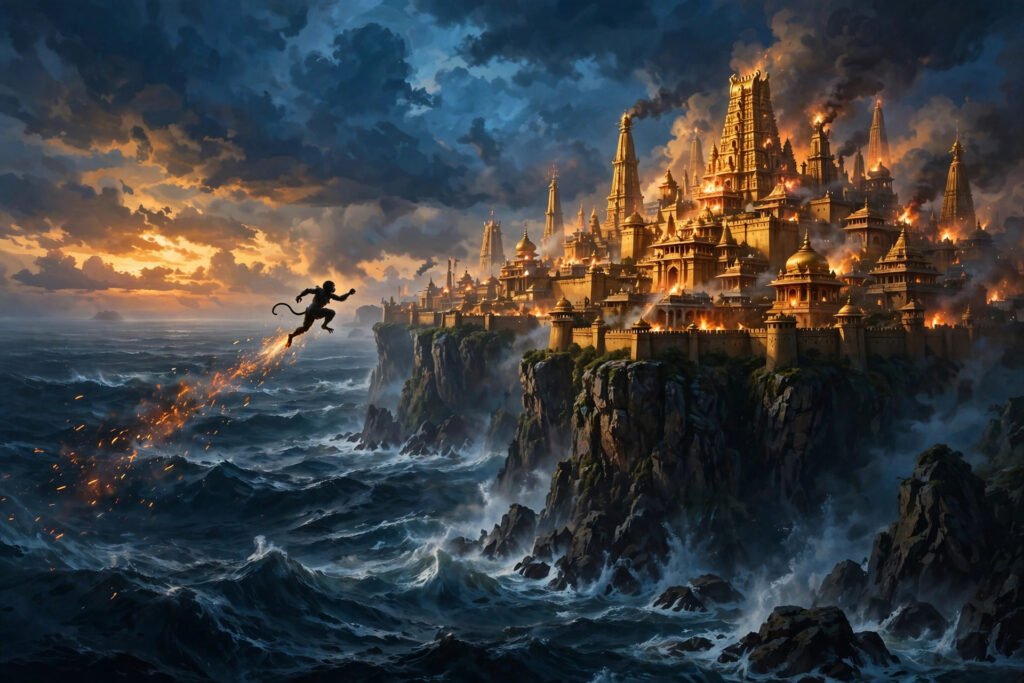
Hanuman’s leap to Lanka is the centrepiece of the first half of Part 2. In the epic, he crosses the ocean in a single leap, searches the golden city, finds Sita in the Ashok Vatika, and gives her Rama’s ring as proof that rescue is coming. Then, captured by Ravana’s forces, he allows his tail to be set alight and turns the fire on Lanka itself, burning the city before leaping back across the sea with the news. It is the most visually spectacular sequence in the epic, and it is also the moment Hanuman stops being a supporting figure and becomes the hero of the second film.
The second half of Part 2 is the war itself. Rama’s army builds the bridge to Lanka — the Rama Setu, the causeway of stones across the sea — and crosses to lay siege to Ravana’s kingdom. The battle that follows is the Yuddha Kanda, the war that the whole two-part project has been building towards: the vanar sena against the armies of Lanka, Lakshmana against Meghanad, and finally Rama against Ravana. In the epic, the war ends with Ravana’s fall and Sita’s rescue, and with the long road back to Ayodhya. How much of that return the film shows — and whether the coronation closes the film or is left for a final scene — is something the makers have not said.
Two figures shape the war. The first is Meghanad, also known as Indrajit, Ravana’s eldest son and the crown prince of Lanka, one of the most formidable warriors in the epic and the opponent Lakshmana must defeat. The second is Ravana himself, who in Part 2 moves from the shadowy presence of the first film to the centre of the story. Our guide to Yash as Ravana explains why his performance matters as much for the box office as for the film, and Part 2 is where that performance gets its fullest stage.
Ramayana Part 2 Cast: Who Returns and Who Steps Forward
The principal cast of Part 1 returns for the sequel. Ranbir Kapoor reprises his role as Lord Rama, Sai Pallavi returns as Sita, and Yash returns as Ravana, the king of Lanka. Ravi Dubey returns as Lakshmana, Rama’s brother and constant companion. Our full cast list covers the ensemble in detail, and the same faces carry the story into its second half.
Two cast members step forward in Part 2. The first is Sunny Deol as Hanuman. His role in Part 1 is best understood as an introduction; in Part 2, Hanuman becomes central to the story, leading the search for Sita, making the leap to Lanka and fighting in the war. Deol was introduced in the post-credits sequence of Part 1, a deliberate signal that his character’s story is the sequel’s story. Our guide to Ranbir Kapoor as Ram explains how the first film sets up that handover, with Rama the prince giving way to Rama the warrior.
The second is Raghav Juyal as Meghanad. The actor, known for Kill, has been cast as Ravana’s son in Part 2, a role that was originally meant for Vikrant Massey, according to reports. Juyal was shown as Meghanad towards the end of Part 1, setting up his expanded role in the sequel, and he is expected to begin shooting his portions once he recovers from a recent leg injury. Meghanad is one of the epic’s great antagonists — a warrior whose defeat is one of the war’s turning points — and the casting gives the sequel a second major villain alongside Ravana.
Sai Pallavi’s Sita also takes on a different weight in Part 2. In the first film she is at the centre of the love story and the exile; in the second she is a captive in Lanka, holding to her faith in the Ashok Vatika while the war is fought to free her. It is a quieter role than the battlefield parts, but it is the emotional centre of the film: the war is fought for her, and her scenes are the reason the war matters.
Scale, Budget and the Team Behind Part 2
Part 2 is being made on the same scale as Part 1, and in some respects on a larger one. The reported production budget for the two parts together is around Rs 1,600 crore, with Part 1 at about Rs 900 crore and Part 2 at about Rs 700 crore, because much of the world-building and asset creation was done for the first film. Our guide to the Ramayana budget explains the competing figures, including producer Namit Malhotra’s combined figure of roughly $500 million, or about Rs 4,000 crore, which Yash has clarified covers both parts together with global release and promotion.
The team is the same. The film is directed by Nitesh Tiwari, known for Dangal and Chhichhore, from a screenplay by Shridhar Raghavan, and produced by Namit Malhotra’s Prime Focus Studios in collaboration with Monster Mind Creations and DNEG, the visual effects company with eight Academy Awards. Malhotra has said the production employs more than 10,000 technicians across the globe. The music comes from the same team behind the two-part project: A. R. Rahman composing the music and Hans Zimmer creating the original score, a combination our guide to the music covers in full.
The visual ambition is the reason the sequel needs its extra year. Part 2 will feature more CGI characters than Part 1 — Hanuman and the whole vanar sena, the armies of Lanka, the burning city and the war itself — and the effects work is the longest part of the production. DNEG built the assets for both films together, which is why so much of Part 2 could be shot before Part 1 was even released. The remaining work is the most demanding part: the war sequences, the motion capture and the final polish that turns filmed material into the finished film.
Will There Be a Ramayana Part 3?
One report, published as Part 1 opened, says a third part is also being considered. The makers have not confirmed that, and the two-part plan announced in November 2024 remains the official structure: Part 1 for Diwali 2026 and Part 2, now expected for Diwali 2028, to complete the story.
A third film would make sense only if the story needed it. Tiwari has said the makers originally considered a trilogy before settling on two parts, because the emotional depth of the epic made a single film impossible while three films created their own challenges. The two parts together run for more than six hours. Whether the war and the return to Ayodhya fit comfortably into Part 2, or whether the makers decide the story needs more room, is a question only the finished sequel can answer. For now, Part 3 is a report, not a plan.
What to Expect Next
There is no trailer for Part 2 yet, and there will not be one for a long time. Part 1’s second trailer was unveiled on 15 October 2026, about three weeks before release, at an event in Bengaluru — and the first film’s promotion ran for two years before that. By the same pattern, a Part 2 trailer is a long way off, and the first footage is likely to arrive with the first poster and teaser campaign much closer to the release. Our guide to the trailer, runtime and formats explains how the first film’s promotion was built, and the sequel can be expected to follow a similar rhythm.
The formats are easier to predict. Part 1 was shot for IMAX, with a 3D experience as part of the plan, and it received a PG-13 rating in the United States. Part 2, carrying the war, is the film most suited to those formats, and it is expected to release in the same languages — Hindi, Tamil, Telugu, Kannada and Malayalam — with Sony Pictures handling the worldwide rollout, as it did for Part 1. None of that has been formally confirmed for the sequel, but it follows from the way the two-part project was set up.
The box office of Part 1 has also changed the stakes for Part 2. A film that crosses Rs 1,000 crore worldwide in eight days creates an audience that is already waiting for the conclusion, and it justifies the two-part structure that made the budget so large in the first place. The first film’s opening proved the audience is there. The second film’s job is to reward it — with the search, the leap, the burning of Lanka and the war that the whole epic has been building towards.
For now, the position is clear. Part 2 is expected in Diwali 2028, a year later than first planned. About 60 per cent of it has been shot, according to the cinematographer, with the biggest visual effects work still to come. The story will carry the search for Sita, Hanuman’s leap to Lanka and the war with Ravana. And the cast that made Part 1 — Ranbir Kapoor, Sai Pallavi, Yash, Sunny Deol and Ravi Dubey, joined by Raghav Juyal as Meghanad — will return to finish it. The wait is a long one. The film it is building towards is the reason for the wait.
FAQs
When is Ramayana Part 2 releasing?
Ramayana Part 2 is now expected to release in Diwali 2028. It was originally planned for Diwali 2027, but producer Namit Malhotra has said the sequel needs an extra year to match the scale of Part 1. No exact date has been officially announced.
Why was Ramayana Part 2 delayed from Diwali 2027?
Producer Namit Malhotra said the team wants more time to present the grand finale properly and did not want to rush the film. The sequel carries the war in Lanka, which needs extensive visual effects and motion-capture work, and the extra year gives the makers time to shoot the remaining sequences and finish the effects.
How much of Ramayana Part 2 has been shot?
Filming began in March 2026. Cinematographer Pankaj Kumar said in an interview with The Hollywood Reporter India that 60 per cent of the film has been shot. Ranbir Kapoor had earlier said about half was complete, and another report puts the figure at around 80 per cent. Extensive visual effects and motion-capture work remains.
What story will Ramayana Part 2 cover?
Part 2 covers the search for Sita, the alliance with Sugriva and Hanuman at Kishkindha, Hanuman’s leap to Lanka and the burning of Lanka, the building of the bridge to Lanka, and the war with Ravana — the Yuddha Kanda, the book of war, of Valmiki’s epic.
Who plays Hanuman and Meghanad in Ramayana Part 2?
Sunny Deol plays Hanuman, whose role becomes central in Part 2 after his introduction in the post-credits sequence of Part 1. Raghav Juyal plays Meghanad, also known as Indrajit, Ravana’s son, a role originally meant for Vikrant Massey according to reports.
Will there be a Ramayana Part 3?
Not confirmed. One report says a third part is under consideration, but the makers have not confirmed it. The official plan remains two parts: Part 1, released 5 November 2026, and Part 2, expected in Diwali 2028.
What is the budget of Ramayana Part 2?
The reported production budget for Part 2 is about Rs 700 crore, within a reported Rs 1,600 crore production budget for both parts together. The combined figure including global release and promotion is reported at about Rs 4,000 crore, or roughly $500 million.
Where does Ramayana Part 1 end?
Part 1 covers Rama’s early life, his marriage to Sita and the start of his exile, and reports point to a cliffhanger around Sita’s abduction by Ravana. Part 2 picks up from the search for Sita and carries the story through to the war in Lanka.
Who composed the music for Ramayana Part 2?
A. R. Rahman composed the music and Hans Zimmer created the original score for the two-part project, and the same musical team is behind the sequel.
In which languages will Ramayana Part 2 release?
No languages have been formally confirmed for Part 2, but it is expected to follow Part 1 with a release in Hindi, Tamil, Telugu, Kannada and Malayalam, with a worldwide release by Sony Pictures International Releasing.