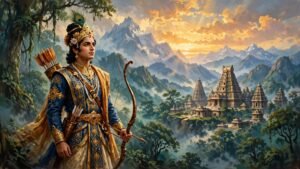
Of all the casting decisions in Nitesh Tiwari’s Ramayana, none has been watched more closely than Ranbir Kapoor as Lord Ram. The role is the centre of the two-part epic, and it is also one of the most demanding roles in Indian cinema: Rama is not a character an actor can simply invent, because audiences arrive with a lifetime of belief, and every gesture is measured against the Ram they already carry in their minds. Kapoor has spoken about that weight with unusual candour, describing his first reaction as fear, his preparation as nearly a year of study, and the part itself not as a role but as a responsibility.
This article looks at how Ranbir Kapoor became Lord Ram on screen: the physical transformation that took him from the bulked-up gangster of Animal to the lean, still prince of Ayodhya; the dual role he has confirmed, playing both Rama and the warrior-sage Parashurama; and what he has actually said about the part, in his own words, at the trailer launch and on television. It also covers what his co-stars saw on set, why the director chose him, and what his Rama means for Part 1 — and for the second film that follows.
Why This Role Is Different From Any Other
Ranbir Kapoor has played romantic leads, conmen, rock stars and gangsters, but Lord Ram is a different kind of assignment altogether. Rama is a figure of faith for hundreds of millions of people, and the audience does not judge the performance the way it judges an ordinary character. As Kapoor himself put it at the film’s trailer launch in Bengaluru, “Lord Rama is not just a character; he lives in the daily prayers and hearts of millions. You cannot just act this part; you have to surrender to his dignity, calm nature, and empathy.”
That is the central problem of the role, and Kapoor has never pretended otherwise. He has said openly that there was no room for him to reinvent the character, describing the experience as one with “no creative freedom” — not as a complaint, but as a statement of fact about playing a figure whose every quality is already fixed in the public imagination. The task was not to create a new Ram but to be worthy of the one people already believe in. In a behind-the-scenes film released by the makers, he put it plainly: “Every day I reminded myself that my job was not to be worthy of this role. My job was to be worthy of the faith that people place in this story.”
Director Nitesh Tiwari, known for Dangal and Chhichhore, has spoken about the same difficulty from the other side: finding the right actor for a story that carries immense faith and emotional significance for millions. In the same behind-the-scenes film, released on Kapoor’s 44th birthday, Tiwari and co-stars Sai Pallavi, Arun Govil and Ravi Dubey explain why Kapoor was chosen — and Kapoor himself describes approaching the character as far more than another acting job.
“My First Instinct Was Fear”
Kapoor’s most repeated line about the role is also the most honest. Appearing on Kaun Banega Crorepati with co-stars Sai Pallavi and Ravi Dubey to promote the film, he was asked by host Amitabh Bachchan about his first reaction to being offered the part. “When this role was offered to me, I knew that this isn’t just a role, it is a big responsibility,” he said. “My first instinct was fear, that if I am qualified enough to play this role? Whether I will be able to do this role? The faith of crores of people is linked to Lord Shri Ram. But very soon this fear turned into gratitude.”
He said the same thing at the trailer launch in Bengaluru, where the film’s second trailer was unveiled: “When Nitesh Tiwari sir and Namit Malhotra first approached me, there was excitement, but more than that, there was a quiet sense of fear and deep responsibility.” The consistency matters. Across different appearances, months apart, the message has not changed: excitement first, then fear, then gratitude.
The role also arrived at a particular moment in his life. Kapoor has said the offer came around the time he became a father, which made the experience more meaningful to him. “I felt gratitude that I got this opportunity at this stage in my life and a chance to become a better human,” he said on the television appearance. “It was during this time that I became a father and I believe that this film is a God’s gift that I got an opportunity to become a better human, to understand Ramayana deeply and to get the opportunity to work with these beautiful people.”
That framing — the role as something that changed him rather than something he performed — runs through everything he has said about the film. He has said it is not impossible to become like Lord Ram, but that learning something from him is a big deal for all of us. It is a striking way for a leading actor to talk about a career-defining part: not as a showcase, but as an education.
Rama’s Strength Is Restraint
Kapoor’s most revealing statement about how he actually played the part concerns what he chose not to do. “Rama’s strength lies in his restraint,” he said at the trailer launch. “Every look, every walk, and every word had to carry weight without showing anger. It needed shutting out the noise and finding complete calm within.”
In the behind-the-scenes film, he went further, naming what he sees as Rama’s defining quality. “Lord Rama’s biggest strength is not his bow, it is his Kshama — his ability to forgive,” he said. “Ye role nahi hai. It’s not that I’ve been offered a film and this role is exciting. Ye ek zimmedaari hai.” The word he keeps returning to is responsibility, and the quality he keeps returning to is calm: a hero whose power is expressed through control rather than display.
That choice shapes the whole performance. The Ram of the first posters and the trailer is still and watchful rather than loud, and the bow is a symbol rather than a prop for action. It is also a deliberate break from the kind of screen hero Kapoor played immediately before this film. In Animal, his character Ranvijay Singh was aggressive, volatile and violent — a performance built on exactly the qualities Rama is not supposed to have. The distance between the two roles is the point, and Kapoor has said that the story is so vast it could fill ten films, and that fitting it into two parts was very hard, especially for the writers.
The Physical Transformation: From Animal to Ayodhya
The most visible part of Kapoor’s preparation was physical. Coming straight from Animal, where he had bulked up significantly, he had to rebuild his body in the opposite direction: leaner, more defined, with the bearing of a prince and warrior rather than the mass of a gangster. His trainer Shivohaam has said in an interview that Kapoor gained 10 to 12 kilos for the role of Vijay in Animal, and that the Ramayana regimen called for something entirely different — agility, definition, and an elevated level of physical and spiritual embodiment.
The training itself was broad and demanding. His Korean fitness coach, Nam-Wook Kang, has shared glimpses of the sessions on Instagram, showing Kapoor working through advanced callisthenics while suspended in mid-air, explosive clap pull-ups, muscle-ups on Roman rings, kettlebell drills for full-body strength and grip, and battle ropes for cardiovascular power and upper-body endurance. Stability ball work built core strength and balance. Away from the gym, the regimen included outdoor runs on natural trails, hiking through hilly terrain for leg strength and mental resilience, and swimming for recovery, lung capacity and stamina.
The point of all of it was not a superhero physique. The programme was designed to produce a body that could carry the stillness the role demands — shoulders strong enough to hold the bow and the armour, a core steady enough for long takes in heavy costume, and the endurance to shoot demanding sequences through long days. Co-star Indira Krishnan, who plays Kausalya and worked with Kapoor in Animal, has described the change as “zameen aasmaan ka farq” — the difference between earth and sky. She has said he focused on building strength, especially in his shoulders, to match the character’s stature, and that the change showed most clearly in his expressions and in the way he carried emotion through his eyes.
Krishnan has also spoken about his discipline on set: arriving early, continuing his training even after wrap-up, and working closely with Tiwari and the crew, often insisting on retakes until both he and the director were satisfied with the shot. She recalled seeing him in a sandalwood ceremony scene, where his calm presence and composed posture reflected Lord Ram’s grace — the first time she had seen him in the avatar, and the moment the transformation became real to her.
Heavy Costumes, High Podiums and the Reality of the Shoot
The physical demands did not end with the gym. Filming involved heavy costumes and difficult conditions. Krishnan has described a blessing scene in which she, as Kausalya, wore a costume weighing about 12 kilos, while Kapoor wore heavy armour — a sequence that took half a day to coordinate. Another sequence was filmed at the Film City helipad, on a podium more than 50 feet high, in the June heat, where she held a baby mould above her head.
Those details matter because they explain what the transformation was for. Playing Ram was not only about looking the part in a poster. It was about standing still and composed in armour under hot lights, holding a posture of calm while wearing weight that would make most people fidget, and doing it take after take. Kapoor’s answer to the public criticism of his casting — which was loud when the announcement was first made — was to focus on his craft and his body language rather than respond in words, according to Krishnan. The work, in other words, was the reply.
Kapoor spent nearly a year studying and preparing for the roles before shooting began, according to reports of his own account. That preparation included learning about Indian mythology in depth, something he has said the film taught him a great deal about. The result, as the makers present it, is a performance built on study as much as on training: a Rama who knows the epic he belongs to.
The Dual Role: Ram and Parashurama
Beyond Rama himself, Kapoor has confirmed that he plays a dual role in the film, portraying both Lord Rama and Lord Parashurama. Parashurama is the sixth incarnation of Lord Vishnu, a warrior-sage whose encounter with Rama is one of the most dramatic moments in the early part of the epic: after Rama breaks the divine bow of Shiva at Sita’s swayamvara, Parashurama appears, furious, and the meeting between the two becomes a test of Rama’s identity and composure.
Kapoor has spoken about Parashurama as a deeply spiritual and complex character, and has said he is grateful for the opportunity to portray both roles — performances that demand not only physical transformation but a profound understanding of the characters’ emotional and spiritual depth. The film’s credits list Kapoor in the roles of Ram, Parashurama and Vishnu, underlining how central he is to the film’s telling of the epic. Playing three aspects of the same divine line — the prince, the warrior-sage and the god himself — makes Kapoor the axis on which the whole film turns.
The dual role also explains part of the physical challenge. Rama and Parashurama are not the same presence: one is calm and restrained, the other is fierce and uncompromising. Kapoor had to build a body and a bearing that could carry both, and then separate them clearly enough for an audience to feel the difference in a single scene. It is the kind of double performance that can define an actor’s career — or expose him. Kapoor’s preparation, by his own account and by his co-stars’ testimony, was built around exactly that risk.
What His Rama Means for Part 1
Part 1 follows Rama’s early life, his marriage to Sita, and the events that lead to the beginning of his exile — the arc in which the prince of Ayodhya becomes the exile of the forest. Kapoor’s Rama is the emotional centre of that arc, and the film’s promotion has leaned heavily on him: the first posters showed him with the bow, the trailer opens on his world, and the behind-the-scenes film released for his birthday is built around his journey to the role.
Shooting for Part 2 was already about half complete for his scenes before Part 1 was released, which shows how far ahead the two-part shoot was planned — and how much of Kapoor’s performance in the sequel was already in the can while audiences were still meeting his Rama for the first time. The second film, planned for Diwali 2027, covers the search for Sita and the war with Ravana, where Rama the warrior comes to the fore. The restraint Kapoor has talked about in Part 1 is the foundation for that: a hero who holds himself back until the moment he cannot.
For the full cast around him — Sai Pallavi as Sita, Yash as Ravana, Sunny Deol as Hanuman, Ravi Dubey as Lakshmana and Arun Govil as Dasharatha — see our complete Ramayana cast list. For the story of how the film came to be made and released, see our guide to Ramayana Part 1, and for the figures behind its scale, our budget explained.
Why Kapoor’s Ram Will Be Judged Differently
Most leading roles are judged on opening weekend. This one will be judged for years, against every Ram who came before it — on television, in theatre, in the epics people grew up hearing. Kapoor seems to know that. He has said there is no telling how the audience would react, because their expectations would be high regardless, and that the judgement is one of time and patience.
That is an unusually modest way for a star to talk about the biggest film of his career, and it may be the most accurate thing he has said about it. The transformation, the training, the dual role and the year of study are all visible in the finished film. What is not visible — and what will decide how the performance is remembered — is whether audiences feel that the actor surrendered to the character rather than the other way round. Kapoor’s own words suggest he tried. The film’s reception will tell whether he succeeded.
FAQs
Who plays Lord Ram in Ramayana?
Ranbir Kapoor plays Lord Ram in Nitesh Tiwari’s Ramayana. He has also confirmed a dual role as Lord Parashurama, and the film’s credits list him in the roles of Ram, Parashurama and Vishnu.
What did Ranbir Kapoor say about playing Lord Ram?
He said his first instinct was fear — that he wondered whether he was qualified for a role tied to the faith of crores of people — and that the fear soon turned into gratitude. He has repeatedly called the role a responsibility rather than just a part, saying, “This is not a role. It’s a responsibility.”
How did Ranbir Kapoor transform physically for Ramayana?
After gaining 10 to 12 kilos for Animal, he rebuilt his body to a leaner, more defined look for Ram. His training included callisthenics, clap pull-ups, Roman ring muscle-ups, kettlebells, battle ropes, stability ball work, outdoor running, hiking and swimming, under coaches including Shivohaam and Nam-Wook Kang.
Does Ranbir Kapoor play a dual role in Ramayana?
Yes. Kapoor has confirmed he plays both Lord Rama and Lord Parashurama, the warrior-sage who confronts Rama after he breaks Shiva’s bow at Sita’s swayamvara. The film’s credits also list him as Vishnu.
How long did Ranbir Kapoor prepare for the role?
He has said he spent nearly a year studying and preparing for the roles before shooting began, including learning a great deal about Indian mythology.
What did Ranbir Kapoor say is Rama’s biggest strength?
He said Rama’s biggest strength is not his bow but his Kshama — his ability to forgive — and that Rama’s strength lies in restraint: every look, walk and word had to carry weight without showing anger.
What did his co-stars say about his transformation?
Indira Krishnan, who plays Kausalya, described the change from Animal to Ramayana as “zameen aasmaan ka farq” — the difference between earth and sky — and praised his discipline, noting he arrived early on set and kept training after wrap-up, and insisted on retakes until he and the director were satisfied.
How much of Ranbir Kapoor’s Part 2 work is already shot?
Shooting for Part 2 was already about half complete for his scenes before Part 1 was released. Part 2, covering the search for Sita and the war with Ravana, is planned for Diwali 2027.
Who directed Ramayana?
Ramayana is directed by Nitesh Tiwari, known for Dangal and Chhichhore, from a screenplay he wrote with Shridhar Raghavan. It is produced by Namit Malhotra’s Prime Focus Studios with DNEG and Yash’s Monster Mind Creations.
Who else stars in Ramayana with Ranbir Kapoor?
Sai Pallavi plays Sita, Yash plays Ravana, Sunny Deol plays Hanuman, Ravi Dubey plays Lakshmana and Arun Govil plays Dasharatha. The full cast list is in our complete Ramayana cast guide.