
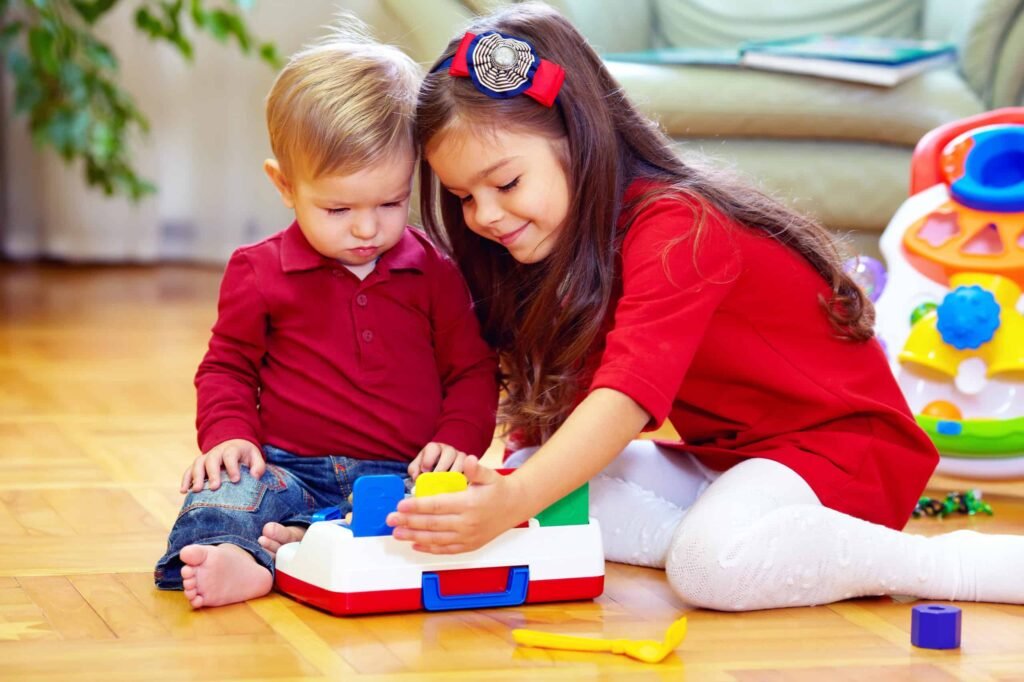
The shrieking starts in the other room, and you already know what it is before you arrive: both kids want the same toy, and neither one is backing down. Your instinct is to play judge, figure out who had it first, and hand down a verdict. But every parent who has tried that knows the verdict never ends the war. It just moves the resentment to the next round.
There is a better way. Learning how to stop siblings fighting over toys without taking sides does not mean letting chaos reign. It means stepping out of the judge’s seat and into the mediator’s chair, using scripts and systems that teach kids to solve the problem themselves. This guide gives you the exact words to say in the moment, the prevention strategies that reduce fights before they start, and the long game that builds genuine conflict resolution skills.
Why Playing Judge Backfires
When you investigate a toy dispute, you are asking questions with no reliable answers. Each child has a different story, both are emotional, and the “truth” about who touched it first is often genuinely unclear. The moment you rule in one child’s favor, the other learns a lesson you did not intend: that justice in this house depends on convincing Mom or Dad, not on fairness.
Worse, judges create repeat customers. If every dispute gets a parental ruling, children never practice solving anything themselves. They learn that escalating loudly enough summons an adult who will fix it. The sibling who “wins” feels vindicated; the one who “loses” feels the parent loves the other more. Over time, this pattern feeds the very rivalry you are trying to calm.
The mediator approach flips this. Instead of deciding who is right, you acknowledge both children’s feelings, state the problem neutrally, and hand the solving back to them. It feels slower at first. It pays off enormously over time.
The In-the-Moment Script
When you hear the fight, move close before you speak. Physical proximity calms children faster than shouted instructions from the kitchen. Then follow these steps in order:
Step 1: Stop unsafe behavior first
Safety comes before problem-solving. If there is hitting, grabbing, or throwing, intervene physically and calmly: “I won’t let you hit. I’m going to hold this toy while we sort this out.” Keep your voice low and steady. You are a calm wall, not another combatant.
Step 2: Describe what you see without blame
Narrate the situation neutrally: “You both want the fire truck. Maya was playing with it, and Jonah wants a turn.” Notice what is missing: no “who started it,” no “you should share,” no lectures. You are simply putting the problem on the table where everyone can see it.
Step 3: Reflect both feelings
Each child needs to feel heard before they can think clearly. “Maya, you weren’t finished and it feels unfair to stop. Jonah, waiting is really hard when you want something right now.” This is not agreeing with either side. It is acknowledging that both experiences are real, which lowers the emotional temperature enough for thinking to resume.
Step 4: Hand them the problem
Ask, don’t tell: “We have one truck and two kids who want it. What can we do?” Young children will stare blankly at first. That is normal. Offer two acceptable choices: “Maya can finish her turn and then Jonah gets it, or we can set a timer for three more minutes. Which works?” Either answer is a child-made solution, which means they are far more likely to accept it.
Step 5: Support the waiting child
The child who waits needs a job, not a lecture about patience. “While you wait, you can build the road the truck will drive on, or pick a song for truck-driving music.” Giving the waiting child something active to do transforms waiting from punishment into participation.
Turn-Taking Systems That End the Argument Before It Starts
Scripts handle the crisis. Systems prevent the next one. Pick one or two of these and use them consistently:
- The visible timer. A kitchen timer or phone timer makes turns concrete and impersonal. “Three minutes each” is a rule, not a parent picking favorites. Let the waiting child be the one to start the timer; it gives them control over the process.
- The “in use” rule. Establish a family rule that a toy in use stays in use until the child is done, and then it is the other child’s turn. This single rule resolves most disputes because it removes the question of who deserves it right now.
- First-then boards for toddlers. A simple picture card showing “Maya’s turn, then Jonah’s turn” gives pre-readers something concrete to check. Toddlers argue less when the order is visible.
- Duplicate the hot toys. If one specific toy causes daily warfare, buying a second one is not spoiling the children. It is strategic conflict reduction. Some battles are not worth fighting on principle.
- Toy rotation. Keep half the toys stored away and swap them every week or two. Fewer toys in circulation means fewer contested toys, and “new” old toys distract from the usual flashpoints.
Prevention: Redesign the Environment
Many toy fights are really about the setup, not the children. A few environmental tweaks reduce friction dramatically:
- Create enough play space. Children crowded into one corner fight more. Spread activities across rooms when possible.
- Offer engaging solo options. When the coveted toy is taken, the other child needs something genuinely interesting to do, not a consolation prize. Stock a “waiting basket” with special toys that only appear during turn-taking.
- Watch for trigger times. Fights spike when kids are hungry, tired, or transitioning between activities. A snack before playtime and warnings before transitions (“ten minutes until we switch activities”) prevent a surprising number of blowups.
- Give each child a “just mine” toy. It is healthy for each child to have one special toy that does not have to be shared. Everything else belongs to the family. This respects their need for ownership while keeping the shared pool fair.
What Not to Do
- Do not force apologies. A coerced “sorry” teaches children that feelings can be faked on command. If one child genuinely hurt the other, guide them toward making amends in their own way, like offering a turn or helping rebuild what was knocked over.
- Do not always make the older child give in. “You’re bigger, you should know better” is the most common unfairness in family conflict. It teaches the older child that their needs matter less and teaches the younger one that age equals entitlement.
- Do not take the toy away as punishment for both. Confiscating the toy until they “learn to share” punishes the child who was playing peacefully and teaches nothing about turn-taking. Hold it briefly to pause the conflict, then restart with a turn plan.
- Do not label the children. “The bully,” “the victim,” “the difficult one”: labels stick and become self-fulfilling. Describe behaviors, not identities.
- Do not solve it from another room. Shouted verdicts (“Just share!”) escalate everything. Walk over. Proximity is half the intervention.
Teaching Long-Term Conflict Skills
The daily toy skirmishes are actually practice sessions for life skills, if you treat them that way. Narrate the skills as children use them: “You two figured out a turn system all by yourselves. That is real problem-solving.” Praise the process, not just the peaceful outcome.
Hold brief family meetings, even with young kids, to solve recurring problems together. “The blocks keep causing fights. What should our block rule be?” Children follow rules they helped create far more willingly than rules imposed on them. And when they do work it out alone, even imperfectly, resist the urge to improve on their solution. A child-negotiated deal that holds is worth more than a parent-perfected one that breeds resentment.
Model the behavior yourself. Children watch how the adults in the house handle competing wants. When parents negotiate calmly about the car, the remote, or the last slice of pizza, kids absorb the template.
When Fighting Is More Than Normal Rivalry
Most sibling conflict is developmental and harmless. Step in more firmly, and consider professional guidance, if you see these patterns:
- One child is consistently the aggressor and the other is consistently frightened.
- Fights regularly involve injury or destruction of property.
- A child changes behavior: withdrawing, sleep problems, or dread about being home.
- The conflict is cruel rather than impulsive, involving taunting or deliberate humiliation.
Normal rivalry is mutual, impulsive, and forgotten quickly. A persistent power imbalance is something else, and it deserves support beyond scripts and timers.
Frequently Asked Questions
Should I make my kids share everything?
No. Forced sharing of everything breeds resentment. The “in use” rule plus turn-taking teaches the actual skill, which is waiting and negotiating, not surrendering on command. Let each child keep one special toy that is theirs alone.
What if I did not see who had the toy first?
Do not guess. Say so honestly: “I didn’t see, so I’m not going to decide that. Let’s figure out the turns from here.” Guessing wrong teaches children that outcomes are arbitrary, which fuels more fighting, not less.
How do I handle toy fights between very different ages?
Adjust expectations, not fairness. A toddler cannot wait as long as a seven-year-old, so use shorter turns for the little one and longer independent activities for the older child. “Fair” means each child gets what they need, not identical treatment.
My kids fight the moment I leave the room. What helps?
They may be performing for an audience, even unconsciously. Stay nearby but uninvolved during play for a while, intervening only for safety. When children realize no referee is coming, many disputes resolve themselves faster than you would expect.
Is it okay to let them work it out without me?
Yes, when it is safe. Minor squabbles that resolve without tears or aggression are exactly how children learn negotiation. Intervene for safety, for cruelty, or when they are stuck in an escalating loop. Otherwise, observe from a distance and praise the resolution afterward.
How long before the mediator approach starts working?
Expect two to four weeks of consistent use before children internalize the pattern. The first week often feels worse because you are no longer delivering the quick verdicts they were used to. Stay consistent. Once they learn that calm problem-solving is the only path forward, the frequency and intensity of fights typically drop noticeably.
You will not end sibling rivalry, and you should not try. Your job is to turn it from a daily war into a training ground for skills they will use forever. For more parenting strategies, see our guides on how to get your kid off a tablet without a tantrum, how to get a teenager to do chores without nagging, and how to stop a toddler from hitting other kids at daycare.













1 thought on “How to Stop Siblings Fighting Over Toys (No Sides Taken)”
Comments are closed.