The BJP’s youth machinery made its presence felt in one of Arunachal Pradesh’s younger districts — and it came with a clear message: organise, connect, and grow.
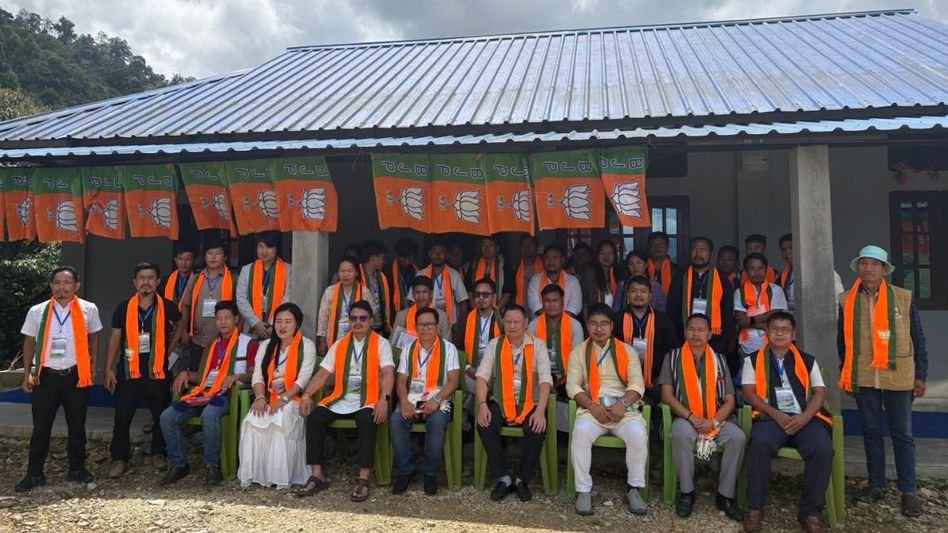
The Bharatiya Janata Yuva Morcha (BJYM) Pakke-Kessang district unit held a one-day ‘Samvaad & Samanvay Baithak’ — a dialogue and coordination meeting — on September 4 in Pakke-Kessang. The gathering was not just another party programme. It felt, by every account, like a deliberate attempt to stitch together a stronger youth network ahead of the political road that lies ahead for the BJP in this part of the state.
The event drew a notable turnout of leadership. Arunachal Pradesh minister Biyuram Wahge was present, lending the programme its political weight. So was BJYM Arunachal Pradesh state president Tame Siyang Tarh, who brought the energy of the state-level organisation directly to the district floor. BJP district president Naya Tana and district-level BJYM functionaries rounded out the gathering — making it a meeting that bridged both senior leadership and ground-level workers in the same room.
That mix of old hands and fresh faces was no accident. Newly joined BJYM workers were specifically given space to participate, interact, and get up close with senior leaders. For many of them, it was probably the first time sitting across from party brass and speaking candidly. That access, in itself, says something about the intent behind the programme.
The agenda was focused and straightforward. Strengthening the organisation at the grassroots, improving coordination among party workers, and expanding youth participation in organisational activities were the three pillars the meeting stood on. No grand policy announcements, no fanfare — just an internal sharpening of tools.
Pakke-Kessang, carved out as a separate district relatively recently, is still finding its feet institutionally. The BJYM clearly sees that as an opportunity. A district still building its systems is also a district where an organised youth wing can plant roots deep and early. The timing of this baithak is hard to read as anything other than strategic.
There’s something worth noting about the name of the programme too — ‘Samvaad & Samanvay’, meaning dialogue and coordination. In a political climate where youth bodies can sometimes become top-down vehicles, this framing at least signals a preference for conversation over command. Whether that translates into practice is something only time and the workers on the ground will be able to answer.
What is clear is that the BJYM is not leaving Pakke-Kessang to figure things out on its own. The state team showed up, the minister showed up, and so did the freshest faces in the organisation.
In politics, showing up is half the battle. The other half is what you build once you’re there — and that work, it seems, has just begun.