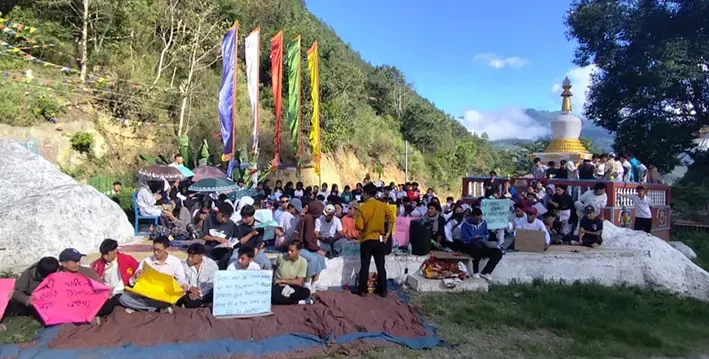
Students at the Central Institute of Himalayan Culture Studies aren’t just protesting. They’re starving themselves — for what they believe is the survival of an irreplaceable cultural mission.
Students of the Central Institute of Himalayan Culture Studies (CIHCS) in Dahung, West Kameng district, launched an indefinite hunger strike on Monday, September 1, demanding the immediate resignation of Director Dr Gurmet Dorjey and the institute’s account and administrative officer. It’s a dramatic escalation — but the students say years of patience have brought them here.
At the heart of this protest is a question that cuts much deeper than any personnel matter: what is the CIHCS actually for?
The institute was founded on the vision of the late 13th Tsona Gontse Rinpoche, who dreamed of a place where young people could pursue serious study in Himalayan culture, Buddhist philosophy, and indigenous languages — while also having access to modern education. It was meant to be a sanctuary for something fragile and precious. Students say that vision is now being quietly buried.
“From the earlier stages of education, including Classes 9 and 10, greater emphasis is being placed on modern subjects, while adequate focus on cultural studies is, in our view, not being maintained,” the students said. That is a painful thing to witness in an institution created specifically to do the opposite.
This isn’t just a curriculum squabble. The students are raising something far bigger — the fear that an institution built to preserve a living culture is slowly walking away from that purpose. And they are not new to this fight. Similar concerns erupted during a student protest in September 2022, when assurances were given. Several of those assurances, students say, remain unfulfilled to this day. Broken promises stop looking like accidents after a while.
Hostel conditions, library resources, basic academic infrastructure — all remain unresolved to their satisfaction. The students are also careful to clarify they are not making personal allegations against individuals, but are demanding institutional accountability.
Director Dr Dorjey, for his part, pushed back firmly. He said genuine concerns have been addressed within the bounds of institutional rules and government norms. He pointed to a high-level meeting on August 31, chaired by the Secretary of the Ministry of Culture, Government of India, where multiple resolution options were placed before student representatives. The students rejected every single one.
“Constructive dialogue, due process and a fact-based approach are far more conducive to safeguarding the interests of the students and the institute than insisting upon the resignation of functionaries,” Dr Dorjey said.
He also highlighted what he sees as a real record of institutional growth — noting the institute had almost no physical presence, not even land in its own name, when he joined. The transformation since, he insists, is visible to anyone who walks the campus.
The students aren’t disputing development on paper. What they’re disputing is the spirit of the place.
“Our objective is not to remove individuals simply for the sake of removing them,” the students’ union stated plainly. They want leadership that actively champions Himalayan cultural studies, maintains a balanced curriculum, improves facilities, and operates with genuine transparency. They want the founding vision lived — not just recited at formal occasions.
Whether a hunger strike is the right instrument for institutional reform is a fair question to ask. But when students are willing to stop eating to save their institution’s identity, something has clearly gone very wrong — and it deserves a great deal more than another meeting.