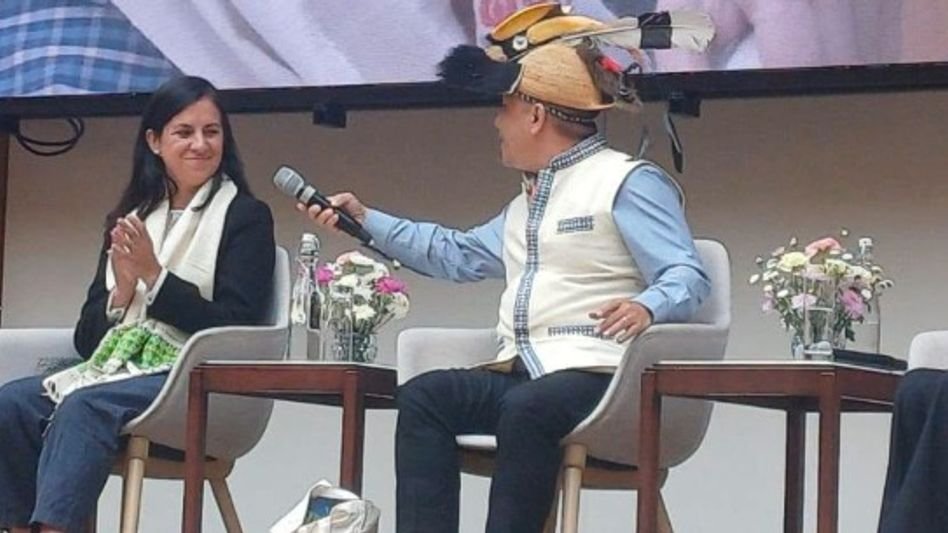
When an MLA from a small hill district in Arunachal Pradesh walks into a global summit alongside leaders from 65 countries, you take notice. That’s exactly what happened in Paro, Bhutan on September 1, when Yachuli legislator Toko Tatung stood before the inaugural plenary of the Global Conscious Food Systems Summit 2026 — and made the case that Keyi Panyor deserves to chart its own path.
Tatung became the first lawmaker from Arunachal Pradesh to participate in the international summit, jointly hosted by the Royal Government of Bhutan, the Conscious Food Systems Alliance (CoFSA), and the United Nations Development Programme (UNDP). Policymakers, scientists, and indigenous representatives from across the world were in the room. And Tatung came prepared — not with vague political promises, but with a concrete blueprint.
He presented the Keyi Panyor Mission Plan 2040, a long-term development framework that his district quietly launched on Independence Day, August 15, 2026. The plan is deliberate about one thing: it refuses to be boxed into the usual five-year electoral cycle thinking. No short-term vote-bank schemes. No borrowed city models. Just a rolling, 14-year vision for what Keyi Panyor can genuinely become.
Speaking on a panel called “Rising to the Moment: Igniting Consciousness to Address the Polycrisis,” Tatung made a pitch that was refreshingly honest. He argued that sustainable development cannot happen without bringing together farmers, scientists, and local communities — that traditional ecological knowledge and modern science need each other, not a hierarchy between them.
One of the headline announcements? Keyi Panyor is being developed as India’s first “Bio-Happy District,” in collaboration with the MS Swaminathan Research Foundation. The idea is to link biodiversity conservation directly to human well-being and rural livelihoods. It’s not just about protecting trees and rivers in the abstract — it’s about making sure the people living among them actually benefit. That framing matters.
Tatung also pointed to the Comprehensive Action Plan for Education, and an ongoing partnership with the Participatory Action Research Coalition of India to push agroecology and natural farming across the district. These aren’t vanity projects. They’re ground-level interventions that take years to show results — exactly the kind of work that rarely gets a photo op but shapes communities for decades.
But it was one line from his address that cut through everything else. Speaking to an audience of global decision-makers, Tatung said plainly: “I do not want Keyi Panyor to become a smaller copy of Delhi or Singapore. I want Keyi Panyor to become the best possible Keyi Panyor.”
That’s not just a quotable line. It’s a stance. At a time when development is often measured in concrete and connectivity, there’s something quietly radical about a politician standing in an international forum and saying — we’re not copying anyone. We’re figuring out who we are, and building from there.
Keyi Panyor is one of Arunachal’s newer districts, still finding its footing. Whether KPMP 2040 translates from vision to reality will depend on sustained political will, community ownership, and the kind of institutional follow-through that outlasts election seasons. That’s the harder part. But the fact that this conversation is happening — at a global summit, with a 14-year framework, rooted in indigenous knowledge — suggests Keyi Panyor may be onto something the rest of the Northeast ought to pay attention to.