
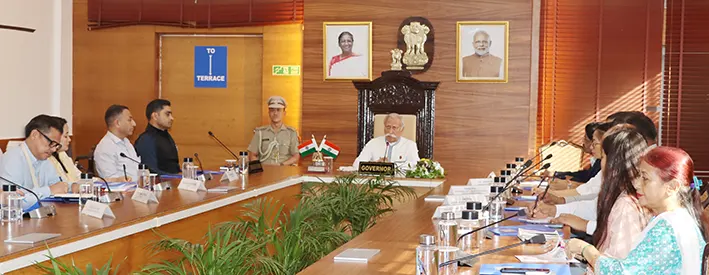
Drugs don’t just destroy a person — they destroy an entire family. That stark message rang loud and clear from Arunachal Pradesh’s Governor KT Parnaik on Wednesday as he issued an urgent call to arms against the growing menace of substance abuse among the state’s youth.
A Virtual Gathering with Real Stakes
Speaking at a virtual conference on ‘Nasha Mukt Yuva for Viksit Bharat’ organised by Lok Bhavan in collaboration with the National Informatics Centre, Governor Parnaik brought together a cross-section of people who rarely sit in the same room — vice-chancellors of government and private universities, senior officers from Health, Education, Sports, Social Justice and Tribal Affairs departments, deputy commissioners, superintendents of police, and Red Cross volunteers. The message he delivered to all of them was the same: this is not someone else’s problem. It belongs to everyone. “When drugs take control of the mind, one loses control over life itself,” he said. Simple words. But they hit differently when you think about how many families across the Northeast have lived that reality.
Not Just About Saying No to Drugs
Governor Parnaik was careful to reframe the entire conversation. A Nasha Mukt Bharat, he argued, is not simply about the absence of narcotics — it’s about building something positive in their place. Healthy choices. Informed decisions. Supportive families. Resilient communities. He stressed that substance abuse isn’t just a health crisis; it bleeds into education, productivity, and ultimately, the nation’s development. That’s a broader lens than what most drug-awareness campaigns tend to offer, and honestly, it’s the right one.
Five Ideas That Could Actually Work
Rather than stopping at speeches, Parnaik put forward a concrete set of proposals. He called for anti-drug cells and counselling mechanisms inside every university, district-level anti-drug task forces equipped with early warning systems, and a dedicated push to use sports and youth engagement as a grassroots counter-movement. He also advocated for stronger community-based rehabilitation networks and — perhaps most notably — a ‘Nasha Mukt Tribal Youth Movement’ driven through local languages and village-level volunteers. That last one matters deeply in Arunachal, where geography and linguistic diversity can make top-down campaigns completely ineffective.
A Duty Call to Future Healthcare Professionals
The Governor turned directly to students — future doctors, nurses, pharmacists, psychologists, and public health workers — urging them to step up as ambassadors of awareness. He also called for greater research in addiction medicine and behavioural sciences, insisting that evidence must drive policy rather than assumptions. His vision: every campus a centre of awareness, every district a hub of prevention, every village a fortress against addiction.
The road to a drug-free Arunachal — and a drug-free India by 2047 — won’t be built by one conference or one governor’s speech. But moments like these, when the right people are in the same virtual room talking with the same urgency, are exactly where change begins to take shape.
HASHTAGS
#NashaMuktYuva #KTParnaik #ArunachalPradesh #DrugFreeIndia #ViksitBharat #YouthEmpowerment #SubstanceAbuse #AntiDrugCampaign #NashaMuktBharat #ArunachalNews #DrugFreeCampus #TribalYouth #NortheastIndia #DrugPrevention #AbotaniTV #JanAndolan #YouthAwareness #CommunityHealth #DrugRehabilitation #HealthyIndia