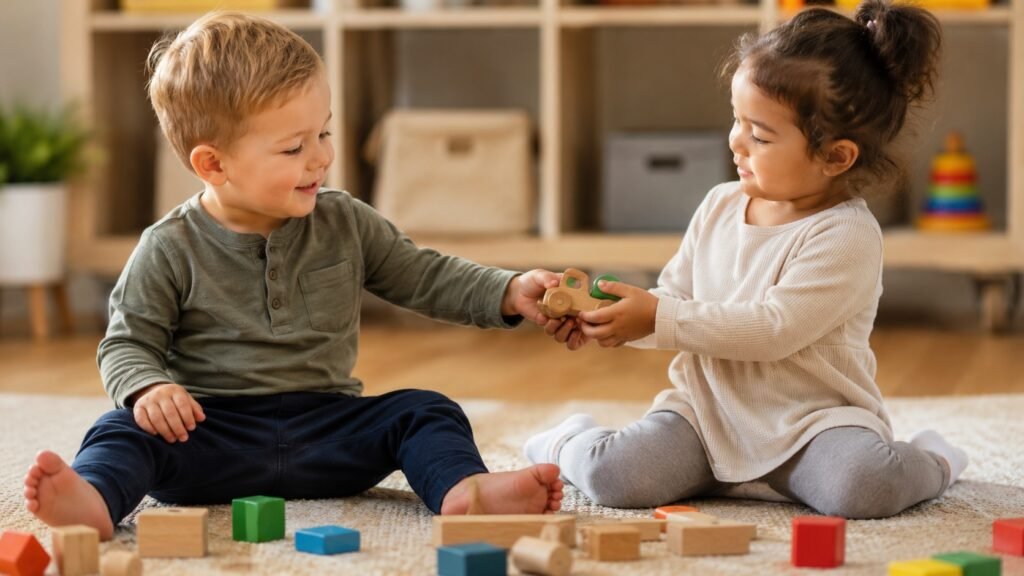
Learning how to teach a toddler to share without forcing it is one of the most common challenges parents face. When your two-year-old clutches a toy and shouts “mine,” it can feel like a failure of manners, but it is actually a normal stage of development. Toddlers are not being selfish — they are still learning that other people have feelings and wants separate from their own. The good news is that sharing is a skill, and like any skill, it can be taught gently and patiently, without power struggles. This guide walks you through practical strategies that help your toddler learn to share willingly.
Why Toddlers Struggle With Sharing
Before you can teach sharing, it helps to understand what is happening in your toddler’s mind. Children under the age of three or four are naturally egocentric, not in a selfish way, but in a developmental way. They genuinely believe the world revolves around their experience. The idea that a friend might feel sad when a toy is taken is abstract and hard to grasp. On top of that, toddlers are working on a sense of ownership and control. Their toys, their snack, their spot on the couch — these things feel like extensions of themselves. When another child reaches for them, it can feel threatening.
Sharing also requires several skills that are still developing: impulse control, the ability to wait, language to express feelings, and the capacity to imagine another person’s perspective. A toddler who grabs a toy back is not being rude — they are using the only tools they have. You are not fixing bad behavior. You are building a skill, one small interaction at a time.
Stop Forcing It — And Why That Works Better
Many parents were raised with the rule that a child must hand over a toy the moment another child asks. The intention is good, but forced sharing usually backfires. When a child is made to give up a toy before they are ready, they learn that sharing means losing something they love, and that adults cannot be trusted to protect their things. The result is often more clinging, more grabbing, and more tears the next time.
Forced sharing also teaches the wrong lesson to the other child: crying or demanding loudly enough gets them what they want. Neither child learns empathy. A better approach is to protect each child’s turn and teach waiting, the real foundation of sharing. When children trust that their turn will come and their belongings will be respected, they become far more willing to offer things freely.
That does not mean you do nothing when your toddler refuses to share. It means you guide instead of commanding. You can say, “You are still playing with the truck. When you are done, your friend can have a turn.” This names what is happening, reassures your child that their play matters, and sets a clear expectation for the other child.
Teach Turn-Taking Before Sharing
Turn-taking is the building block of sharing, and it is much easier for a toddler to understand. Sharing often feels like giving something away forever. Taking turns feels fair and predictable. Start with games and routines that make turns fun and visible.
Use a Timer They Can See
A sand timer or a simple kitchen timer works wonderfully with toddlers because it turns waiting into something they can watch. Say, “When the sand runs out, it is Sam’s turn with the ball.” The timer becomes the neutral authority instead of you, which reduces arguments. Keep turns short at first, around one or two minutes.
Play Games Built Around Turns
Rolling a ball back and forth, taking turns dropping blocks into a bucket, or stirring a bowl together during cooking all teach the rhythm of “my turn, your turn” in a low-stakes way. When your child waits happily in a game, name it: “You waited for your turn. That was kind.” Specific praise like this sticks far better than a general “good sharing.”
Model the Behavior You Want to See
Toddlers are expert copycats. If they see you sharing food at the table, offering your phone to show a photo, or lending a neighbor a tool, they absorb the idea that sharing is simply what people do. Narrate your sharing in simple words so the lesson is visible. “I am sharing my crackers with Dad because sharing makes lunch more fun.” It sounds simple, and it is — but that simplicity is exactly what a toddler needs.
Modeling also means how you handle your own belongings. If you snatch a toy away from your child to give it to another child, you have just modeled grabbing. If you ask calmly and accept their answer, you model respect. Your behavior in these small moments teaches more than any lesson about manners ever could.
Give Your Toddler Choices, Not Commands
Choices give toddlers a sense of control, and a child who feels in control is more willing to cooperate. Instead of saying “Share your toys,” try offering a real choice. “Would you like to let Mia play with the doll, or would you like to offer her the blocks?” Either answer involves sharing, but your child gets to decide how. You can also let them choose which toys are for sharing before a playdate. Put special comfort toys or brand-new favorites aside, and set out plenty of shareable toys. This prevents most conflicts before they start.
Another useful choice is about timing: “You can finish building your tower, and then it is Leo’s turn with the blocks.” This respects your child’s current play while making the next step clear.
Use Stories, Play, and Pretend to Build Empathy
Empathy is the engine behind genuine sharing. A child who can imagine how a friend feels is far more likely to offer a toy without being asked. You can build empathy through stories and play long before your child can explain the concept itself.
Read Books About Sharing
Picture books that show characters sharing, waiting, and feeling happy about it give your child a mental picture of what sharing looks like. After reading, talk about the story in simple terms. “How do you think the bear felt when his friend shared the honey?” You do not need a long discussion. One gentle question plants the seed.
Use Dolls and Stuffed Animals
Pretend play is a powerful teaching tool. Set up a small scene with two stuffed animals where one wants a toy the other has. Act out both sides, including the feelings. “Bear is sad because he wants a turn. Bunny says, ‘You can have it when I am done.'” Your child watches the whole exchange and learns the words they can use in real life. You can even let your child be the one to solve the problem in the game, which builds confidence for real playdates.
Name Feelings Out Loud
When your toddler is upset about sharing, name the feeling before you fix the problem. “You feel mad because you wanted the car.” Feeling understood calms a child faster than any instruction. Once they are calm, you can guide them: “It is hard to wait. Your friend feels sad too. What could we do?” Even if they cannot answer yet, the question teaches them that feelings on both sides matter.
Set Up Playdates for Sharing Success
Many sharing battles are really environment problems, not behavior problems. A few simple changes can prevent most conflicts.
- Have duplicates of popular toys. Two toddlers and one coveted truck is a recipe for tears. Two trucks, or at least a similar alternative, removes the pressure.
- Limit the number of toys out. A room full of toys is overwhelming. A small selection makes sharing easier and cleanup simpler.
- Keep playdates short. An hour of focused play is plenty for most toddlers. Tired and hungry children share far less willingly than rested ones.
- Stay close and coach early. Watch for the early signs of a struggle — hovering, tense hands, a rising voice — and step in before it becomes a grab. A calm “Looks like you both want the puzzle. Let’s take turns” works best before the tears start.
- Let your child put away special toys first. Before a friend arrives, ask your toddler which toys they want to keep private. Respecting that choice teaches them that their boundaries matter, which makes them more generous with everything else.
What to Say When Your Toddler Refuses to Share
Even with the best preparation, there will be moments when your toddler plants their feet and says no. What you say in that moment matters. Avoid shaming language like “You are being selfish” or “Don’t be greedy.” Labels stick, and a child who hears them often starts to believe them. Instead, stay calm, acknowledge the feeling, and hold the boundary.
Try scripts like these:
- “You are not ready to share the train yet. That is okay. We can wait.”
- “Your friend is waiting. When you are done, it will be her turn.”
- “It is hard to share something you love. I understand.”
- “Let’s find another toy for your friend while you finish.”
If the situation escalates into hitting or grabbing, step in firmly and kindly. Separate the children gently, comfort the upset child, and restate the rule simply: “We do not grab. We ask for a turn.” Keep your tone steady — your calm is contagious, even when it does not feel like it.
If the other parent is watching, it can feel awkward to let your child keep a toy. Resist the urge to force a handover to save face. A brief, friendly explanation works well: “We are working on taking turns. He will share when he is done.” Most parents understand, because they have been there too.
Mistakes to Avoid When Teaching Sharing
A few common habits can quietly undo your progress. The first is praising only the act of handing something over — if you make a big fuss every time your child shares, sharing becomes a performance for applause rather than a habit. Notice it warmly, then move on. The second is comparing your child to other children. “Look, Emma shares so nicely” makes your child feel judged and less willing to cooperate. The third is expecting too much too soon. A two-year-old who shares occasionally is doing wonderfully.
It also helps to remember that the goal is not a child who gives away everything on demand. The goal is a child who understands fairness, can wait for a turn, and sometimes chooses to be generous because it feels good. That is a much richer skill, and it lasts far longer than forced politeness.
Everyday Moments That Teach Sharing Naturally
You do not need special lessons. Daily life is full of sharing practice: sharing snacks at the table, taking turns choosing a bedtime story, or passing dishes at dinner. Meal times are especially useful, because food is concrete and the turn comes quickly. Offer a choice: “Would you like to share your apple slices with me, or keep them for yourself?” Either answer is fine. The point is that sharing is a choice, not a demand.
Outings offer practice too. At the playground, encourage your child to let another child have a turn on the swing after a count of ten. At the library, talk about how books are shared by the whole community. These small, real moments build the habit far more effectively than a lecture about being nice. For more ideas on handling everyday toddler challenges, see our guide on how to get a toddler to eat vegetables without a fight, which uses the same patient, choice-based approach at the dinner table. And if you are planning a family outing, our tips on how to plan a road trip with kids without screens include plenty of turn-taking games that work just as well at home.
When to Worry — and When Not To
Most toddlers who resist sharing are developing exactly as they should. Sharing improves steadily between ages three and five as language, empathy, and impulse control mature. However, if your child is older than four and consistently cannot take turns, frequently hits or bites over toys, or seems unable to notice other people’s feelings at all, it is worth mentioning to your pediatrician. Every child develops at a different pace, and a professional can help you tell the difference between a normal stage and something that needs extra support.
In the meantime, keep your expectations realistic and your tone warm. Celebrate the small wins: the time your child handed over a crayon without being asked, the time they waited patiently for a swing, the time they offered a snack to a sibling. Those moments are the real evidence that your gentle approach is working.
Frequently Asked Questions
At what age do toddlers start sharing?
Most children begin to share occasionally around age two, and sharing becomes more consistent between ages three and five as empathy, language, and impulse control develop. Occasional sharing at age two is a great sign, and reluctance before that is completely normal.
Should I make my toddler share when another child asks?
Forcing a handover usually backfires and teaches your child that sharing means losing something they love. A better approach is to protect their turn, set a clear time limit, and let the other child know their turn is coming. This builds trust and makes willing sharing more likely over time.
How can I teach my toddler to share with siblings?
Use the same turn-taking approach at home: short, visible turns with a timer, duplicate toys where possible, and specific praise when your child waits or offers something. Let each child keep a few special toys private, and practice sharing through games and pretend play before expecting it in heated moments.
What if my toddler grabs toys from other children?
Stay calm and step in early. Gently stop the grabbing, name the feeling, and restate the rule: “We do not grab. We ask for a turn.” Then help your child wait or offer an alternative toy. Repeated, calm guidance works better than scolding, and the behavior usually fades as impulse control grows.
Is it okay for my toddler to have toys they do not have to share?
Yes, and it is actually helpful. Letting your child keep a few special comfort toys private before a playdate teaches them that their boundaries are respected, which makes them more generous with everything else. Sharing should be a choice, not a rule that applies to every single possession.
How long does it take for a toddler to learn to share?
Sharing is a gradual skill, not a single lesson. Most children make steady progress over months and years, with plenty of good days and setbacks along the way. Consistent, gentle coaching and lots of practice with turn-taking will get you much further than pressure or punishment.