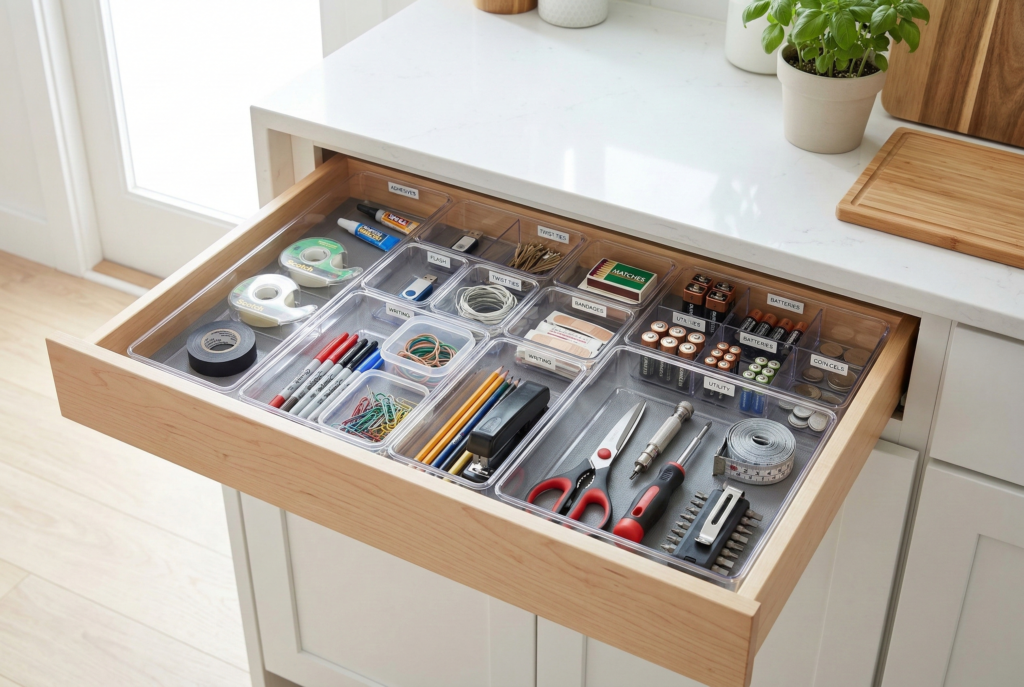
Every home has one: the junk drawer. That mysterious kitchen, hallway, or office drawer where dead batteries, takeout menus, mystery keys, and rubber bands go to live forever. If yours has gotten out of hand, here is how to declutter a junk drawer in 30 minutes and set up a system simple enough that it actually stays organized.
This is not a whole-house decluttering project. It is one drawer, one timer, one clear win. Thirty minutes is enough because a junk drawer is a contained space with a finite number of items — and because you will be making fast decisions instead of pondering every paperclip.
Before you start, set a timer for 30 minutes. The timer matters. It keeps you from wandering into other rooms or suddenly deciding to alphabetize your spice cabinet. Your only job until the timer rings is this one drawer.
What You Need Before You Start
Gather these supplies so you do not lose time mid-project hunting for a trash bag:
- A large trash bag or trash can nearby
- A recycling bin or bag
- A box or bag labeled “relocate” — for things that belong elsewhere in the house
- A small bowl for batteries, screws, and other tiny loose items
- Damp cloth or paper towels and an all-purpose cleaner
- Any small containers, drawer dividers, or ice cube trays you already own
Do not go buy organizing products first. The most common reason junk drawer cleanouts fail is that people start by shopping for containers instead of dealing with the contents. Declutter first, contain later — with what you already have, if possible.
Step 1: Empty the Drawer Completely (5 Minutes)
Pull the drawer out as far as it goes and take everything out. Every single item goes onto the counter or table next to you. Do not sort yet — just empty it.
Once it is empty, wipe down the inside of the drawer with a damp cloth. Crumbs, sticky spots, and mystery residue accumulate in junk drawers more than anywhere else. If there is drawer liner that is torn or sticky, pull it out and replace it later or leave the drawer bare — a clean bare drawer beats a dirty lined one.
Step 2: Trash the Obvious Junk (5 Minutes)
Now go through the pile and throw away the obvious garbage. Be ruthless and fast — do not open things, read things, or “save it just in case.” The following can go straight into the trash:
- Expired coupons, old receipts, and expired insurance cards
- Takeout menus from restaurants you never order from (menus are online now)
- Dead pens — test them quickly on scrap paper, toss the dry ones
- Dried-out markers, highlighters, and glue sticks
- Old rubber bands, which lose their stretch and crumble
- Single-use condiment packets older than a few months
- Random screws and hardware you cannot identify
- Chargers and cables for devices you no longer own
- Stretched-out hair ties, single socks, and broken clips
If you are hesitating on an item, ask one question: “Have I used this in the past year?” If the answer is no and it is easily replaceable, let it go. The whole point of a junk drawer is quick access to genuinely useful things — every useless item in it makes the useful ones harder to find.
Step 3: Sort What Is Left Into Categories (7 Minutes)
Whatever survives the purge gets grouped into categories. Do not overthink the categories; most junk drawers settle into four or five groups:
- Writing tools: pens, pencils, markers, sticky notes, scissors
- Fix-it supplies: tape, super glue, screwdriver, batteries, flashlight
- Small essentials: keys, coin pouch, stamps, spare earbuds
- Paper goods: notepad, envelopes, current coupons
- Relocate: anything that clearly belongs in another room
The “relocate” pile is important. A junk drawer becomes a junk drawer precisely because items that belong elsewhere get dumped into it. Sunscreen belongs in the bathroom, the dog leash by the door, the board game pieces in the game box. Drop relocate items in your relocate bag and put them away after the drawer is done — do not take a trip to the garage in the middle of the 30 minutes or you will never come back.
Step 4: Set Up Simple Zones (8 Minutes)
Here is where the drawer stops being a junk drawer and becomes a useful drawer. You are going to divide it into zones so items land in the same place every time.
You do not need expensive bamboo organizers. Cheap, effective dividers include:
- A cutlery tray from the dollar store
- Ice cube trays for tiny items like batteries, screws, and safety pins
- Small gift boxes or check boxes
- Muffin tins (surprisingly sturdy in a deep drawer)
- Rolled washcloths as flexible dividers
Place the dividers in the drawer first, then assign each zone a category from Step 3. Put the most-used items toward the front. If you grab scissors and tape daily, they live in the front sections; batteries and the spare key sit toward the back.
Keep it loose. A junk drawer should hold maybe 15 to 25 items total. If a category needs more than one section, that is fine — but if you find yourself needing twelve compartments, you are storing too much.
Step 5: Return Items and Make the Rules (5 Minutes)
Put the sorted items back into their zones. Now make two quick decisions that keep the drawer from reverting:
The one-in, one-out rule. When something new wants to live in the drawer, something old leaves. New pen? An old pen goes. This single habit prevents the drawer from refilling over the coming months.
The 30-second reset. Once a week — pick a moment like when the coffee is brewing — spend 30 seconds putting drawer items back in their zones and tossing any obvious trash. A drawer that gets a weekly 30-second reset never needs another 30-minute overhaul.
Take your relocate bag and put everything away now. Set a calendar reminder for next week if you think you will forget the reset. Done — check the timer.
Mistakes That Send the Junk Drawer Back to Chaos
Most junk drawers re-clutter within weeks because of a few predictable mistakes. Watch for these:
Treating it as storage instead of a tool station
A junk drawer should hold only items you grab often: scissors, tape, a pen, batteries. Long-term storage items — the instruction manual for the microwave, a bag of assorted cables — belong somewhere else. If you have not touched an item in months, it is not a “quick grab” item.
Buying organizers before decluttering
Containers do not reduce clutter; they just hide it in neater boxes. Sort and purge first, then measure what is left and choose dividers that fit. Buying organizers first almost always results in containers that are the wrong size for what you actually keep.
Keeping “just in case” items
The third phone charger for a phone you sold two years ago, the extra key to an unknown lock, the menu for a restaurant that closed. “Just in case” items feel safe to keep but they are the reason the drawer was a mess. If replacing it would cost less than a few dollars or take less than a minute online, release it.
Letting other people dump things in unchecked
When kids, partners, or roommates treat the drawer as the default landing zone for everything, zones collapse fast. The fix is a tiny landing tray on the counter next to the drawer: incoming random items go in the tray, and whoever owns them puts them away. The drawer itself stays sacred. Small habits like this work the same way as the routines that help a morning routine actually stick — tiny, repeatable, and low-friction.
What a Finished Junk Drawer Looks Like
A healthy junk drawer is not empty and it is not Instagram-perfect. It is a drawer where you can open it, grab what you need in five seconds, and close it without anything catching. Typical contents:
- 2–3 working pens and a pencil
- Scissors and a roll of tape
- A small screwdriver or multi-tool
- Fresh batteries (not a graveyard of dead ones)
- A notepad or sticky notes
- One flashlight
- Stamps or an envelope or two
- A spare key you can actually identify
If you can find the scissors on the first try, you won.
Quick Maintenance Checklist
Pin this inside a cabinet door or keep it on your phone:
- Weekly: 30-second reset, zones restored, trash tossed
- Monthly: test pens, toss expired coupons, check battery pile
- Seasonally: full 10-minute re-sort, remove anything unused in the last season
- Anytime: one-in, one-out for new additions
A drawer that takes 30 minutes to fix once and 30 seconds to maintain is one of the highest-return home projects you can do. And once the junk drawer is handled, the same sort-toss-zone method works on the bathroom cabinet, the desk, and the car glove box. If the rest of your home could use the same treatment, try a fast win like learning how to make your apartment smell fresh next — small, visible improvements keep your momentum going.
Frequently Asked Questions
How long does it really take to declutter a junk drawer?
About 30 minutes for a typical kitchen or hallway drawer, as long as you work with a timer and make fast decisions. An overflowing deep drawer or one packed with sentimental papers can take closer to 45 minutes. Set a timer either way — the constraint is what keeps the project from sprawling.
Should I buy drawer organizers before starting?
No. Declutter first, then choose dividers that fit what you actually kept. Repurposed ice cube trays, small boxes, and a dollar-store cutlery tray work as well as premium organizers for a fraction of the cost.
What should actually stay in a junk drawer?
Only frequently grabbed items: working pens, scissors, tape, a screwdriver, fresh batteries, a flashlight, sticky notes, and one or two small essentials like stamps or a spare key. Aim for 15 to 25 items total.
How do I stop the drawer from getting messy again?
Use the one-in, one-out rule for new items and do a 30-second reset once a week — just putting things back in their zones and tossing trash. A drawer with weekly maintenance never needs another full cleanout.
What do I do with mystery keys?
If you cannot identify what a key opens within a week, label it with masking tape (“mystery key — found in junk drawer”) and store it in a labeled bag elsewhere, not in the drawer. After six months without a match, it is safe to recycle it as scrap metal.
Can I declutter a junk drawer without throwing things away?
You can relocate everything instead of trashing it, but be honest: the drawer was a mess because it held too much, not because it was badly arranged. Most people find that 30 to 50 percent of a junk drawer is genuine trash — expired, broken, or obsolete items nobody will miss.