Renters, dorm dwellers, and anyone who does not want to put holes in the wall face the same challenge: how to hang heavy curtains without drilling into the wall. Blackout curtains, lined drapes, and velvet panels can weigh five to fifteen pounds per window, which rules out flimsy adhesive hooks — but it does not rule out a no-drill installation. With the right hardware and a few smart techniques, you can hang genuinely heavy curtains that stay up for years and come down without a trace. Here are the seven best methods, ranked by how much weight they hold, plus the mistakes that send curtains crashing down at 3 a.m.
First: How Heavy Are Your Curtains, Really?
Before choosing a method, weigh your panels. Most home kitchen scales max out too low, so use a bathroom scale: weigh yourself holding the curtains, then without, and subtract. As a rough guide:
- Light (under 3 lbs): sheer voiles, unlined cotton panels.
- Medium (3–7 lbs): standard polyester drapes, light linen.
- Heavy (7–15 lbs): blackout curtains, lined drapes, thermal panels.
- Very heavy (15+ lbs): velvet, interlined, or floor-length triple-weave blackout panels for wide windows.
The word “heavy” in the method ratings below assumes the 7–15 pound range. If your curtains are heavier than that, look toward the strongest options — magnetic rods and tension rods with rubber ends — or split wide windows into narrower panels with a rod per section.
Method 1: Heavy-Duty Tension Rods (Best All-Rounder)
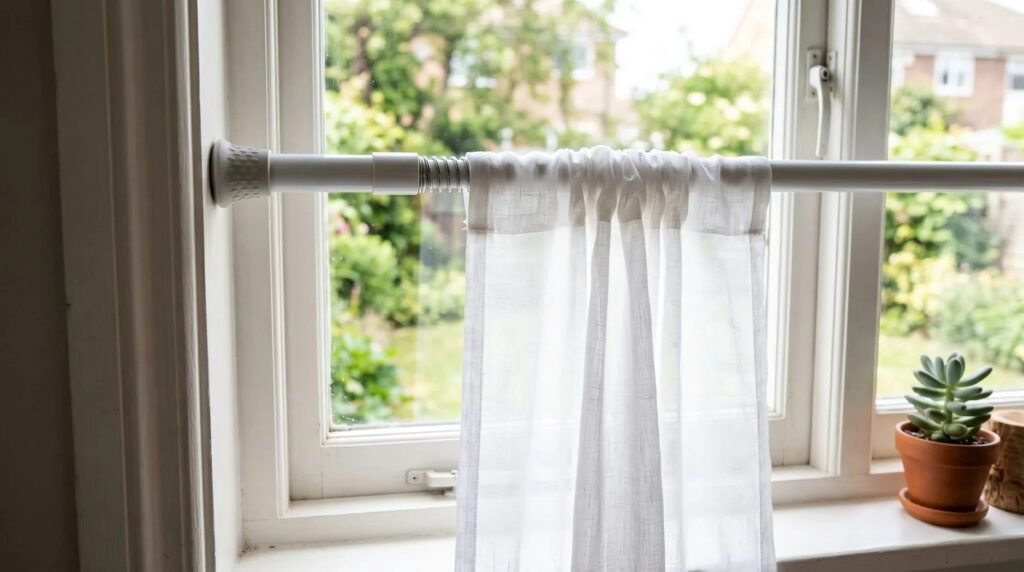
A tension rod fits inside the window frame and holds itself in place with spring or twist-lock pressure — no brackets, no holes. For heavy curtains, the key is buying a rod rated for the job. Standard cheap tension rods flex and slip; heavy-duty models with rubber end caps and thicker steel shafts genuinely hold real weight.
How to install: Measure the inside of your window frame, buy a rod sized for that span, twist or spring it until it is about an inch wider than the frame, then wedge it in place and let the pressure do the work. The rubber ends grip the frame and distribute force evenly.
Weight capacity: 10–20 lbs for heavy-duty models, depending on span. Shorter spans hold more — a rod across a 28-inch window holds far more than the same rod across a 60-inch window, because flex increases with length.
Pros: cheapest option, fully removable, no wall contact at all, works on tile and metal frames too.
Cons: sits inside the frame, so curtains cannot stack to the sides of the window; will not work if the frame is shallow or uneven. On very smooth surfaces, a wrap of rubber shelf liner around the ends adds grip.
Best for: renters, single windows, blackout curtains on bedroom windows.
Method 2: Adhesive Bracket Hooks (Strong and Invisible)
Modern adhesive technology has come a long way past flimsy plastic hooks. Heavy-duty adhesive curtain brackets use wide mounting plates with industrial-strength adhesive foam and are designed to hold real rods and drapes.
How to install: Clean the wall area with rubbing alcohol and let it dry completely — this step determines whether the bond lasts a month or a year. Stick the brackets up, then wait the full cure time on the package (usually 24 hours) before hanging anything. Patience here is the entire difference between success and a midnight curtain collapse.
Weight capacity: 5–10 lbs per pair for most heavy-duty products; some industrial designs claim up to 15 lbs. Use two brackets for standard windows and add a center support bracket for spans over 48 inches.
Pros: mounts on the wall above the frame so curtains can stack to the sides; nearly invisible once the curtains are up; removes cleanly with a pull-tab strip on painted drywall.
Cons: adhesive bonds poorly to textured walls, brick, and wallpaper; heat and steam (bathrooms, kitchens, sunny windows) weaken adhesive over time; removal can pull paint on older or low-quality paint jobs.
Best for: smooth painted walls, apartments where you want the classic “rod above the frame” look without screws.
Method 3: Magnetic Curtain Rods (Surprisingly Strong)
If your window or door frame is metal — many apartment windows, steel doors, and some metal-framed sliding doors — magnetic curtain rods are the strongest no-drill option per dollar. High-strength neodymium magnets grip steel with remarkable force.
How to install: Just place the magnetic brackets on the metal surface. That is the whole installation. Repositioning takes seconds.
Weight capacity: 10–20 lbs depending on magnet strength and metal thickness. Thin decorative metal frames hold less than solid steel door frames.
Pros: instant install, infinitely adjustable, extremely strong on real steel, leaves zero marks.
Cons: useless on wood, drywall, and aluminum (magnets do not stick to aluminum); magnetic paint is a gimmick that holds almost nothing, so do not count a painted wall as a metal surface.
Best for: steel doors, metal window frames, and apartments with metal-framed windows — test with a fridge magnet first.
Method 4: Over-the-Window Tension Cable Systems
A tension cable (wire) system stretches a steel cable between two wall-mounted or frame-mounted anchor points. Designed for shower curtains and room dividers, the same hardware works beautifully for window curtains, and cables handle wide spans better than rods because they do not sag in the middle the way a rod does.
How to install: Mount the anchors on opposite sides of the window using the tension mechanism (no drilling — they wedge or adhere), thread the cable through, and tighten with the turnbuckle. Hang curtains with clip rings, which slide easily along the cable.
Weight capacity: 15–25 lbs across spans up to about 8 feet, making this one of the strongest no-drill options for wide windows.
Pros: best no-drill choice for very wide windows; sleek modern look; clip rings make the curtains easy to open and close.
Cons: anchors need a solid surface to tension against; installation is fiddlier than a rod; the cable can hum or vibrate if curtains are yanked.
Method 5: No-Drill Curtain Rod Brackets That Grip the Trim
Several products on the market are designed to hook over or clamp onto existing window trim and molding, using the trim itself as the anchor. They slide over the top of the casing and hold a standard curtain rod.
How to install: Slide or clamp the bracket over the window trim, tighten the adjustment screws, and drop in your rod. No adhesive, no pressure, no marks.
Weight capacity: 7–12 lbs, limited by the strength of your trim. Solid wood trim holds well; thin MDF or vinyl trim flexes.
Pros: no curing time, no adhesive residue risk, uses a real rod for a classic look.
Cons: requires protruding window trim — flush modern windows have nothing to grip; can scuff delicate trim if overtightened (wrap the contact points in felt pads).
Method 6: Command-Style Picture Hanging Strips on a Board
This is a clever hybrid: mount a lightweight wooden board (a 1×2 furring strip cut to window width) to the wall with several heavy-duty adhesive strips, then attach small screw-in curtain rod brackets to the board with wood screws. The board distributes the weight across many adhesive points.
Weight capacity: 10–15 lbs if you use enough strips — plan one pair of large strips every 8 inches of board.
Pros: distributes load better than any single-point adhesive; lets you use standard rod brackets; still fully removable.
Cons: more work and more visible hardware; the board itself adds weight that counts against capacity.
Method 7: Freestanding or Room-Divider Style Curtain Displays
When the wall truly cannot be touched — historic apartments, glass walls, dorm rooms — skip the wall entirely. Freestanding garment racks, tension poles that press between floor and ceiling, and room-divider frames can hold curtains in front of a window without any wall contact at all.
Weight capacity: 10–30 lbs depending on the stand; heavy-duty garment racks are built for winter coats and handle drapes easily.
Pros: zero wall involvement, doubles as a room divider, easy to move.
Cons: takes up floor space; looks less like built-in window treatment and more like a screen.
Quick Comparison: Which Method for Your Situation?
- Bedroom blackout curtains, standard window: heavy-duty tension rod — simplest and cheapest.
- Want the rod mounted above the frame (classic look): adhesive brackets on smooth walls.
- Metal window or door frame: magnetic rod — strongest and easiest.
- Very wide window or sliding door: tension cable system.
- Textured or brick walls where adhesive fails: tension rod inside the frame, or freestanding stand.
- Heavy velvet on a wide window: split into two narrower panels, each on its own tension rod, or use a cable system.
Pro Tips That Keep Heavy Curtains Up
- Respect the cure time. Every adhesive failure story starts with someone hanging curtains two hours after sticking the brackets up. Wait the full 24 hours (or whatever the package says).
- Prep the surface. Clean with rubbing alcohol, not household cleaners — cleaners leave residue that weakens the bond. The surface must be completely dry.
- Add a center support. Any span over 48 inches with heavy curtains needs a middle bracket or the rod will bow. This is the most skipped step and the most common cause of failure.
- Use clip rings instead of rod pockets. Rod-pocket curtains create friction and drag when opened; clip rings glide and put less sideways force on the mounts.
- Test with a lighter load first. Hang a light sheet for a day before trusting the setup with heavy drapes. If it holds, upgrade with confidence.
- Check humidity. Bathroom and kitchen steam weaken adhesives over months. For those rooms, prefer tension rods or magnetic options.
Mistakes That Send Curtains Crashing Down
- Overloading a standard tension rod: a $5 rod from the discount bin is rated for sheers, not blackout drapes. Buy the heavy-duty version and check the weight rating on the package.
- Skipping the center support on wide windows: gravity always wins eventually. Any rod over four feet with heavy fabric needs middle support.
- Sticking adhesive to dusty or cold walls: adhesive bonds need clean, room-temperature surfaces. Winter installations on cold exterior walls are the classic failure.
- Hanging curtains before the adhesive cures: mentioned above, but worth repeating — this one mistake causes most adhesive failures.
- Assuming magnetic paint works: magnetic paint holds a few ounces at best. Real steel is required for magnetic rods.
- Forgetting the rod’s own weight: a thick wooden or metal rod can weigh several pounds by itself. Count it in your total.
Frequently Asked Questions
Can tension rods really hold heavy blackout curtains?
Yes, if you buy a heavy-duty rod rated for the weight and keep the span reasonable. Look for thick steel shafts, strong spring or twist-lock mechanisms, and rubber end caps. Shorter spans hold dramatically more weight than long ones, so for wide windows use two shorter rods or a cable system instead of one long rod.
Will adhesive curtain hooks damage my walls when removed?
Usually not on smooth, well-painted drywall — pull-tab adhesive strips are designed to release cleanly. The risk rises with old, cheap, or freshly painted walls, and with wallpaper or textured surfaces. Test one strip in a hidden spot first, and follow the removal instructions exactly (slow, low-angle pull).
What is the strongest no-drill way to hang heavy curtains?
On a metal frame, magnetic rods are the strongest and simplest. On a standard wall, a tension cable system handles the most weight across the widest span. Inside a window frame, a heavy-duty tension rod is the most reliable. All three can hold genuinely heavy drapes when installed correctly.
How do I hang curtains without drilling in a rental apartment?
Tension rods inside the window frame are the classic renter solution — nothing touches the wall. If you prefer the rod mounted above the frame, heavy-duty adhesive brackets on smooth walls give the same look without holes. Both come down without a trace when you move out, protecting your security deposit.
My curtains keep falling. What am I doing wrong?
The three usual suspects: the rod or brackets are underrated for the actual weight (weigh your curtains), there is no center support on a wide span, or adhesive was loaded before it fully cured. Fix those three things and failures become rare.
Can I hang curtains on a wall with no trim and no window frame depth?
Yes — this is where freestanding options shine. A floor-to-ceiling tension pole on each side of the window, or a sturdy garment rack placed in front of the window, holds curtains with zero wall contact. Adhesive brackets on the flat wall above the window also work if the surface is smooth.
Once your curtains are up, complete the room with other no-damage upgrades — our guide to hanging pictures without nails in an apartment rental pairs perfectly with this one, and making your apartment smell fresh without air fresheners finishes the cozy-window vibe.