
Knowing how to stretch hip flexors without a foam roller is a game changer if you sit most of the day and do not own any fitness equipment. Your hip flexors — the muscles at the front of your hips that lift your knees — shorten and tighten when you sit for hours, which can leave your hips feeling stiff and your lower back achy. The good news is that some of the most effective hip flexor stretches use nothing but your bodyweight and a little floor space. This guide explains why hip flexors get tight, walks you through seven equipment-free stretches with proper form, and shows you how to build a short daily routine that actually loosens them up.
What Are the Hip Flexors and Why Do They Get Tight?
The hip flexors are a group of muscles — mainly the iliopsoas and rectus femoris — that connect your lower spine and pelvis to the top of your thigh bone. Every time you lift your knee, walk upstairs, or stand up from a chair, they do the work. When you sit, these muscles stay in a shortened position for hours. Over time, the body adapts to that position: the muscles lose some of their resting length and feel stiff when you try to extend your hips fully, like when standing up straight or taking a long stride.
This pattern is so common among office workers, drivers, and students that tight hip flexors are sometimes called a signature issue of the sitting lifestyle. The stiffness itself is the main complaint — a pulling or tight sensation at the front of the hip, especially after long periods of sitting. Gentle, consistent stretching gradually restores the muscles’ comfortable range.
General Signs Your Hip Flexors Are Tight
You might have tight hip flexors if you notice stiffness at the front of your hips when you stand up after sitting for a while, if your lower back feels achy after long drives or desk sessions, if you struggle to take a full stride when walking, or if deep lunging positions feel intensely tight in the front of the hip. These are common, everyday observations — not medical diagnoses. If you experience sharp pain, numbness, or symptoms that do not improve with gentle movement over a couple of weeks, check in with a qualified health professional.
Before You Start: Stretching Safely
- Warm up first: March in place or walk around for two to three minutes. Stretching cold muscles is less effective and less comfortable.
- Never force a stretch: You should feel a gentle pull, never sharp or stabbing pain. Ease off immediately if anything hurts.
- Breathe steadily: Slow, deep breaths help muscles relax into a stretch. Try to deepen the stretch slightly with each exhale.
- Hold each stretch 30 to 60 seconds: Shorter holds do little; longer holds let the muscle genuinely release. Do both sides.
- Wear comfortable clothing: You need free hip movement — avoid tight jeans or restrictive waistbands.
7 Stretches for Hip Flexors Without Any Equipment
1. Half-Kneeling Hip Flexor Stretch
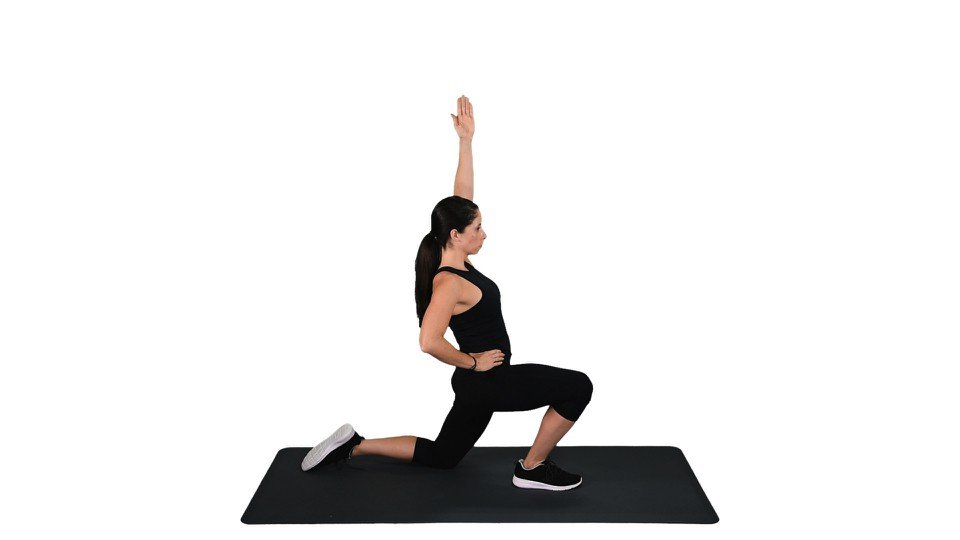
This is the single most effective bodyweight hip flexor stretch, and the one to learn first. Kneel on one knee with the other foot flat on the floor in front of you, like a proposal pose. Tuck your tailbone slightly under (imagine pulling your belt buckle toward your chin) and gently shift your hips forward until you feel a stretch at the front of the back leg’s hip. Keep your torso upright — do not lean forward. Hold 30 to 60 seconds per side. To deepen it, raise the arm on the same side as the back leg overhead and lean slightly away.
2. Standing Hip Flexor Stretch
Stand in a staggered stance with one foot about two feet behind the other, both feet pointing forward. Bend the front knee slightly, tuck your tailbone, and press your hips gently forward until you feel the stretch in the back leg’s hip flexor. Hold onto a wall or chair for balance. This is the standing version of the half-kneeling stretch — perfect when you do not want to get on the floor, like during a work break.
3. Low Lunge Stretch
From standing, step one foot far forward into a deep lunge and lower your back knee to the floor. Rest your hands on the front thigh or the floor for support. Sink your hips down and slightly forward, keeping your chest lifted. You will feel this across the front of the back hip and thigh. Hold 30 to 60 seconds per side. This stretch also opens the groin and lengthens the calf of the front leg as a bonus.
4. Supine Hip Flexor Stretch (Lying Down)
Lie on your back near the edge of a bed or sturdy table so one leg can hang off the edge. Hug the opposite knee tightly to your chest. Let the hanging leg drop toward the floor — gravity does the stretching for you. You will feel a deep but gentle pull across the front of the hanging hip. This is the gentlest option on the list and a great starting point if kneeling positions bother your knees. Hold 30 to 60 seconds per side.
5. Butterfly Stretch
Sit on the floor, bring the soles of your feet together, and let your knees fall outward. Sit tall, then gently press your knees toward the floor with your elbows — no bouncing. Lean forward slightly from the hips for a deeper stretch. While this mainly targets the inner thighs and groin, those muscles work closely with the hip flexors, and loosening them improves overall hip mobility. Hold for 60 seconds.
6. Bridge Pose
Lie on your back with knees bent and feet flat on the floor, hip-width apart. Press through your heels and lift your hips toward the ceiling, squeezing your glutes at the top. Hold for five slow breaths, lower, and repeat five to eight times. Bridges strengthen the glutes — the opposing muscles to the hip flexors. Strong glutes reduce the workload on tight hip flexors, which is why strengthening pairs so well with stretching.
7. World’s Greatest Stretch (Modified)
Step into a deep lunge with your hands on the floor inside the front foot. Keeping the back leg straight, rotate your torso and reach the arm on the front-leg side toward the ceiling, following it with your eyes. Hold a few breaths, return, and switch sides. This dynamic move stretches the hip flexors while also opening the chest, spine, and hamstrings — an efficient full-body addition to the routine. Do five slow rotations per side.
A Simple Daily Routine (Under 10 Minutes)
You do not need to do all seven stretches every day. Here is a balanced routine that covers everything in under ten minutes:
- March in place for two minutes to warm up
- Half-kneeling hip flexor stretch — 45 seconds per side
- Low lunge stretch — 45 seconds per side
- Butterfly stretch — 60 seconds
- Bridge pose — 8 repetitions
- World’s greatest stretch — 5 rotations per side
Do this once daily — morning or evening both work — and most people notice their hips feeling looser within one to two weeks. Consistency beats intensity: five gentle minutes every day outperforms one aggressive session per week.
Lifestyle Habits That Keep Hip Flexors Happy
Stretching works best alongside small daily changes. Stand up and walk for two to three minutes every half hour of sitting — set a timer if you forget. When you sit, keep both feet flat on the floor instead of tucking one leg under you. Take the stairs when you can, since stair climbing moves the hips through a fuller range than flat walking. And if you exercise, include glute-strengthening moves like squats and bridges regularly; balanced strength around the hip joint keeps the flexors from overworking.
Mistakes to Avoid
- Arching your lower back: In kneeling and lunge stretches, an arched back shifts the stretch off the hip flexor and into the spine. Tuck the tailbone slightly instead.
- Bouncing: Ballistic bouncing can trigger a protective muscle contraction — the opposite of what you want. Move slowly and hold still.
- Only stretching one side: Imbalances cause their own problems. Always do both legs, even if one side feels tighter.
- Holding your breath: Muscles release as you exhale. Breathe slowly and deeply through every hold.
- Expecting instant results: Flexibility improves over weeks of consistent practice, not a single session. Be patient with your body.
- Stretching through sharp pain: A gentle pull is fine; sharp, shooting, or pinching pain is a signal to stop and get professional guidance.
Frequently Asked Questions
How long does it take to loosen tight hip flexors?
With daily gentle stretching, most people feel noticeable improvement within one to two weeks, and meaningful flexibility gains within four to six weeks. Long-standing tightness from years of sitting takes longer — consistency over months is the real fix.
Can I stretch my hip flexors every day?
Yes. Gentle static stretching is safe to do daily. In fact, daily practice is more effective than occasional long sessions. Just keep the intensity moderate — you should feel a comfortable pull, never pain.
Do I need a foam roller for hip flexors?
No. While foam rollers can help release muscle tension, they are not required. The bodyweight stretches in this guide target the hip flexors directly and are effective on their own.
Why do my hip flexors feel tight even though I exercise?
Exercise does not cancel out eight-plus hours of sitting. Running, cycling, and even weightlifting can keep the hip flexors in shortened or heavily used positions. Dedicated stretching plus regular movement breaks address what workouts miss.
Is it better to stretch in the morning or evening?
Whichever time you will actually stick with. Morning stretching loosens overnight stiffness; evening stretching unwinds a day of sitting. Many people benefit from a short session at both ends of the day.
When should I see a professional about hip tightness?
If you have sharp or persistent pain, numbness or tingling, a feeling of catching or locking in the hip, or tightness that does not improve after a few weeks of consistent gentle stretching, consult a qualified health professional for personalized guidance.
This article is for informational purposes only and is not medical advice. Consult a qualified professional.