
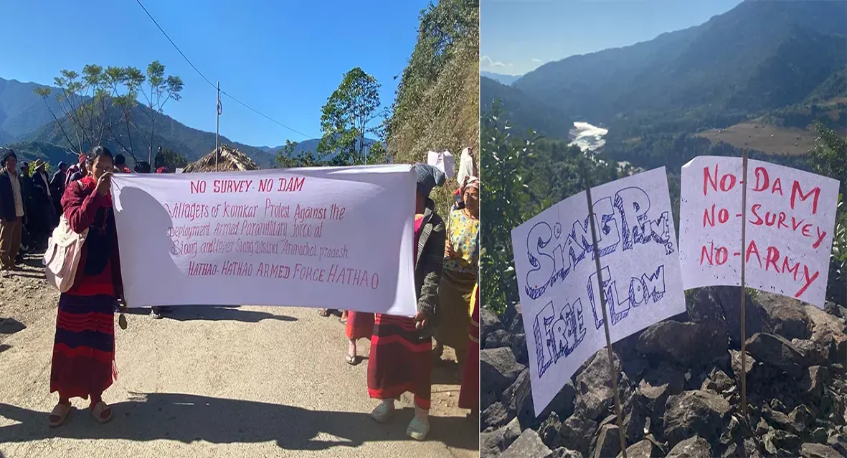
The Siang River has flowed through the heart of Arunachal Pradesh for centuries — feeding farms, sustaining cultures, and binding the Adi people to their ancestral land. Now, a proposed mega-dam threatens to bury all of that under hundreds of metres of water. And the people who call this valley home are not going quietly.
The proposed 11,300 MW Siang Upper Multipurpose Project (SUMP) — planned near Geku village in Upper Siang district — has triggered fierce opposition from indigenous tribal communities. The numbers alone are staggering. The Siang Indigenous Farmers’ Forum (SIFF) alleges the dam could displace over 1.5 lakh people, mostly from the Adi and other indigenous tribes, and submerge as many as 27 villages — wiping out ancestral homes, land rights, and everything attached to them.
This isn’t just about electricity. This is about identity.
The project was first conceived in 2017 when NITI Aayog proposed a 10,000 MW multipurpose storage-type dam on the Siang River — the Indian stretch of the Yarlung Tsangpo flowing down from the Tibetan Plateau. The government’s pitch sounds reasonable on paper: flood control, clean energy, water security. But the communities who would lose everything have never been properly asked.
During the Pre-Feasibility Report (PFR) survey, no proper consultation with the tribal communities of the Siang Valley was undertaken. Instead, the state government signed an MoU with just two residents of Pangkang village, outlining a development package of Rs 5 crore over three years — in exchange for allowing the survey. Other villagers opposed the MoU outright, saying most of them do not favour the dam. Environmental lawyer and anti-dam activist Ebo Mili didn’t mince words — he called it a calculated attempt to divide the villagers.
The government, for its part, insists it has public support. Rural Development Minister Ojing Tasing has vigorously claimed that around 70% of the population favours the project. But that figure rings hollow to the thousands who have taken to the streets in protest.
There’s also the geopolitics at play. India has expressed serious concern over China’s 60,000 MW Medog Hydropower Station on the Yarlung Tsangpo upstream, with Chief Minister Pema Khandu calling it a “water bomb” — warning that if China suddenly releases water, the entire Siang belt could be destroyed. The central government has used this threat to justify pushing SUMP forward. A dam to counter a dam. Security through displacement.
That logic doesn’t sit well with scientists either. Over 114 scientists, researchers, and practitioners have called for a complete halt to all work on the site, including surveys and pre-clearance procedures. Their concern? The project violates the 2006 Forest Rights Act, the 2002 Biological Diversity Act, and several international environmental and indigenous rights agreements. The Siang valley is no ordinary stretch of land — it sits in one of the world’s most seismically active and ecologically sensitive zones.
Human Rights of Arunachal (HRA) has also stepped in, backing the communities and calling on state and central governments to immediately stop pre-feasibility surveys and drilling in Siang and Upper Siang districts. Their position is clear — the objection is not to development itself, but to projects undertaken without sufficient consultation, environmental protection, and respect for indigenous rights.
The Adi people didn’t ask to be caught between India’s energy ambitions and China’s upstream agenda. They asked to be heard. So far, the only thing louder than their protests has been the sound of survey drills.
A river that has given life for generations is now at the centre of a battle over who gets to decide its future — the people who live beside it, or the people who sit in offices far away.