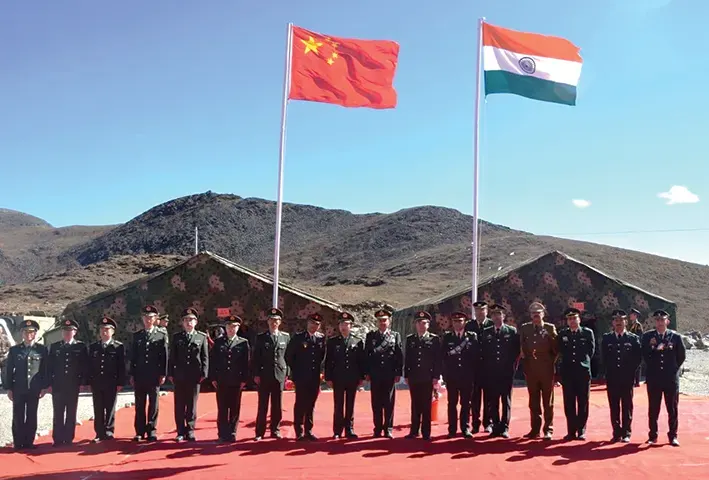
After years of frozen silence and lingering suspicion since the bloody Galwan Valley clash of 2020, India and China sat down again — this time in Beijing — and walked out with something they called progress.
The 25th round of talks between the special representatives of the two countries on the boundary question produced what the Ministry of External Affairs described as “eight points of outcomes and consensus.” National Security Adviser Ajit Doval and China’s Foreign Minister Wang Yi co-chaired the meeting. Both sides “reaffirmed” their commitment to maintaining peace and tranquillity in the border areas. Good words. Whether they hold is another story entirely.
The eight points cover a wide ground. They include setting up two new border meeting points for senior military commanders, establishing two additional hotlines in the eastern and middle sectors of the LAC, holding an expert-level meeting on trans-border rivers in September 2026, and sharing real-time hydrological data during emergencies. There’s also movement on increasing infrastructure and tour batches for Indian pilgrims visiting Mount Kailash and Lake Mansarovar, reopening designated border trading points, and finalising the 26th round of talks in India in 2027.
On paper, it reads like real momentum.
But here’s the thing — and this is where Arunachal comes squarely into the picture. With recent claims by communities of Chinese intrusion in Taksing in Upper Subansiri district and China’s continuing claim over Arunachal Pradesh, these agreements to engage in serious talks are important, though one cannot necessarily be certain or cheerful. The border communities living along these disputed lines don’t quite see the world the way Delhi or Beijing does. What local communities in Arunachal accept as theirs is different from what the Indian government acknowledges because there is no clarity on the ground and no demarcated boundary.
That tension is real, and it doesn’t disappear with a joint statement.
The traditional grazing grounds are now mostly contested land, particularly in Anjaw, Upper Subansiri and Dibang Valley, among the 12 districts that share a border with Tibet. New Chinese settlements have also been reported near the border along the LAC. People who have lived on these lands for generations — who know exactly where their cattle used to graze and where their ancestors traded — are watching these diplomatic manoeuvres from a distance and wondering if anyone is really listening to them.
In some places, indigenous communities living along the borders know their traditional boundaries, but their traditional maps and those of India and China are not necessarily the same because of differing perceptions by all three.
Still, the fact that talks are happening at this level, with this kind of detailed output, matters. India and China cannot afford not to talk for a prolonged period, even if the relationship remains frosty and one can never be sure when the mood might change in Delhi and Beijing.
The two sides have underlined their commitment to advancing negotiations on a framework signed in 2005, in pursuit of a fair, reasonable and mutually acceptable solution. The 2005 agreement itself carries weight — it emphasises mutual understanding, equal security, and the practical realities on the ground.
Hope is not the same as certainty. But right now, for a border that has seen too much tension and too little dialogue, these eight points — however complicated they may be — are at least a beginning. Arunachal’s communities deserve more than diplomatic language. They deserve answers. And they’re still waiting.