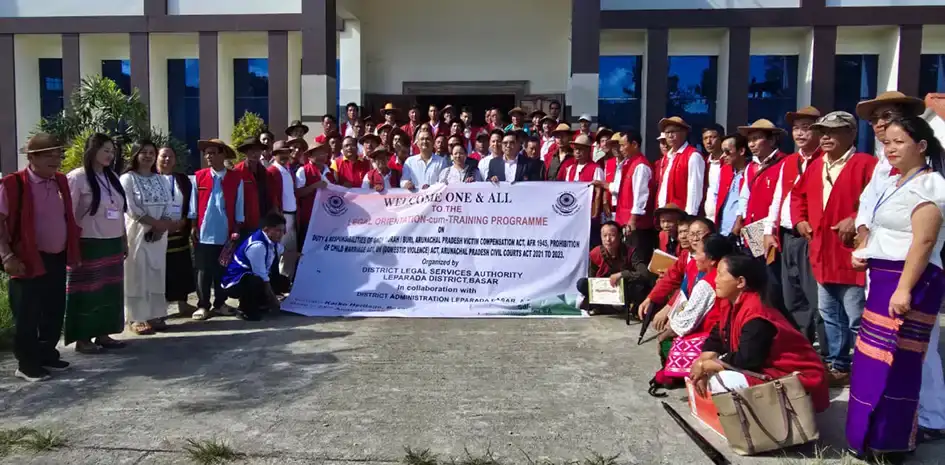
Sixty-three village heads walked into a room in Basar not knowing much about victim compensation schemes or civil court acts — and walked out as potential pillars of justice for their communities.
Bridging the Gap Between Law Books and Village Life
The Leparada District Legal Services Authority (DLSA), working alongside the district administration, held a legal orientation-cum-training programme for Gaon Buras and Buris (GBs) in Basar on Saturday. It sounds formal on paper, but what actually happened in that room was something far more grounded — senior judges and legal officers sitting down with village-level functionaries, explaining laws that directly affect the people these GBs interact with every single day.
The session covered a wide sweep of topics: the duties and responsibilities of GBs, the Arunachal Pradesh Victim Compensation Scheme, the Assam Frontier (Administration of Justice) Regulation of 1945, the Prohibition of Child Marriage Act, laws related to domestic violence, and the Arunachal Pradesh Civil Courts Act, 2021. That’s not a light agenda. And it speaks to just how much legal ground village functionaries are expected to navigate — often without any formal training at all.
The Judges Came Down to the Ground Level
District and Sessions Judge Jaweplu Chai, who also chairs the DLSA, addressed the participants directly on how GBs can act as bridge-builders between their communities and the formal justice system. It’s one thing for a law to exist on paper; it’s another for someone in a remote village to even know it exists — and that’s exactly the gap these GBs are meant to close.
ADC Tamo Riba made a point that really cuts to the heart of grassroots governance — that coordination between traditional village institutions and the district administration isn’t optional. It’s how things actually get done on the ground. Resource persons including Chief Judicial Magistrate Utumso Boo, DLSA panel advocate Mijum Doke, and chief legal aid defence counsel Ito Riram added practical, case-based perspectives to the session, making the legal provisions feel less abstract.
Child Marriage and Domestic Violence Take Centre Stage
Of everything discussed, the issues of child marriage and domestic violence received the sharpest focus. Participants were sensitised to the legal consequences of these practices and, critically, the importance of early intervention and reporting. This matters enormously in rural Arunachal, where GBs are often the first — and sometimes the only — authority a victim encounters before things either get better or worse.
The programme also walked participants through victim compensation mechanisms and the availability of free legal aid, ensuring that GBs know where to direct people who need help but can’t afford it.
63 Villages, One Message
Around 63 GBs from across Leparada district took part. That’s 63 villages now better equipped with legal knowledge that their residents may one day desperately need.
Empowering those who stand closest to the community isn’t just good governance — it’s the most efficient route to justice. When a Gaon Bura knows the law, an entire village gains a quiet protector.
HASHTAGS
#AbotaniTV #ArunachalPradesh #LeparadaDLSA #GaonBura #LegalAwareness #RuralJustice #ChildMarriageLaw #DomesticViolence #FreeLegalAid #Basar #VictimCompensation #LegalTraining #ArunachalNews #GrassrootsJustice #VillageLeaders #AccessToJustice #NortheastIndia #CommunityLaw #LegalEmpowerment #DLSA