Fifty farmers walked in. They walked out with a different way of looking at their own land.
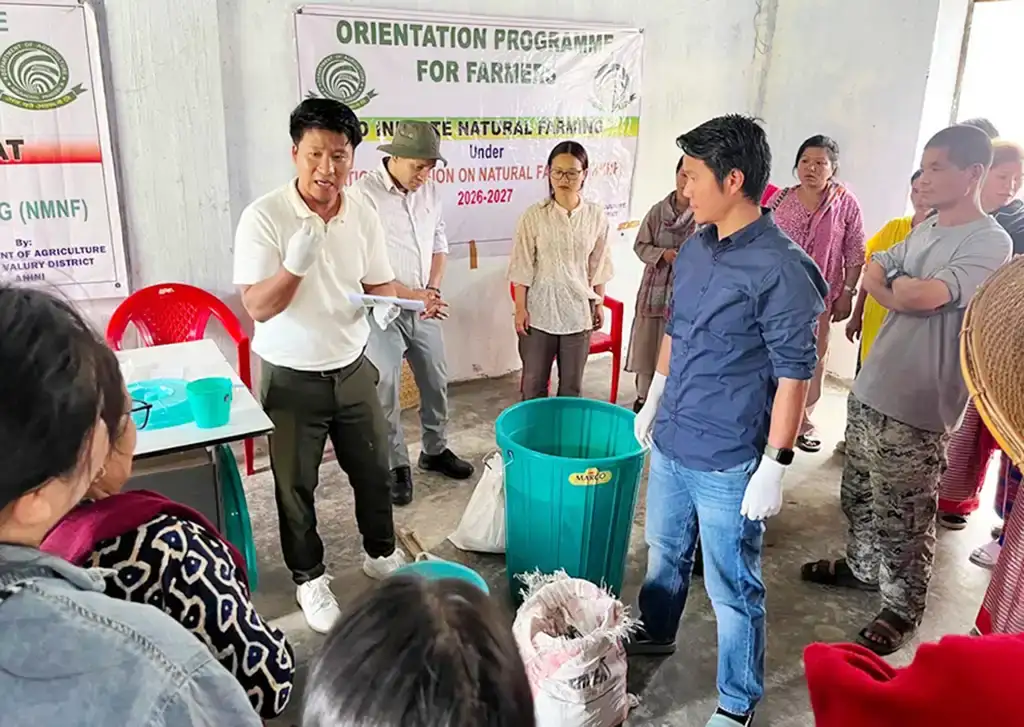
On Sunday, the Dibang Valley Agriculture Department held an awareness and orientation programme on natural farming at Mipi — and the turnout alone said something. More than 50 farmers, community members, and local officials gathered under one roof not to discuss politics or policy, but to talk about soil. About seeds. About returning to the way things used to be done — only smarter.
Back to the Roots, But Make It Science
The session was conducted under the supervision of Anini ADO Duyu Udi, with ZPM Siyo Miwu, Mipi Circle Officer Anmol Singh, and GPC Dumpi Mega also present. The real draw of the day, though, was Neelam Sunny — agroforestry expert from Dibang Valley KVK — who broke down the principles of natural farming in terms that actually made sense on the ground. He spoke about indigenous bio-inputs like beejamrit and jeevamrit, preparations made from locally available materials that can dramatically improve soil health. No fancy chemicals. No expensive imports. Just knowledge, applied carefully.
Why This Matters More Than It Sounds
For farmers in a region like Dibang Valley, the economics of farming can be brutal. Input costs eat into margins. Synthetic fertilisers and pesticides don’t come cheap, and the soil quietly suffers over years of heavy chemical use. Natural farming, if adopted well, offers a way out of that cycle. Speakers at the programme stressed exactly this — that reducing dependence on external inputs isn’t just good for the environment, it’s good for the wallet. Resilient farms. Healthier yields. Lower costs over time. It’s not idealism; it’s arithmetic.
Community at the Center
What stood out about this programme was that it wasn’t a top-down lecture delivered to passive listeners. Farmers were encouraged to think about what works locally — practices suited to Dibang Valley’s specific climate and terrain, not imported solutions designed for flatlands elsewhere. That’s the kind of ground-level thinking that actually sticks. When people see themselves in the solution, they’re far more likely to act on it.
A Department Walking the Talk
The Agriculture Department’s repeated push for natural farming awareness across Arunachal — this being one in a series of such programmes — signals something worth noting. This isn’t a one-off event staged for optics. There’s a pattern here, a sustained commitment to shifting how farming is understood and practiced across the state.
Fifty farmers walked into a room in Mipi and heard something simple but powerful: your land doesn’t need more chemicals — it needs better care. Whether that message travels from the programme hall to the actual fields is the real test. But it has to start somewhere. And it did.
HASHTAGS
#NaturalFarming #DibangValley #ArunachalPradesh #SustainableFarming #OrganicFarming #AgricultureAwareness #KVK #Beejamrit #Jeevamrit #SoilHealth #EcoFriendlyFarming #FarmersOfIndia #ClimateResilient #GreenAgriculture #ArunachalFarmers #IndigenousFarming #NortheastIndia #FarmLife #AbotaniTV #RuralIndia