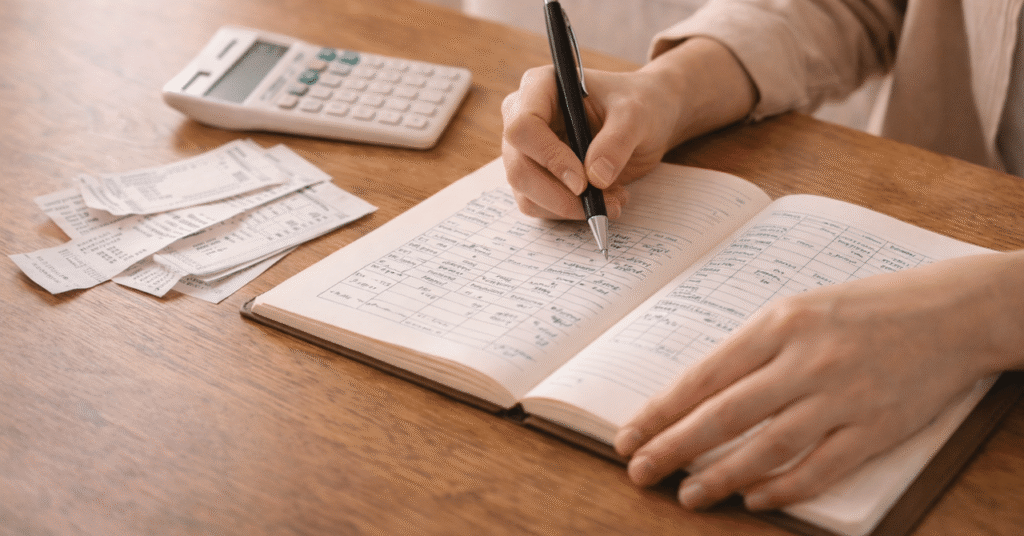
Learning how to track your spending without a budgeting app is simpler than most people expect, and for many people it works better than an app ever did. You do not need a subscription, a bank connection, or a dashboard full of charts. You need a way to write down what you spend, a number that tells you what is safe to spend, and a short weekly check-in. This guide walks through each part so you can start today with nothing more than a notebook or the phone already in your pocket.
Why Manual Tracking Works So Well
Budgeting apps promise to do the work for you, and that is why they fail for many people: when spending is sorted automatically, you never really look at it. A notification here, a colorful chart there, and the money still disappears. Manual tracking forces a small moment of attention every time money leaves your hands, and that attention is the whole point. Writing down a twelve dollar lunch makes the lunch real in a way that an auto-imported transaction never does. You start to notice patterns within days: the coffee that shows up four times a week, the delivery fees that quietly add up, the subscription you forgot you had. It takes a habit of about two minutes a day, and a setup with nothing to break, update, or pay for. A notebook never crashes, a notes app never locks your data behind a paywall, and a spreadsheet never shows you an ad. Manual tracking also keeps your financial life private. Your spending data stays in your hands instead of on a company server, and you are never asked to hand over your bank login to a third party.
Start With Your Safe-to-Spend Number
Before you record a single purchase, work out one number: how much you can safely spend on everyday things between now and your next payday. This safe-to-spend number is the heart of the whole system, because it turns tracking from a history lesson into a live guide. Here is how to find it. First, write down the money you expect to come in before your next payday. Second, subtract every fixed bill that must be paid in that same stretch: rent or mortgage, utilities, phone, insurance, loan payments, and any other bill with a fixed amount and a due date. Third, subtract the money you want to set aside for savings, even if it is a small amount. What is left is your safe-to-spend number, the pool that covers groceries, transport, eating out, entertainment, clothes, and everything else that varies from day to day. Write that number at the top of your notebook or spreadsheet where you will see it every time you open it. Each time you spend, subtract the amount from the number. What remains is what you can still spend without touching bill money or savings. If the number gets low with days still to go, that is useful information, not a failure: cook at home, skip the extra trip, or delay a purchase while there is still time to adjust. If the number stays healthy, you can spend without guilt, because the bills are already covered. Recalculate it every payday. A rough number you check daily beats a perfect budget you never look at.
Pick Your Method: Notebook, Notes App, or Spreadsheet
There are three good ways to track spending by hand, and the best one is the one you will open every day. Each has real strengths and real limits, so pick based on your habits rather than what sounds most impressive.
The paper notebook. A small notebook and a pen is the simplest method of all, and for many people it is the most effective. Writing by hand slows you down just enough to make each purchase register, and there is no screen, no battery, and no distraction. Keep the notebook in your bag or pocket, and give each day a line or two. The downside is that paper cannot add things up for you, and a lost notebook means lost records. Still, if you like paper and you carry a bag, this is a strong choice. Choose a notebook small enough to carry everywhere, and keep a pen clipped to it so there is never an excuse to skip an entry.
The notes app on your phone. A notes app is the middle path: always with you, searchable, and free. Open a single note titled with your safe-to-spend number, and add each purchase as a short line with the amount and what it was for. At the end of the day, add the numbers up and write the new remaining balance at the top. The advantage is speed and backup, since most notes apps sync automatically. The risk is distraction, so keep the note pinned or on your home screen: open it, type one line, and close it again. If you already live on your phone, this method fits your life with the least friction.
The spreadsheet. A spreadsheet is the best choice if you like totals and categories and you do not mind sitting down at a computer or tablet. Set up columns for date, what you bought, category, and amount, and let the spreadsheet add everything up for you. You can see at a glance how much went to groceries versus eating out, and you can sort and filter when you want to dig deeper. The weakness is that a spreadsheet is not always at hand, so jot purchases in your notes app or on a receipt and enter them once a day, in the evening. Used this way, a spreadsheet gives you the clearest picture of all three methods, and it costs nothing. Commit to your method for a full month before judging it. Switching methods every few days is the fastest way to quit.
Set Up Simple Categories That Fit Your Life
Categories are what turn a list of purchases into useful information, but most people create far too many of them. Ten or twelve broad categories are plenty, and five or six is often enough. Start with the basics: groceries, eating out and coffee, transport, household, clothing, entertainment, health, and a catch-all called other. If a category never gets used, drop it. If one category keeps swallowing half your spending, split it into two. A good category list lets you sort a purchase in two seconds without thinking hard. A grocery run goes under groceries, a bus fare under transport, a movie ticket under entertainment. If you pause and wonder where something belongs, your categories are too fussy. Do not create a category for a single unusual purchase; that is what other is for. The point of categories is not perfect accounting. It is to show you, at a glance, where the money actually goes, so you can decide whether that matches what matters to you.
Build a Daily Capture Habit That Takes Two Minutes
The daily habit is the engine of the whole system, and it works best when you tie it to something you already do. Log purchases right after you make them when you can, and sweep up anything you missed at a fixed time each day, such as after dinner or just before bed. Keep the entry short: amount, what it was, and category. A line like “9.50, lunch sandwich, eating out” is all you need. Do not write essays about your spending. The shorter the entry, the more likely you are to make it. If you pay mostly by card, your bank app can serve as a backup at the end of the day, but card records show the store name, not what you bought, and cash purchases will not appear at all. Keep receipts in one pocket or one spot at home until they are logged, then throw them away. If you miss a day, do not try to reconstruct it perfectly the next morning. Log what you remember, mark the gap, and move on. One missed day does not ruin the system; quitting because of one missed day does. After about two weeks, the habit starts to feel strange to skip, which is exactly when manual tracking starts paying off. You will catch yourself pausing before impulse buys, and that pause is worth more than any chart.
Do a Short Weekly Review
Once a week, sit down for ten minutes with your notebook, note, or spreadsheet and ask three questions. First, how much did I spend, and how does that compare with my safe-to-spend number? Second, which categories were higher than I expected, and why? Third, is there one small change I want to make next week? Add up each category, update your remaining safe-to-spend balance, and write one sentence about what you noticed. That sentence is the most valuable part of the review, because it turns numbers into a decision. It might be “delivery fees cost more than the food twice this week,” or “groceries were fine, but coffee added up fast.” Pick one change, not five. Maybe you cook twice more next week, or you set a simple limit for eating out. Small weekly adjustments beat grand plans every time, because they are easy to keep and they compound. If one category ran over but another came in under, shift the balance and keep going. Look ahead too: if a bigger expense is coming, such as a car service or a gift, set a little aside now so it does not arrive as a surprise. For ideas on cutting everyday costs, see how to save money on groceries without coupons, and for more ways to trim household spending, see how to keep a house cool in summer without air conditioning.
Use Bank Statements to Catch What You Missed
Even careful trackers miss things, and that is what bank statements are for. Once a week, or at least once between paydays, open your bank or card statement and compare it with your own record. Look for anything on the statement that is not in your notebook: a subscription renewal, a small recurring charge, an automatic payment you forgot, or a tip added after the fact. Add each missing item to your record and subtract it from your safe-to-spend number. This keeps your numbers honest, and it surfaces quiet leaks that manual tracking can miss, especially subscriptions and auto-renewals that never pass through your hands. When you find one, decide on the spot whether it earns its place. If a subscription brings you real value, keep it and add it to your fixed bills. If you barely use it, cancel it right away and enjoy the small win. Do the same with cash: if you took cash out and cannot remember where it went, write a single line for the withdrawal and treat it as spent. Precision matters less than completeness. A record that captures nearly everything and gets checked against the statement is far more useful than a perfect record that stops after three days.
Common Mistakes to Avoid
The first mistake is making the system too complicated. A tracker with twenty categories, color codes, and daily targets looks impressive and dies within a week. Start simple, and add detail only if you find yourself wanting it. The second mistake is tracking for a few days and then judging the results. The first week is noisy and incomplete, because you are still building the habit. Give it a full month before you draw conclusions about your spending. The third mistake is recording only big purchases and skipping the small ones. Small purchases are the ones that add up invisibly, so the coffee, the snack, and the small top-up matter more than the rare big expense. The fourth mistake is using tracking as a reason to feel guilty. If a week runs over, the system did its job by showing you, and the fix is a small adjustment. The fifth mistake is keeping your safe-to-spend number in your head instead of writing it down. A number you cannot see is a number you cannot use at the checkout. Write it where you will see it every day. Finally, do not compare your spending with anyone else’s. The only comparison that matters is your spending against your own goals.
Frequently Asked Questions
How long does manual spending tracking take each day?
About two minutes a day once the habit is set: a few seconds per purchase, plus a quick evening sweep. The weekly review takes about ten minutes.
What if I forget to log purchases for several days?
Do not rebuild every missing day from memory. Check your bank or card statement, log what you can identify, add one line for unaccounted cash, and restart the habit the same day. A gap is normal and the system still works.
Is a notebook or a spreadsheet better for tracking spending?
Neither is better in general. A notebook wins for speed and focus, because writing by hand makes each purchase feel real. A spreadsheet wins for totals and category views, because it adds everything up for you. Choose the one you will open daily, and use a notes app as a capture step if your spreadsheet is not always at hand.
How do I track cash spending without an app?
Keep receipts until they are logged, and write cash purchases down the same day. When you withdraw cash, log the withdrawal itself, then log what you spend it on if you want detail. If some cash goes unaccounted for, record the withdrawal as a single line rather than leaving a hole in your record.
Should I track every single purchase, even tiny ones?
Yes, especially the tiny ones. One coffee means little, but the same small purchase repeated across many days is often the biggest surprise in a spending review.
How do I stay motivated to keep tracking?
Keep the system small and the payoff visible. Watch your safe-to-spend number each day and use the weekly review to make one small change at a time. Most people stay motivated once they see the first clear pattern.
Tracking your spending without a budgeting app is not about discipline or sacrifice. It is about paying attention for two minutes a day, knowing your safe-to-spend number, and checking in once a week. Start with a notebook or a note on your phone, set up a handful of categories, and give the habit a full month.
This article is for informational purposes only and is not financial advice. Consult a qualified professional.