
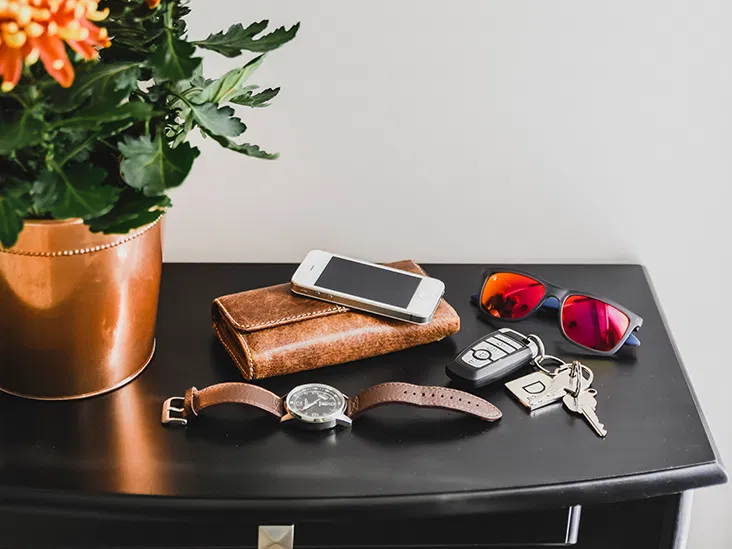
If you want to know how to stop losing your keys, phone and wallet every morning, you are not alone — and you are not forgetful, you are systemless. The morning scramble happens because these three items are small, move constantly through your house, and you grab them while your brain is half-awake and already thinking about the day ahead. The fix is not a better memory. It is a better system: a single home for each item, a routine that puts them there, and a few backup layers for the days the routine fails. Here is exactly how to build that system in one weekend.
Why You Keep Losing Them (And Why Memory Tricks Do Not Work)
Losing things is rarely a memory problem. Research on everyday object loss points to attention, not recall: you set your keys down while answering a text, thinking about dinner, or juggling bags, and the moment never registers. Mnemonic tricks and “just try to remember” fail because they rely on the exact resource — attention — that is in shortest supply when you arrive home.
The good news: you do not need to fix your brain. You need to remove the decision entirely. Every strategy in this guide works by reducing the number of places an item can possibly be, until the answer to “where are my keys?” is always the same sentence.
The Core System: One Landing Zone
Step 1: Pick a Single Drop Spot
Choose one location — a small tray, a wall-mounted key hook, or a basket on an entryway table — and declare it the official home for your keys, phone, and wallet. This is the single most important step in this entire guide. When every item has exactly one place it lives, “lost” becomes almost impossible.
Pick a spot you pass on your way in and your way out. The best location is usually right next to the door you use most. If you enter through the garage, put it in the garage entryway, not the formal front door — convenience beats aesthetics here.
Step 2: Make It Visible and Obvious
Your landing zone should catch your eye. A bright-colored tray, a hook at eye level, or a small shelf with a bowl works better than a drawer, because drawers hide things and hidden things get forgotten. If you are a visual person, choose something colorful. If you like minimalism, a single elegant tray is enough. The design matters less than the rule: everything lands here, every time.
Step 3: Build the “Coming Home” Ritual
A system only works if you use it. Pair the drop spot with a tiny ritual you perform the moment you walk in: shoes off, items in the tray. Do it in the same order every day for two weeks, and it becomes automatic. Stacking it onto an existing habit (coming home, taking off shoes) is far more reliable than relying on motivation. For help building this kind of habit into a broader structure, see our guide on how to create a morning routine that actually sticks — the same habit-stacking principles apply at both ends of the day.
Fix Each Item Individually
Your Keys: Add Bulk and Sound
Keys get lost because they are small and silent. Fix both properties. Put them on a distinctive, chunky keychain — a bright color, a large tag, or a unique shape — so they are easy to see and hard to slip into a couch cushion unnoticed. Then attach a Bluetooth tracker. These small tags pair with your phone and let you ring your keys from an app, or see their last known location on a map. For the most commonly lost item in the house, this is money well spent.
Also, reduce your keychain to essentials. Every extra loyalty card and old key adds weight and clutter, making the whole bundle harder to notice and easier to leave behind. Carry what you actually use.
Your Phone: Give It a Parking Spot
Phones wander because they are always in use. At home, designate one charging station — ideally inside your landing zone — where the phone lives when you are not actively using it. A charger that lives somewhere specific beats a cable that migrates around the house. When the phone always charges in the same place, you always know where it is.
Enable your phone’s built-in find feature (Find My on iPhone, Find My Device on Android) and make sure you know how to trigger it from another device. Also learn the voice command that makes it ring — on many phones you can ask a smart speaker or a watch to find it, which helps when the phone is on silent.
Your Wallet: Shrink It and Anchor It
Wallets get left behind because they slide into bags, jackets, and couch cushions. First, slim it down — carry only the cards you use weekly, and move the rest (loyalty cards, old insurance cards, punch cards) to a phone app or a drawer. A slim wallet is harder to lose and easier to feel in a pocket.
Then give it a permanent home: either in the landing zone tray or in one specific pocket of your daily bag. If it goes in a bag, that bag also has a home — on a hook by the door, not wherever it lands. Bluetooth card trackers exist for wallets too, and they are worth it if your wallet is the item you lose most.
Morning-Proof Your Routine
The Night-Before Reset
The morning search is really a nighttime failure. The single most effective morning habit happens the night before: do a sixty-second sweep. Before bed, walk to your landing zone and confirm that keys, phone, and wallet are all there. If something is missing, you have the whole evening to find it — not a panicked ten minutes before you need to leave. This pairs naturally with planning your day the night before, which turns the evening into a launchpad for a calm morning.
The “Pat Down” Checklist
Pilots use checklists because memory is unreliable under pressure. Borrow the idea: before you leave, run a quick physical pat-down — phone, wallet, keys — touching each pocket. Say them out loud if it helps. It takes five seconds and catches the one morning in fifty when the routine slipped. Some people use the rhyme “spectacles, testicles, wallet, watch” — adapt it to your own essentials.
Prep Everything the Night Before
Mornings go wrong when you are making decisions while rushing. Reduce the decisions: pack your bag, lay out your clothes, and stage anything you need to take (lunch, gym bag, documents) by the door in the evening. With everything staged and your three essentials confirmed in the landing zone, the morning becomes a simple grab-and-go instead of a scavenger hunt.
Backup Layers for Bad Days
Trackers: Your Safety Net
Even with a perfect system, off days happen — travel, houseguests, illness. A Bluetooth tracker on keys and wallet, plus your phone’s find feature, means a lost item becomes a thirty-second search instead of a crisis. Think of trackers as insurance: cheap, invisible, and invaluable on the day you need them. Replace tracker batteries once a year, ideally when you do another annual task like changing smoke detector batteries.
A Spare Key Strategy
Keep a spare house key somewhere secure and separate: with a trusted neighbor, in a lockbox, or at a nearby family member’s house. A spare does not prevent losing your keys, but it converts a lockout emergency into a minor inconvenience. Do not hide it under the doormat — that is the first place anyone looks.
The “Launch Pad” for the Whole Family
If you live with others, extend the system. Give everyone their own labeled hook or tray in the same entryway area. Kids’ backpacks go on hooks, sports gear in a bin. When the whole household uses one launch pad, nobody is tearing the house apart looking for someone else’s stuff, and the morning leaves on time.
Mistakes to Avoid
- Having three “official” spots. One item with multiple homes is just organized losing. Commit to a single spot per item.
- Choosing a spot you do not pass. The perfect-looking tray in a room you never enter is useless. Convenience beats design.
- Skipping the night-before check. This sixty-second habit is what makes the whole system failure-proof. The morning search starts the night before.
- Carrying too much. Bloated keychains, stuffed wallets, and five bags multiply the places things can hide. Slim down ruthlessly.
- Relying on memory instead of environment. You will not “just remember” — design the environment so remembering is unnecessary.
Your One-Weekend Setup Plan
Here is how to implement everything in one weekend. Saturday: buy or designate your landing zone (tray, hooks, or basket), slim down your keychain and wallet, and set up one charging station. Sunday: attach trackers, enable phone-finding features, and stash a spare key. Sunday night: do your first night-before sweep. Within two weeks of consistent use, the ritual becomes automatic — and the morning search for keys, phone, and wallet becomes a story you tell about how things used to be.
Frequently Asked Questions
Why do I lose my keys every morning even though I am not forgetful?
It is an attention problem, not a memory problem. You set items down while distracted, and the moment never registers in your memory. The fix is a system — one landing spot used every time — not a better memory.
What is the best place to keep keys so I never lose them?
A single, visible spot right by the door you use most: a tray, hook, or bowl. It must be somewhere you pass both coming in and going out, and it must be the only place keys ever go.
Do Bluetooth trackers really work for lost keys?
Yes. They let you ring a lost item from your phone and show its last known location on a map. They are a reliable safety net, though the landing-zone habit remains the primary system.
How do I stop losing my wallet specifically?
Slim it down to essential cards only, then give it one permanent home — the entryway tray or one specific pocket of your daily bag. Consider a slim Bluetooth card tracker if it is your most-lost item.
How long does it take to build the habit?
Most people find the coming-home drop ritual becomes automatic within two to three weeks of consistent use, especially when stacked onto an existing habit like taking off your shoes.
What if other people in my house do not follow the system?
Give everyone their own labeled spot in the same entryway area. You cannot control others, but you can make the right behavior the easiest behavior — and your own items will still be exactly where you left them.












1 thought on “How to Stop Losing Your Keys, Phone and Wallet Every Morning”
Comments are closed.