
There’s something quietly powerful about watching a child stop, look up, and actually notice a butterfly. In West Kameng district, that moment was intentional — and it happened 250 times over.
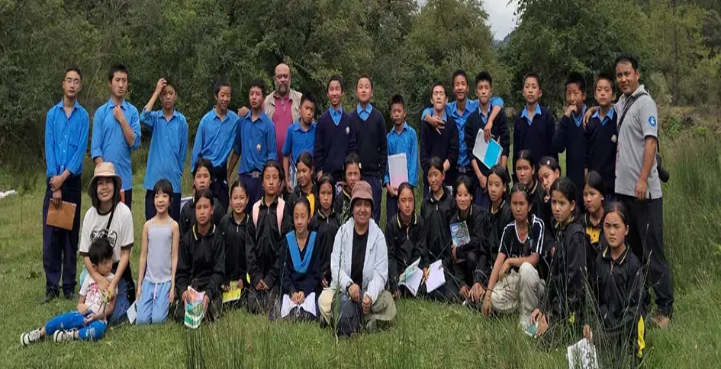
Shergaon-based NGO Garung Thuk (GT), in collaboration with Kolkata-based Nature Mates (NM) and the Centre for Climate Change at Ashoka University, Sonipat, rolled out a vibrant series of events this September to mark the Big Butterfly Month (BBM). The events spanned four locations — Shergaon, Jigaon, Morshing, and Mandalaphudung — and they weren’t your average awareness programme. Kids went on butterfly walks. They watched documentaries. They sat through presentations and played games, all designed to make one thing stick: that the insects around them matter.
Around 250 participants turned up across the venues. That’s not a small number for a remote district, and it says something about how much these communities are willing to engage when approached right.
GT member and honorary wildlife warden Dr Lobsang Thashi Thungon was at the heart of it, alongside Sarika Baidya, researcher and programme manager for butterfly research and conservation, who brought her team all the way from Kolkata. Dr Thungon didn’t mince words about why events like this are worth fighting for. “Today’s young kids are our future,” he said. “So, we need to sensitise them early. Such events are important to impart critical knowledge, nurturing them to grow into conservation leaders.” He also made a direct appeal — that Baidya and her team keep coming back.
It’s the kind of appeal that tells you these aren’t outsiders parachuting in with a clipboard. There’s a relationship here, built over three years of consistently showing up.
Baidya herself put her finger on the larger problem. “Insect conservation is still very much underappreciated in our country,” she said. “Such events are important to start the necessary conversation for insect conservation and engage the wider community, especially the students, in conservation actions.” That word — conversation — matters. Because before anyone protects something, they have to first be curious about it. And that curiosity has to start somewhere.
This year, the BBM celebrations didn’t just teach. They also documented. More than 70 butterfly species were recorded from the region during the month — a number that quietly underlines just how biodiverse this corner of Arunachal Pradesh really is. That kind of documentation takes effort, patience, and trained eyes. Having schoolchildren alongside researchers during butterfly walks only adds more eyes to the work.
The events were supported by the Centre for Climate Change and Sustainability at Ashoka University and sponsored by DSP Mutual Fund, India. Both GT and NM have been running BBM programmes across schools in the area for three consecutive years now, and each year the footprint seems to grow a little wider.
What’s happening in West Kameng is a reminder that conservation doesn’t always look like protests or policy papers. Sometimes it looks like a child on a trail, pointing at a wing pattern they’ve never seen before and asking, “What’s that one called?” That question is where it all begins — and someone made sure 250 children got the chance to ask it.