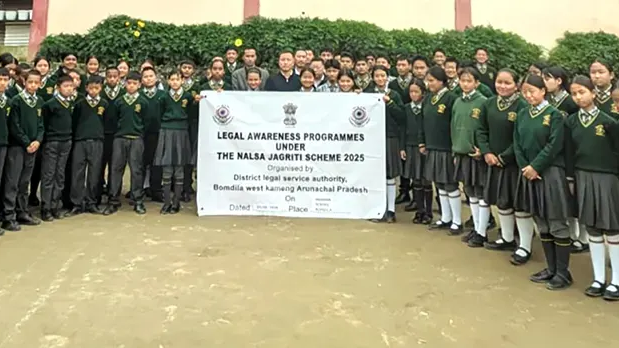
They weren’t just sitting through another school assembly. This time, what they heard could change — or save — their lives.
On Tuesday, the West Kameng District Legal Services Authority (DLSA) brought lawyers, legal counsels, and real conversations straight into the halls of Modern School in Bomdila. The session wasn’t a dry lecture. It was a room full of students learning — possibly for the first time — what the law actually says about them, for them, and because of them.
What the Law Says About Children
DLSA Secretary Tashi Wangchu kicked things off with something many families in the region rarely talk about openly: child marriage. He walked students through the Prohibition of Child Marriage Act, 2006, explaining the legally defined ages of marriage for both males and females. But more than just quoting the law, he laid bare the real-world consequences — how early marriage stunts the biological growth and overall development of young parents and their children alike. It’s a cycle that’s hard to break once it starts, and Wangchu made sure the students understood that.
He also spoke on the Right of Children to Free and Compulsory Education Act, 2009 — reminding every child in that room that getting an education isn’t a privilege. Up to the age of 14, it’s their fundamental right. That’s not just a feel-good statement; it’s a legal guarantee.
POCSO: A Law That Protects Every Child
Chief legal aid defence counsel Dorjee Tsering Sermupa took the floor to explain the Protection of Children from Sexual Offences (POCSO) Act, 2012. One point stood out: the Act is gender-neutral. It doesn’t just protect girls — it protects boys and children of diverse gender identities too. That’s a fact many people, including adults, still don’t know.
Sermupa also unpacked the Juvenile Justice (Care and Protection of Children) Act, 2015 — explaining the difference between children who come into conflict with the law and those who simply need care and protection. Both, he emphasized, are entitled to rehabilitation and support, not punishment.
Knowing the Difference — And Saying No
Deputy chief legal aid defence counsel Lham Tsering brought one of the most critical conversations to the table — good touch versus bad touch. Simple terms, but ones that can empower a child to speak up when something feels wrong. He also addressed drug and substance abuse directly, urging students to steer clear of narcotics. Not just because the law says so, but because their futures depend on it.
Students Didn’t Just Listen — They Asked
What made the programme genuinely impactful was the interaction. The students didn’t sit quietly — they asked questions, they engaged, they pushed back on legal issues they wanted to understand better. That kind of curiosity is exactly what programmes like this are meant to spark.
Awareness is the first step to protection. And in Bomdila on Tuesday, a classroom full of young minds got a little bit safer.
HASHTAGS
#AbotaniTV #ArunachalPradesh #ChildProtection #POCSOAct #WestKameng #Bomdila #DLSA #ChildRights #LegalAwareness #StopChildMarriage #RightToEducation #JuvenileJustice #ChildSafety #GoodTouchBadTouch #DrugAwareness #KnowYourRights #StudentAwareness #ProtectOurChildren #ArunachalNews #SafeChildren