
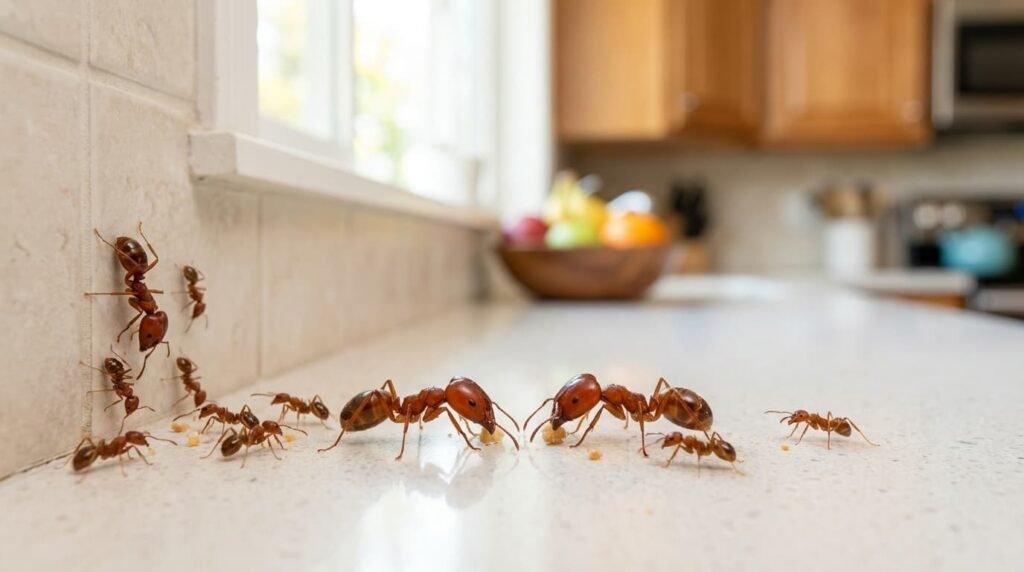
Few things ruin a quiet morning faster than opening a cabinet and finding a marching line of ants across the counter. Kitchens are the number one target for household ants because they offer exactly what a colony needs: food, water, and warmth. The good news is that you do not need chemical sprays to solve the problem. Learning how to get rid of ants in the kitchen without pesticides is straightforward, and natural methods often work better than sprays in the long run, because they target the colony instead of only the ants you can see.
This guide covers the full strategy: finding where ants enter, erasing the scent trails they follow, using natural repellents, building a bait that reaches the nest, and sealing your kitchen so they stay out.
Why Ants Invade Your Kitchen
Ants do not invade randomly. Scout ants leave the colony looking for food and water, and when one finds a crumb, a drop of juice, or a sticky jar, it walks home laying down a chemical scent trail called a pheromone trail. Other ants follow that trail, reinforce it, and within hours you have a steady highway across your countertop.
Understanding this changes your whole approach. Spraying the ants you see kills the workers on the trail, but the colony simply sends more, because the scent trail and the food source are still there. The methods in this guide break the trail, remove the food, and carry treatment back to the colony itself.
Most kitchen invaders are one of a few common types. Sugar ants and odorous house ants go after sweets and crumbs. Pavement ants enter through cracks in the foundation and love greasy food. Carpenter ants are larger and may signal a moisture problem in wood.
Step 1: Find the Trail and the Entry Point
Before you clean anything up, spend five minutes watching. This is the most valuable step in the whole process, and skipping it is the most common mistake.
- Follow the line. Watch where the ants are walking. The trail usually runs in a straight line from a food source back to a crack, a gap around a pipe, a window frame, or a baseboard.
- Check common entry points. Look behind the sink, around dishwasher and refrigerator water lines, under windows, and where cables or pipes pass through walls. Ants can squeeze through gaps as thin as a credit card.
- Find the food source. Check for a spilled drop of honey, an open sugar bag, crumbs under the toaster, pet food left out, or a sticky jam jar. Even a single drop of soda on the counter is enough to start an invasion.
- Note the time of day. Ant activity often peaks in the morning and evening. Knowing when they are most active tells you the best time to place bait.
Write down or photograph the entry point. You will need it later when you seal the gap, and if the ants return, you will know exactly where to look first.
Step 2: Erase the Scent Trail With Vinegar
The fastest way to stop the march is to destroy the pheromone trail. White vinegar does this well because its strong smell overpowers the ants’ chemical markers, and it is safe to use on countertops and floors.
- Mix equal parts white vinegar and water in a spray bottle.
- Spray the entire trail generously, from the food source all the way back to the entry point.
- Wipe it up with a paper towel and spray once more, leaving the surface slightly damp for a few minutes.
- Repeat daily for three to four days. Scout ants will keep testing the old route, and each time they find no scent trail, fewer of them return.
Vinegar also works as a general kitchen cleaner, so this step doubles as a deep clean of the area. Avoid using vinegar on natural stone countertops like marble or granite, since the acid can etch the surface; on stone, use soapy water instead.
Pros: Cheap, safe around food, and immediately effective at breaking the trail. Cons: It does not kill the colony, so ants can return if the food source or entry point is not dealt with. Vinegar is a first step, not the whole solution.
Step 3: Remove What Attracts Them
Ants keep coming back to a kitchen that feeds them. A serious cleanup removes their reason to visit and makes every other method far more effective.
- Store food in sealed containers. Transfer sugar, flour, cereal, and snacks from cardboard boxes and open bags into glass jars or hard plastic containers with tight lids.
- Wipe counters every night. A quick wipe with soapy water removes crumbs, grease film, and invisible sugary residue that ants can smell even when you cannot see it.
- Fix the small leaks. A dripping faucet, a damp sponge left in the sink, and condensation under the fridge all give ants the water they need.
- Take out trash daily during an invasion. Food scraps in the bin are a feast. Use a bin with a tight-fitting lid and wipe the rim clean.
- Do not leave pet food out overnight. Pick up bowls after feeding time, or set the bowl inside a shallow dish of water to create a moat ants cannot cross.
- Clean under appliances. Crumbs collect under the toaster, the microwave, and the stove. Pull them out once a week and vacuum the gaps.
This cleanup is not a one-time chore. Keeping a kitchen ant-free is mostly a habit, and the households that rarely see ants are usually the ones that wipe down surfaces nightly and store food properly. Similar chemical-free thinking works elsewhere in the home too; see our guide on how to get rid of spiders in the house without chemicals for the same seal-and-clean approach applied to another pest.
Natural Repellents That Actually Work
Repellents do not kill ants, but they make your kitchen an unpleasant place to be, which pushes scout ants to look elsewhere. Use them at entry points and along the places ants travel.
Lemon juice
Ants dislike the acid and smell of citrus. Squeeze fresh lemon juice along windowsills, door thresholds, and cracks, or wipe counters with a cloth dampened with lemon juice. Lemon peels placed near entry points work too, though they need replacing every few days as they dry out.
Cinnamon
Ground cinnamon disrupts the scent trail and irritates ants. Sprinkle a thin line across the entry point or along the baseboard where ants travel. Cinnamon essential oil mixed with water in a spray bottle is stronger and lasts longer than the powder.
Peppermint oil
This is one of the strongest natural ant repellents. Mix ten to fifteen drops of peppermint essential oil into a cup of water and spray it around entry points, window frames, and under the sink. Reapply every few days.
Coffee grounds
Used coffee grounds are a classic kitchen repellent. Spread them in a thin line along the outside of a door or window where ants enter. The grounds lose strength as they dry, so refresh them weekly.
Cucumber peels and chalk
Cucumber peels, especially from bitter varieties, repel many ant species. Place fresh peels near entry points. A line of ordinary chalk across a threshold also works as a short-term barrier, since it disrupts the scent trail, though it washes away easily.
Pros: Safe, pleasant-smelling, and easy to apply. Cons: Repellents are temporary and only protect the spots you treat. They push ants to a new entry point rather than solving the colony problem, so pair them with bait and sealing.
DIY Borax Bait That Reaches the Colony
Repellents and cleaning keep ants out of sight, but only bait eliminates the colony. Borax bait works because worker ants carry the sweet mixture back to the nest and feed it to the queen and the larvae. The colony collapses from the inside over one to two weeks. Borax is a naturally occurring mineral, not a synthetic pesticide spray, and this method uses only tiny amounts placed where ants travel.
- Mix one part borax with three parts sugar and stir in just enough warm water to make a thick syrup. A common batch is one teaspoon of borax, three teaspoons of sugar, and a few tablespoons of warm water.
- Soak cotton balls in the syrup and set them on small pieces of cardboard or in bottle caps.
- Place the bait stations directly on the ant trail, near the entry point but away from food preparation surfaces.
- Leave them alone for several days. You may see more ants at first as they discover the bait. This is a good sign; it means the bait is being carried home.
- Refresh the bait every two to three days until ant activity stops completely, usually within one to two weeks.
Safety first: Borax is toxic if eaten in quantity, so keep bait stations out of reach of children and pets. Never place bait on countertops where food is prepared. Label the stations so nobody mistakes them for something else, and wash your hands after handling borax.
Pros: The only home method that reliably kills the colony, not just the visible ants. Cons: Slow, taking a week or more, and it requires careful placement away from kids and pets.
Seal Entry Points for Good
Once the current ants are gone, sealing keeps the next colony out. This is the step most people skip, and it is the reason ants return season after season.
- Caulk cracks and gaps. Use silicone caulk around window frames, baseboards, and where pipes enter the wall. A ten-dollar tube of caulk can close the main routes into your kitchen.
- Replace worn door sweeps and weather stripping. A gap under the back door is a highway for ants. A new sweep costs little and blocks both ants and drafts.
- Seal around the sink and dishwasher lines. Check the gaps where water lines pass through cabinets and walls, and fill them with caulk or expanding foam.
- Fix damaged screens. A torn window screen lets ants and other insects in freely.
For a broader look at sealing your home against pests, our guide on how to get rid of gnats in houseplants without chemicals covers the same habit of removing moisture and food sources that keeps many household pests away.
Long-Term Prevention Habits
Getting rid of ants once is a project. Keeping them away is a routine. These habits take only minutes a day and make your kitchen far less inviting to scouts.
- Wipe counters and sweep the floor every night. Crumbs left overnight are an open invitation.
- Rinse recyclables before binning them. A jam jar or soda can with residue inside attracts ants even from inside a bin.
- Store fruit in the refrigerator during an invasion. A fruit bowl on the counter is a reliable ant magnet, especially bananas and peaches.
- Empty the compost bin often. If you keep a countertop compost container, empty it daily while ants are active.
- Keep the kitchen dry. Fix dripping taps, wipe up spills promptly, and run the exhaust fan while cooking to reduce moisture.
Common Mistakes to Avoid
- Spraying the ants you see and stopping there. Sprays kill workers but leave the colony, the scent trail, and the food source untouched. The ants come back within days.
- Wiping the trail before placing bait. Bait only works if ants can find it. Place bait first, let the ants carry it home for a week, and then erase the trail.
- Using bait that is too strong. If the borax concentration is too high, ants die before they reach the nest and the colony survives. Stick to the one-to-three ratio of borax to sugar.
- Leaving pet food out. Many invasions start at the pet bowl, not the pantry. Pick bowls up after feeding time.
- Sealing entry points before the colony is dead. If you block the only exit while the colony is still alive inside your walls, ants may push deeper into the house and appear in new rooms. Bait first, seal second.
When to Call a Professional
Natural methods handle most kitchen ant problems, but some situations need a professional exterminator. Call one if the ants keep returning after three weeks of baiting and sealing, if you find large carpenter ants that may be nesting in damp wood, if you see ants in multiple rooms at once, or if you have pharaoh ants, which are notoriously hard to eliminate because a colony can split into several nests when disturbed.
A good professional will inspect the home, identify the species, and use targeted treatments such as gel baits rather than blanket spraying. Ask whether they offer low-toxicity or bait-based options. Even after professional treatment, the cleaning and sealing habits in this guide are what keep ants from coming back. For another pest that often needs the same staged approach, see our guide on how to get rid of silverfish in the bathroom without pesticides.
Frequently Asked Questions
What kills ants in the kitchen instantly without pesticides?
A spray of soapy water kills ants on contact and erases their scent trail at the same time. Mix a few drops of dish soap into a spray bottle of water and spray the ants directly. This handles the ants you can see, but it does not kill the colony, so follow up with borax bait.
Does vinegar really get rid of ants?
Vinegar erases the pheromone trail ants use to navigate, which stops the marching line quickly. It does not kill the colony, so ants can return if food and entry points remain. Use vinegar together with cleaning, bait, and sealing for a complete solution.
How long does borax bait take to work?
Most people see a clear drop in ant numbers within three to five days, and the colony usually collapses within one to two weeks. You may see more ants than usual in the first day or two as workers discover the bait and carry it home. That surge is a sign the bait is working.
Are natural ant remedies safe around pets and children?
Vinegar, lemon, cinnamon, and proper food storage are safe. Borax bait and concentrated essential oils like peppermint need care: place bait where children and pets cannot reach it, and never use essential oils near small children or pets without checking safety guidance first.
Why do ants keep coming back to my kitchen every year?
Usually because the entry point was never sealed or a food source remains. Ants follow the same routes season after season. Sealing the entry point with caulk, combined with a thorough cleaning and a round of bait, breaks the cycle.
Can I use baking soda to get rid of ants?
Baking soda mixed with powdered sugar is a popular home remedy, and some ants will eat it, but it is far less reliable than borax bait. Sugar ants may ignore it, and it rarely reaches the queen in enough quantity to kill a colony.














1 thought on “How to Get Rid of Ants in the Kitchen Without Pesticides”
Comments are closed.