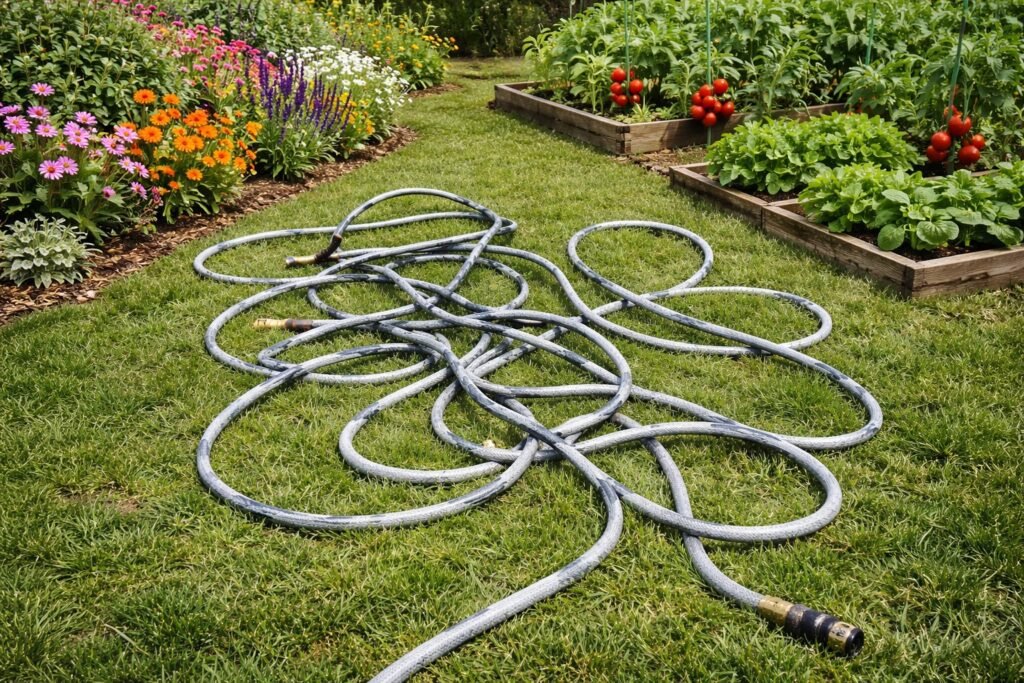
Learning how to keep a garden hose from kinking without a reel is mostly about understanding why hoses kink in the first place. A kink is a sharp bend that pinches the hose shut, cutting off water flow and, over time, weakening the hose wall at that exact spot. Reels solve the problem by keeping the hose in a smooth, even coil, but you can get the same result for free with better coiling, smarter storage, and a few watering habits. This guide covers all of it: how to coil a hose so it stays kink-free, how to store it without a reel, how to water without creating new kinks, and how to rescue a hose that already kinks in the same place every time.
Why Garden Hoses Kink
A garden hose kinks when it is forced into a bend tighter than its material can handle. Think of bending a drinking straw: bend it gently and water still flows, but fold it sharply and the walls collapse together and block the passage. Hoses behave the same way. The most common causes are twisting during use, pulling the hose around a sharp corner, coiling it in tight loops, and letting it sit in a tangled pile where bends get pressed into the material.
Hose memory also plays a role. A hose that has been stored in the same kinked shape for a long stretch tends to hold that shape, so it folds at the same weak spot again and again. Heat and sunlight can make the material softer and more likely to collapse, while cold makes it stiffer and more likely to crease instead of curving. Age matters too: an older hose with a worn or thinned wall kinks more easily than a newer one. None of this means you need a reel. It means you need to treat the hose in ways that avoid sharp bends and let it relax into smooth curves.
Start by Undoing the Damage: Uncoil Fully Before Every Use
The single most effective habit is also the simplest: uncoil the entire hose before you turn on the water. Many kinks happen because someone pulls out only part of a coiled hose and starts watering while the rest is still wound tight. The section still in the coil twists as it is dragged, and the twist becomes a kink the moment water pressure builds up behind it.
Lay the hose out in a long, loose path from the faucet to wherever you will water, and let it rest for a moment. Walk along it and straighten any loops or twists by hand before opening the faucet. This takes less than a minute and prevents most kinks before they start. If the hose has been stored in a tight coil, give it a little extra time to relax and stretch out. A hose that starts straight is far less likely to kink than one that starts tangled, no matter how carefully you handle it afterward.
The Figure-Eight Coil: The Best Free Coiling Method
If you only learn one coiling technique, make it the figure-eight coil. Unlike a simple round coil, which twists the hose a little more with every loop, the figure-eight alternates the direction of each loop and cancels out the twist. The result is a coil that lies flat, unwinds cleanly, and resists kinking the next time you use it.
How to coil in a figure eight
Start at one end of the hose and make a loop about two feet across. For the next loop, cross the hose over in the opposite direction, forming the second half of the figure eight. Continue alternating: one loop curving one way, the next curving the other way. Keep the loops loose and roughly the same size, and do not force the hose into tight circles. When you reach the end, the coil should sit fairly flat and feel relaxed, not springy or twisted. It may feel awkward the first couple of times, but it quickly becomes automatic, and the difference in how the hose behaves next time is immediately noticeable.
Why it beats a round coil
A round coil adds a small twist with every loop. By the time you have coiled a long hose, that twist has built up into real tension, and the hose fights you when you unroll it, flipping and folding into kinks. The figure-eight method avoids that buildup entirely, which is why professional gardeners and stage crews use it for cables and hoses alike. It takes no extra time once you know it, and it needs no equipment at all.
The Over-Under Method for Longer Hoses
For longer hoses, the over-under method is another excellent free technique. Make the first loop normally, with the hose passing over the top. For the next loop, give the hose a half twist so it passes under instead of over, which reverses the twist. Alternate over and under for the whole length. Like the figure eight, this keeps the hose twist-free, and it has an added benefit: an over-under coil can be carried over your shoulder or hung from a hook without tangling.
Both methods work well, so use whichever feels more natural to you. The important thing is to stop using the simple round coil that twists the hose tighter with every loop. If you have always coiled your hose in plain circles, switching to either of these methods alone may solve most of your kinking problems.
Store the Hose Without a Reel
Good storage is where most kink prevention happens, and none of these options costs anything if you use what you already have around the home and yard.
Hang it on a wide hook or peg
A large hook, a sturdy peg, or a wide nail driven into a fence post or wall makes an excellent hose holder. The key word is wide: the hose should hang in a broad, gentle loop, not drape over a thin nail or sharp edge that creates a pressure point. Hang the coiled hose in its figure-eight or over-under shape, and keep the loops loose. Avoid hanging the hose by its very end so that all the weight pulls on one spot. If the only hook you have is narrow, wrap it with a rag or an old cloth to widen and soften the surface it rests on.
Use a bucket or large container
A sturdy bucket, tub, or old storage bin makes a surprisingly good hose home. Coil the hose loosely inside the container, starting with the faucet end at the bottom and layering the loops gently on top of each other. The container walls support the coil and keep it from collapsing into a tangled pile, while the open top lets you lift the hose out without dragging it across sharp edges. Keep the container in a shaded spot, since direct sun heats the hose and softens the material. A container with a lid is even better for keeping out debris, but leave the lid ajar or off entirely in damp conditions so trapped moisture does not encourage mildew.
Keep it off the ground and out of traffic
Wherever you store the hose, keep it somewhere it will not be stepped on, driven over, or crushed under other items. A hose left lying across a path gets walked on, and every footstep presses a flat spot into it that can become a future kink. The same goes for stacking heavy pots or tools on top of a coiled hose. Choose a storage spot that is out of the way but still easy to reach, so you are not tempted to just drop the hose wherever you finish watering.
Water Without Creating New Kinks
How you handle the hose while watering matters as much as how you store it. A few simple habits during use will keep water flowing freely.
Take the path of least resistance
Before you start watering, plan a route from the faucet to your plants that avoids sharp corners. Do not drag the hose tightly around the corner of a house, a fence post, or a tree trunk, since a tight corner is exactly where kinks form. Instead, give the hose a wide, sweeping curve around obstacles, and leave some slack in the line. A hose pulled taut is a hose waiting to kink, because any small tug creates a sharp angle at the nearest fixed point. Slack is your friend: a little extra length in the line absorbs movement and keeps bends gentle.
Move the hose, not just the nozzle
When you move to a new area of the yard, walk back and reposition the hose itself rather than yanking it from the nozzle end. Yanking twists the hose and drags it across edges that catch and fold it. Instead, pick up the middle of the hose, carry it to the new spot, and lay it down in a smooth curve. It takes a few extra seconds, but it prevents the twist buildup that causes most mid-watering kinks.
Watch the pressure
Very high water pressure can worsen kinking, because the pressure pushes hard against any slight bend and collapses it fully shut. If your faucet has a shut-off valve, try opening it only partway rather than all the way. You will still get plenty of water for most garden tasks, and the hose will be more forgiving of gentle curves. If you notice the hose bulging or whipping near the faucet, that is a sign the pressure is too high for the hose, and turning it down will help immediately.
Fix a Hose That Kinks in the Same Spot
A hose that always kinks in the same place has a weak spot, often where it was previously folded or crushed. You can usually rescue it without replacing the hose. Start by laying the hose out straight in the sun for a while, since gentle warmth softens the material and helps it relax out of its creased shape. Then run warm water through the hose, not hot enough to damage it, just warm enough to make the material pliable, while you gently straighten the weak section by hand.
Another useful trick is to splint the weak spot temporarily with a short section of a slightly larger hose or a piece of flexible tubing slipped over it, if you happen to have one lying around. This supports the wall at the weak point and prevents it from collapsing. Avoid wrapping the spot tightly with tape, which can trap moisture and does not actually strengthen the wall. If the same spot keeps kinking even after these efforts, and the hose wall feels thin, cracked, or soft there, the section may be worn out. In that case, cutting out the damaged section and rejoining the hose with a connector you already own is a practical repair, and it is still far cheaper than replacing the whole hose.
Seasonal Hose Care That Prevents Kinks
A little care between watering sessions keeps a hose flexible and kink-resistant over the long term. Drain the hose after use by lifting the far end and letting water run out toward the faucet end, or simply by holding the nozzle end lower than the rest and letting gravity do the work. A hose full of standing water is heavier, stiffer, and more likely to hold the shape of whatever coil it sits in.
Store the hose in the shade whenever possible. Prolonged sun exposure degrades the outer material, making it brittle in some spots and soft in others, both of which encourage kinking. During cold weather, drain the hose completely before storing it, since water left inside can freeze, expand, and damage the walls. A drained, loosely coiled hose stored in a sheltered spot will come out of storage in much better shape than one left full of water and tangled on the ground.
Mistakes That Cause Kinks
The most common mistake is coiling a hose while it is still full of water and under pressure. The water makes the hose stiff and heavy, so it resists smooth coiling and folds sharply instead. Always turn off the faucet and release the pressure before coiling. Another frequent mistake is wrapping the hose tightly around a narrow post or tree trunk for storage, which presses a permanent bend into the material at every contact point.
Dragging a hose across gravel, concrete edges, or sharp garden borders also causes trouble, since rough surfaces catch and twist the hose as it moves. Carry the hose over rough ground instead of dragging it. Finally, avoid leaving the hose in a tangled heap “just for now.” Temporary heaps have a way of becoming permanent storage, and a hose that sits tangled for weeks will remember every fold. Taking thirty seconds to coil it properly at the end of each watering session saves far more time than untangling kinks later.
Frequently Asked Questions
Can I really stop kinking without buying a reel?
Yes. A reel is convenient, but it is not the only way to keep a hose smooth. Proper coiling with the figure-eight or over-under method, storage on a wide hook or in a container, and watering habits that avoid sharp bends achieve the same result without any purchase.
What is the best way to coil a hose so it does not kink?
The figure-eight coil is the best free method for most people, because it cancels out twist with every alternating loop. The over-under method works equally well for longer hoses. Both are far better than a simple round coil, which adds twist with every loop.
Why does my hose kink in the same spot every time?
That spot has likely been weakened by a previous sharp fold, crushing, or prolonged pressure. Lay the hose straight in gentle warmth, run warm water through it, and straighten the section by hand. If the wall feels thin or cracked there, cutting out the damaged section and rejoining the hose is the lasting fix.
Should I drain my hose after every use?
Draining is a good habit. It makes the hose lighter and easier to coil, prevents water from sitting inside and stiffening the hose, and protects it from freeze damage in cold weather. Simply hold the nozzle end low and let gravity empty it before coiling.
Does water pressure affect kinking?
Yes. Very high pressure pushes hard against any slight bend and can collapse it into a full kink. Opening the faucet only partway usually still provides plenty of water for garden tasks while making the hose more forgiving of gentle curves.
Is it okay to leave my hose outside all the time?
It is better to store it in a shaded, sheltered spot, loosely coiled or hung on a wide hook. Constant sun degrades the material, and a hose left lying on the ground gets stepped on, run over, and tangled, all of which create future kinks.