
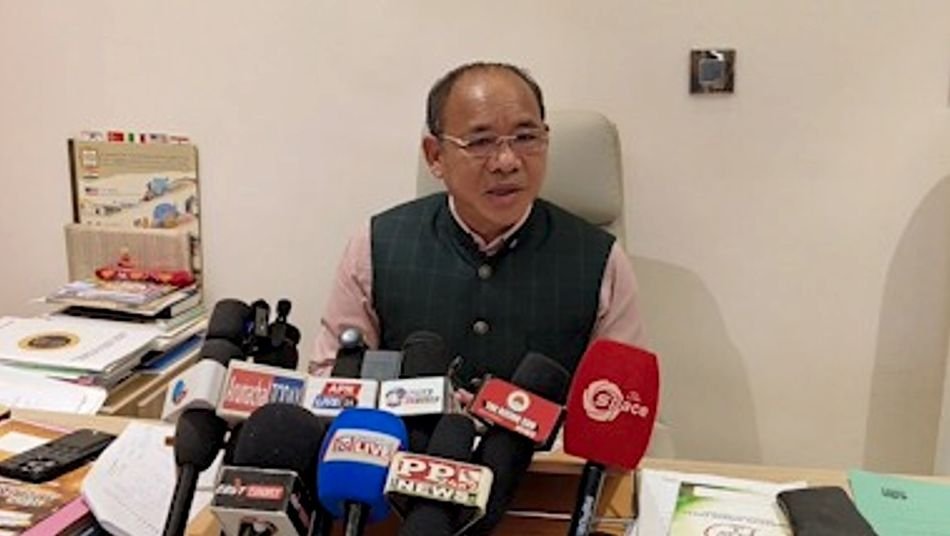
The government isn’t just looking for ideas on paper. It wants solutions that can actually work — and it’s willing to fund them.
Arunachal Pradesh made a bold move on October 5, launching the National Innovation Challenge (NIC), a platform inviting young Indians — students, startup founders, village innovators, community groups — to step forward with solutions to problems that actually exist in their neighbourhoods. Not theoretical problems. Not sanitised case studies designed for classrooms. Real ones. The kind that hit you when you step out your front door.
The challenge was launched as part of the 25-year public service milestone of Prime Minister Narendra Modi, but what stands out is that the government framed it not as a tribute event, but as something with genuine utility. The stated goal was to honour that milestone by building a platform where young people solve problems rather than just observe a commemoration. That’s a meaningful distinction.
The scale of the initiative is significant. The challenge will be conducted across five cities — Bengaluru, Ahmedabad, Mumbai, Kolkata and New Delhi. For Arunachal and the wider Northeast, the entry point is through the Kolkata regional leg. That regional challenge will cover West Bengal, Odisha, Jharkhand, Bihar and the Northeast, including Arunachal Pradesh. So when a young student from Ziro or Bomdila submits an idea, they are competing on the same platform as innovators from across eastern India — which, depending on how you look at it, is either an exciting opportunity or a reminder of how often the Northeast has to prove itself twice as hard to be noticed.
Who Can Apply — And What They’re Looking For
The challenge is open to school and college students, polytechnic trainees, young professionals, early-stage startups, independent innovators and community groups. Applicants can participate individually or in teams.
Two categories have been proposed — Junior, for school, ITI and undergraduate students, and Open, for graduates, professionals, startups and community groups. The Junior category will focus on insight, ingenuity and clarity of thinking, while the Open category will place greater emphasis on the strength of the implementation case, with a prototype or pilot expected.
That last part matters. The bar in the Open category isn’t just “have a good idea” — you need to show how you’d actually make it happen. That’s what separates this from a school science fair.
Applications opened on October 5, with October 25 as the deadline for inquiries and October 30 as the final date for submissions. Submissions go through the Arunachal Pradesh State Startup Portal.
The pathway after selection is well-structured. Shortlisted innovators will first be invited to Itanagar to present their ideas before a jury. Selected participants will then travel to Kolkata for the next round, with finalists proceeding to New Delhi. And here’s a detail that shouldn’t be overlooked — the Arunachal Pradesh government will bear the travel expenses of selected participants. For a young innovator from a remote district who might otherwise see financial cost as a barrier, that commitment from the state is genuinely consequential.
A Startup Ecosystem That’s Actually Growing
None of this is happening in a vacuum. Arunachal has been quietly building its innovation infrastructure for a while now, and the numbers reflect that.
The Arunachal Pradesh Innovation & Investment Park (APIIP) has been conceptualised as the nodal institution for innovation in the state, including for the National Innovation Challenge. Alongside it, the Arunachal Pradesh Entrepreneurship Development Programme (APEDP) has gained recognition in the national startup ecosystem.
Arunachal Pradesh was adjudged a ‘Best Performer’ under the Government of India’s National Startup Ranking Framework. That recognition didn’t come from just declaring ambitions — APEDP has so far incubated 156 startups, while another 100 startups are currently under incubation. Those are real ventures, with real founders, working out of a state that many outsiders still primarily think of in terms of geographical remoteness.
The national picture reinforces why this push makes sense right now. India’s position in the Global Innovation Index improved from 81st in 2015 to 38th in 2025. The number of DPIIT-recognised startups has increased from around 350 in 2014 to more than 2.4 lakh in 2025-26, making India the world’s third-largest startup ecosystem. Arunachal wants a visible piece of that story — and not just as a footnote.
What This Is Really About
The challenge seeks solutions at every level — at the level of a state, district, city, village or panchayat, with a credible pathway to implementation and potential for scaling or replication. Village. Panchayat. Those words are doing a lot of work here. They signal that the government isn’t just interested in tech-startup glamour. A young person from a border village who has figured out a smarter way to manage water access or reduce food wastage in their community is just as welcome here as someone pitching a mobile app in Itanagar.
There’s something quietly radical about a state government telling its young people: your local problem is worth solving, and we want to help you do it.
Arunachal has always had the human potential. What’s changing is the infrastructure around it — the portals, the pathways, the people willing to mentor and fund. The National Innovation Challenge, whatever its political backdrop, is a real opening. And if young innovators from across this state show up and use it the way it’s intended, the solutions that emerge may well be the ones their communities have been waiting years for.