
The Siang belt is simmering. And the All Adi Youth Association has had enough.
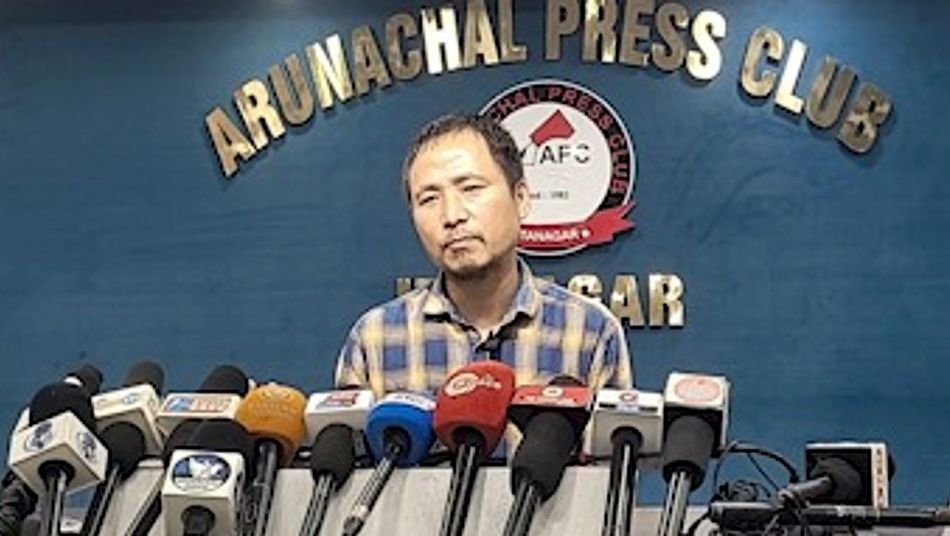
On October 6, the All Adi Youth Association (AAYA) walked into the Arunachal Press Club with one message that was direct, unambiguous, and long overdue — withdraw the Central Armed Police Forces and state police from Siang and Upper Siang districts immediately, and only then talk about the Siang Upper Multipurpose Project (SUMP). No forces, no dialogue. That’s the position. And judging by what has unfolded in villages like Riga and Ugeng in recent weeks, one can hardly blame them for drawing that line.
AAYA Secretary (IPR) Okut Tali addressed the press conference and didn’t mince words. He condemned what he described as the alarming situation that has gripped the Siang belt — a region that is now as tense as it has been in living memory — all because of a proposed dam project that a significant section of the indigenous Adi community simply does not want.
The Siang Upper Multipurpose Project, proposed at a staggering capacity of over 10,000 MW, has been a fault line in Arunachal Pradesh for years. But things took a sharper, more dangerous turn when clashes erupted between protesters and security personnel in Riga and Ugeng. Several protesters were reportedly injured. So were CRPF personnel. When police and protesters are bleeding on the same ground, something has clearly gone very wrong.
Tali pointed out that the heavy presence of security forces in areas including Sitang and Riga had done nothing to ease tensions. If anything, it had made them worse. The Adi people who have lived along the Siang river for generations are watching armed forces patrol their villages — villages that now face the prospect of being submerged if the dam goes through. That’s not a recipe for calm. That’s a recipe for exactly what is now happening.
What made AAYA’s press conference particularly significant was the sharp pushback against the state government’s narrative. The government has claimed that a majority of project-affected families have already accepted the SUMP and signed Memoranda of Understanding. Tali flatly rejected that. He pointed to the protests, to the clashes, to the sheer intensity of public opposition, and asked: does this look like consent to you?
It’s a fair question. AAYA alleged that the MoUs cited by the government do not represent all 27 project-affected villages. Worse, the association claimed that consultation and consent-gathering exercises were conducted selectively — in some cases, quite literally behind closed doors and outside the concerned villages altogether. If that’s true, then what the government is presenting as community agreement is something far more complicated, and far more contested.
There’s also something culturally significant about how AAYA framed its opposition. Tali invoked the Kebang — the traditional community assembly of the Adi people, a customary institution through which disputes have been resolved for centuries. He argued that deploying armed forces in the region runs completely counter to the Adi way of dealing with disagreements. The Adi community has its own democratic traditions, its own mechanisms for dialogue and consensus. Sending in the CRPF is not part of that tradition. It is, in the community’s eyes, an act of force — not governance.
The association’s demands don’t stop at troop withdrawal. AAYA has also called for the revocation of the suspension of several gaon burahs — village headmen — who were suspended by the district administration over their alleged participation in anti-SUMP protests. These are elected, customary village leaders. Suspending them for opposing a government project sends a chilling message to anyone thinking about speaking up. AAYA has called it out for what it is: suppression of citizens’ constitutional rights. The association is also demanding that the FIRs registered against protesters in Siang and Upper Siang be immediately withdrawn.
The state government, for its part, has maintained that the Pre-Feasibility Report currently being conducted is merely an initial technical assessment — not a green light to build the dam. That distinction may matter in legal and bureaucratic terms. On the ground in Siang, it matters very little. For communities that have watched forests cleared, rivers studied, and security forces arrive, the PFR feels like the beginning of an irreversible process. And they are not waiting for the end of that process to resist it.
The SUMP has become a flashpoint for something much larger — the question of who gets to decide what happens to indigenous land, rivers, and communities in the Northeast. The Adi people are not anti-development. But they are insisting, loudly and at considerable personal risk, that development cannot happen without their genuine, informed, and free consent. Not consent gathered in closed rooms. Not consent from a handful of signatories while the rest of the village protests outside.
The government has a choice to make. It can keep the armed forces in place, keep collecting contested signatures, and keep escalating a situation that has already turned violent. Or it can pull back, sit down, and actually listen to the 27 villages whose rivers, farms, and futures are on the table.
The Siang has been flowing through these hills for thousands of years. The Adi community has lived alongside it just as long. They know what they’re fighting for. The question now is whether the government is willing to hear them — or whether it will take even more confrontations before that message finally lands.