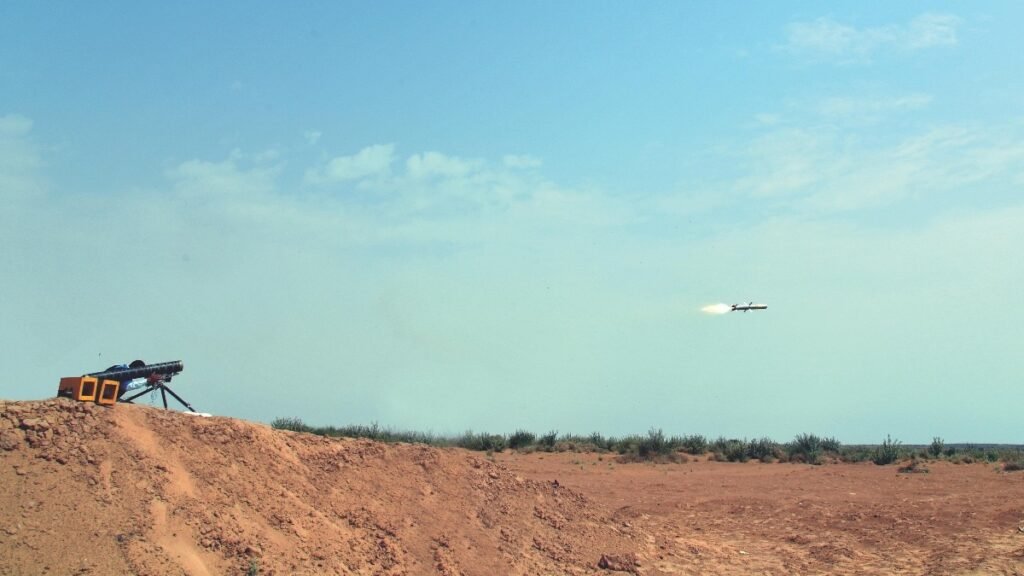
India has successfully test-fired JWALA MK-1, an indigenous autonomous counter-drone micro-missile system, at the Pokhran firing range in Rajasthan, in a boost to the country’s indigenous defence capabilities. The system was developed by defence technology firm IG Defence, which described it as India’s first autonomous Counter-Unmanned Aircraft System (CUAS) micro-missile.
The surface-to-air system has been designed to detect, identify and classify hostile unmanned aerial vehicles (UAVs) before intercepting and destroying them through a hard-kill mechanism. According to the company, it has an operational range of up to 5 km, engaging targets at distances of 2 to 5 km and altitudes ranging from 50 metres to 5,000 metres, covering cruise as well as higher-altitude aerial targets.
How JWALA MK-1 works
At the core of the system is GRID, an artificial intelligence-based mission autonomy and battle management system developed by IG Defence, which coordinates the engagement process and allows the system to respond to aerial threats through an integrated command architecture. The interceptor uses a dual-pulse solid rocket motor paired with aerodynamic fin controls for propulsion and flight manoeuvrability, and carries a pre-fragmented high-explosive warhead fitted with a proximity fuse that detonates near its target rather than relying solely on a direct hit.
Bodhisattwa Sanghapriya, founder and chief executive officer of IG Defence, described the successful flight test as a defining moment for India’s private-sector defence industry. The company said JWALA MK-1 is an indigenous, autonomous and cost-effective solution to address the rapidly evolving threat posed by hostile unmanned aerial systems, and that a dedicated micro-missile offers a more economical hard-kill layer alongside existing air defence guns.
What remains undisclosed
The Pokhran test marks a development milestone for JWALA MK-1, but the company has not disclosed details of the test’s engagement conditions, the number of targets intercepted, the cost per engagement, or the system’s production and induction timeline. IG Defence had previously demonstrated T-SHUL BEAM, an electronic countermeasure-based soft-kill system, at the Indian Air Force’s Dronathon 2026 exercise in Pokhran. Meanwhile, the Indian Army is also conducting trials at Pokhran for domestic firms to test jet-powered kamikaze drones, a weapon class used extensively in the Russia-Ukraine conflict.
The development comes amid growing concern over the use of relatively inexpensive drones for surveillance, reconnaissance and attacks against military installations. India’s indigenous missile programme continues to advance — DRDO test-fired the Pralay missile off the Odisha coast — and the armed forces are paying close attention to drone threats after an Indian was hurt when drone debris struck the Shaybah oilfield in Saudi Arabia. An IAF IL-76 recently landed at 13,629 feet in Ladakh, a world record.
#JWALAMK1 #IGDefence #Pokhran #CounterDrone #IndianArmy #AtmanirbharBharat #Defence #Missile