
Two weeks of clothes in a carry-on sounds impossible — until you see someone do it. The secret is not magic compression or expensive gear. It is a system: a small, mix-and-match wardrobe, laundry built into the plan, and packing techniques that turn wasted space into usable space. This guide shows you how to pack a carry on for two weeks without checking a bag, step by step, so you can skip baggage claim, dodge checked-bag fees, and move through airports and train stations like the trip belongs to you.
Whether you are headed across the country or across the ocean, the method below works for any two-week trip with access to occasional laundry. It also scales: once you can pack for fourteen days in a carry-on, a long weekend feels effortless.
Why Travel Carry-On Only
Before the how, a quick word on the why — because commitment matters when you are staring at your closet the night before a trip.
- No lost luggage: Your bag is with you from gate to hotel. Misrouted checked bags ruin roughly the first two days of a trip; carry-on travelers never find out.
- No baggage fees: Many airlines charge for every checked bag. On a round trip with connections, carry-on-only travel can save a meaningful amount.
- Faster everything: You walk off the plane and you are done. No carousel wait, no overweight-bag anxiety at check-in, easier boarding.
- Forced simplicity: A small bag means fewer decisions each morning. Travelers consistently report feeling lighter and more mobile with less stuff.
- One-bag freedom: Trains, buses, cobblestone streets, and stairs all get dramatically easier with a single bag you can lift yourself.
Step 1: Know Your Bag’s Real Limits
Most standard carry-on suitcases hold 35 to 45 liters, with common maximum dimensions around 22 x 14 x 9 inches for major airlines. But limits vary — budget carriers are stricter, and international airlines often enforce weight caps around 7 to 10 kilograms. Check your specific airline’s rules before you pack, not after.
Weigh your empty bag. Hard-shell suitcases can eat up 3 to 4 kilograms of your allowance before you pack a single sock. A lightweight soft-sided bag or a 40-liter travel backpack often gives you several extra kilograms of usable capacity. If your airline enforces weight limits strictly, the bag itself is the first upgrade worth making.
Step 2: Build a Capsule Travel Wardrobe
This is the heart of the method. You are not packing fourteen outfits — you are packing a small wardrobe of interchangeable pieces that create far more than fourteen combinations. Aim for roughly 10 to 12 clothing items total, plus what you wear on the plane.
The 5-4-3-2-1 formula
A reliable starting point for two weeks:
- 5 tops: neutral, quick-dry or wrinkle-resistant. Mix short and long sleeves depending on the climate.
- 4 bottoms: two pairs of pants or jeans, plus shorts or a skirt. Dark colors hide wear between washes.
- 3 layers: a light jacket, a sweater or fleece, and a rain shell. Wear the bulkiest layer on travel days.
- 2 pairs of shoes: one comfortable walking pair (worn on the plane), one versatile second pair. Shoes are the biggest space thieves — two is the hard limit.
- 1 of the extras: a scarf, hat, or belt that changes the look of repeat outfits.
Add underwear and socks for about five to seven days — these are small, and you will do laundry. Add sleepwear that doubles as a layer if needed.
Choose a two-color palette
Pick two base neutrals — navy and gray, black and olive, brown and white — and let every piece work with every other piece. When everything matches, getting dressed takes thirty seconds and nothing looks repeated, even when pieces repeat. A single accent color in a scarf or top keeps photos interesting.
Fabric matters more than fashion
Merino wool and synthetic blends resist odor, dry overnight, and shrug off wrinkles. Cotton is comfortable but heavy, slow to dry, and shows wear fast. You do not need a full technical wardrobe — even two or three quick-dry pieces in the mix make laundry day dramatically easier. For a long trip, this is also a good moment to plan a budget road trip style mindset: spend on versatile pieces that serve the trip, not on a vacation wardrobe you will wear once.
Step 3: Plan Laundry Into the Trip
This is the step most people resist and every experienced light traveler swears by. Two weeks of underwear and socks will not fit — and they do not need to. Plan one or two laundry sessions during the trip.
- Hotel or rental laundry: Many hotels offer same-day service; vacation rentals often include a washer. Check before you book if this matters to you.
- Laundromats: Common in most cities, often cheap, and a genuinely local experience. A mid-trip laundromat stop takes about an hour of passive waiting.
- Hand washing: A travel clothesline and a small bottle of detergent handle underwear and quick-dry tops in any sink. Wash in the evening, dry overnight.
Schedule laundry for the midpoint of the trip. Wash everything on day seven, and your five-to-seven-day clothing supply stretches effortlessly across fourteen days. Pack a small dry bag or zip pouch for dirty laundry to keep it separate.
Step 4: Master the Packing Techniques
With the wardrobe chosen, technique determines whether it all fits. These methods are proven by thousands of one-bag travelers:
Roll, don’t fold
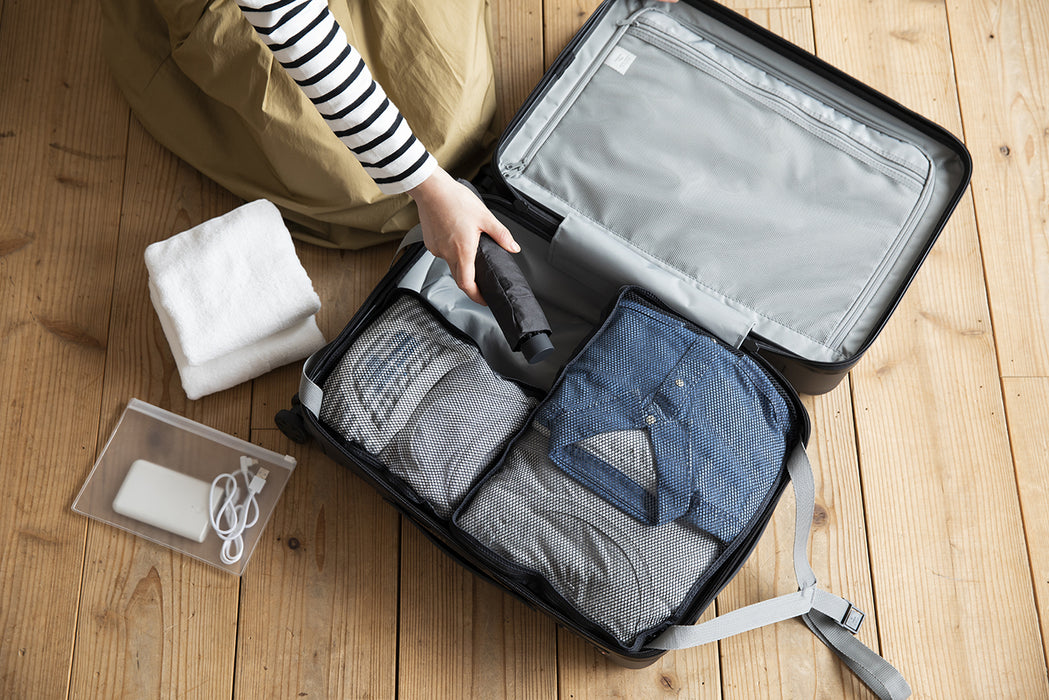
Tightly rolled clothes compress better and wrinkle less than folded stacks for most casual fabrics. Roll each item individually — t-shirts, pants, underwear — and pack the rolls side by side like a filing system. For structured items like blazers or dress shirts, use the bundle-wrapping method: wrap them around a core of rolled soft items to minimize creases.
Use packing cubes
Packing cubes are the single highest-impact packing purchase for carry-on travel. They compress clothes, keep categories separated, and let you pull out “tops” without exploding the whole bag. Compression cubes go further, squeezing air out of bulky items like sweaters. Organize by category or by outfit — either works.
Fill every dead space
Shoes are hollow — stuff them with socks, chargers, or rolled underwear. The gaps along the bag’s walls fit belts (coiled), rolled scarves, and flat pouches. Place heavy items near the wheels of a rolling bag for stability, and keep your liquids bag and documents at the top for easy access at security.
Wear the bulky stuff
Your heaviest shoes, bulkiest jacket, and thickest sweater travel on your body, not in your bag. This single rule can free up a third of your carry-on’s volume. Dress in layers for the flight — planes are cold anyway, and you will be comfortable.
Step 5: Handle Toiletries and Liquids Smartly
The liquids rule (containers of 3.4 ounces or less in a single quart-sized bag) is the hard constraint on toiletries. Strategy:
- Decant, don’t bring full bottles: Two weeks of shampoo fits in a small reusable bottle. Buy travel-size containers once and refill them forever.
- Go solid where possible: Bar shampoo, bar soap, and solid deodorant skip the liquids bag entirely and last longer than their bottled equivalents.
- Buy at the destination: Sunscreen, full-size shampoo, and other bulky items are often cheaper to buy on arrival than to haul. Plan a quick store stop on day one.
- Skip the “just in case” pharmacy: Bring prescription medications plus a tiny kit of basics — pain reliever, bandages, any personal essentials. Everything else exists at pharmacies worldwide.
Step 6: Pack Electronics Without the Tangle
Electronics bloat many carry-ons. Consolidate: one multi-port charger instead of three bricks, a single cable type where possible, and a compact power bank. A small tech pouch keeps everything findable. Download entertainment, maps, and translation packs offline before you leave — it saves both space (no bulky guidebooks) and data.
Keep valuables and a change of essentials in your personal item (the backpack or tote that fits under the seat). If overhead space runs out and your carry-on gets gate-checked on a full flight, your documents, medications, electronics, and one outfit stay with you. This backup layer is what separates relaxed travelers from stressed ones.
The Complete Two-Week Carry-On Checklist
Use this as your final pass before zipping up:
- 5 tops (quick-dry or wrinkle-resistant, neutral palette)
- 4 bottoms (including one comfortable travel pair)
- 3 layers (light jacket, sweater or fleece, rain shell)
- 2 pairs of shoes (wear the bulkier pair)
- 5–7 sets of underwear and socks
- Sleepwear (doubles as a layer if possible)
- 1 versatile accessory (scarf, hat, or belt)
- Toiletries in a quart bag + solid alternatives
- Prescription medications and a mini first-aid kit
- Travel documents, cards, and insurance details (plus digital copies)
- Electronics: phone, charger, power bank, adapters, headphones
- Packing cubes, laundry bag, small detergent packets, travel clothesline
- Reusable water bottle (empty through security)
- Personal item: documents, valuables, one outfit, snacks, entertainment
Do a trial pack two or three days before departure. If it does not fit, cut — do not upgrade the bag. The trial pack also reveals what you forgot while there is still time to fix it. And if your closet itself feels overwhelming during the process, the same principles behind decluttering a small bedroom apply to your suitcase: keep what serves the trip, release the rest.
Mistakes to Avoid
- Packing for “what if” instead of “what is”: The formal outfit for the dinner that might happen, the third jacket for weather that probably will not come. Every “just in case” item is weight you carry for two weeks. If a true surprise arises, buy it there.
- Bringing three or more pairs of shoes: Shoes are the fastest way to fill a carry-on. Two pairs maximum — comfortable walkers on your feet, one versatile backup inside.
- Ignoring the laundry plan: Packing fourteen days of underwear “to be safe” guarantees an overflowing bag. Commit to the mid-trip wash.
- Full-size toiletries: A two-week supply of most products fits in containers a fraction of the size. Decant everything.
- No personal-item strategy: Putting documents, medications, and valuables in the overhead bag leaves you exposed if it gets gate-checked. Essentials ride under the seat, always.
- Packing the night before: Rushed packing always overpacks. A trial pack days ahead, plus a written list, is the difference between a bag that closes and one that does not.
- Forgetting airline differences: The bag that flies free on one airline gets a fee — or a forced gate check — on another. Verify size and weight rules for every airline on your itinerary.
Frequently Asked Questions
Can you really fit two weeks of clothes in a carry-on?
Yes — with a capsule wardrobe of about 10 to 12 mix-and-match pieces and one planned laundry session mid-trip. You are not packing fourteen distinct outfits; you are packing versatile pieces that combine into dozens of outfits. Rolling clothes, packing cubes, and wearing bulky items on travel days make the volume work.
How many outfits do I actually need for two weeks?
About five to seven days’ worth of clothing, washed once mid-trip. A proven formula is five tops, four bottoms, and three layers in a coordinated color palette, plus five to seven sets of underwear and socks. Laundry on day seven resets the whole wardrobe for week two.
What is the best way to do laundry while traveling?
Use whatever fits your itinerary: hotel laundry service, a local laundromat (often the cheapest option), or hand-washing quick-dry items in a sink with a travel clothesline for overnight drying. Pack a small detergent supply and a dry bag for dirty clothes. Schedule the wash for the trip’s midpoint so the timing is predictable.
How do I fit everything with strict airline weight limits?
Start with a lightweight bag, since the suitcase itself can consume a large share of a 7 to 10 kilogram limit. Wear your heaviest items, choose quick-dry fabrics over heavy cotton and denim, decant toiletries, and go solid where possible. Weigh the packed bag at home with a luggage scale — never discover the problem at the airport.
Should I use a rolling suitcase or a travel backpack?
Both work for two weeks. Rolling suitcases protect clothes better and are easier on long airport walks; travel backpacks win on stairs, cobblestones, and crowded transit. Choose based on your trip’s terrain: smooth airports and hotels favor wheels, while multi-city itineraries with trains and old-town streets favor a backpack.
What should go in my personal item vs. the carry-on?
Your personal item — the bag under the seat — holds everything you cannot afford to lose access to: passport and documents, medications, electronics and chargers, valuables, a change of clothes, and snacks. The overhead carry-on holds the bulk wardrobe and toiletries. This split means a forced gate-check never separates you from your essentials.