
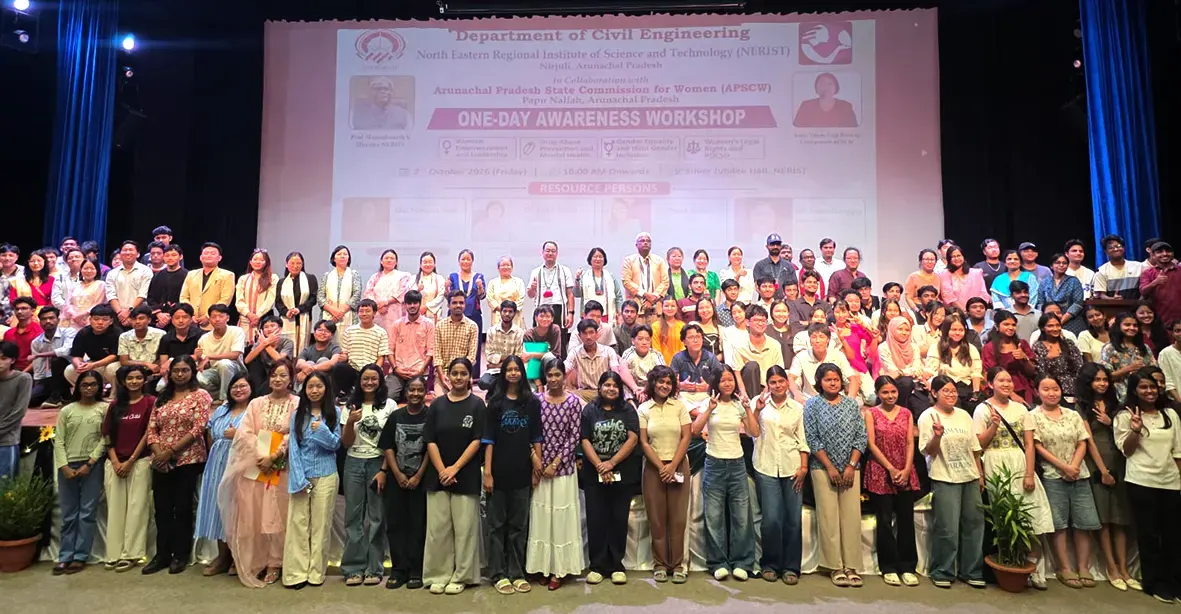
It was not just another workshop. At NERIST, Friday felt different.
Nirjuli, October 2 — The North Eastern Regional Institute of Science and Technology (NERIST) did something important on Friday — it opened a space where young people could talk honestly about things that matter. Not just textbooks and theory, but real life. Gender inequality. Drug abuse. Legal rights. The kind of conversations that should happen more often but rarely do inside college campuses.
Organized in collaboration with the Arunachal Pradesh State Commission for Women (APSCW), the one-day workshop brought together around 360 participants — students, faculty, invited guests — and packed the room with voices that the younger generation genuinely needed to hear.
Senior journalist Tongam Rina kicked things off with a session on “Women Empowerment and Leadership.” She didn’t sugarcoat it. She spoke about the quiet courage it takes for women to claim their space in decision-making, why education is still the most powerful equalizer, and why confidence — not just opportunity — needs to be actively built in young women. It was the kind of talk that makes people sit up straight.
Then came Dr. Igam Bagra, assistant professor at TRIHMS, who addressed something that hits painfully close to home in the Northeast — drug abuse. He laid out the physical, psychological and social damage that substance abuse does, especially to young people, while pushing hard for prevention, early counselling and family involvement. He stressed that waiting for the problem to become obvious is already waiting too long.
Perhaps one of the most striking sessions of the day was Dr. Yuma Narah’s talk on “Gender Equality and Third Gender Inclusion.” In a region where these conversations are still finding their footing, Dr. Narah challenged participants to think beyond the binary — to question the stereotypes they’ve grown up with, and to build spaces where dignity isn’t conditional on gender identity. For many in that hall, it was likely the first time someone had put that thought so plainly in front of them.
Advocate Nikita Danggen rounded out the expert sessions with a clear-eyed breakdown of legal protections under POCSO and the rights available to women and children. Knowing the law, she made clear, is not optional — it’s protection.
The inaugural programme set a strong tone from the start. NERIST Director Prof. Narendranath S, APSCW Chairperson Yalem Taga Burang, and Dean of Academic Prof. Sarsing Gao all addressed the gathering, each echoing a common thread — that colleges are not just meant to produce exam-toppers. They are meant to produce people who think, who care, and who know how to stand up for what’s right.
The programme also featured a poem by student Sidiksha Mishra and a presentation by the NERIST Ladies Club, adding a personal, creative touch to what could have easily remained a formal seminar. Instead, it became something more alive.
The workshop was coordinated by Dr. Yamem Tamut and Somila Hashunao, with strong backing from the NERIST administration, student volunteers, and faculty.
Three hundred and sixty people in one room, talking about empowerment and equality — that’s not a small number. That’s a beginning.