
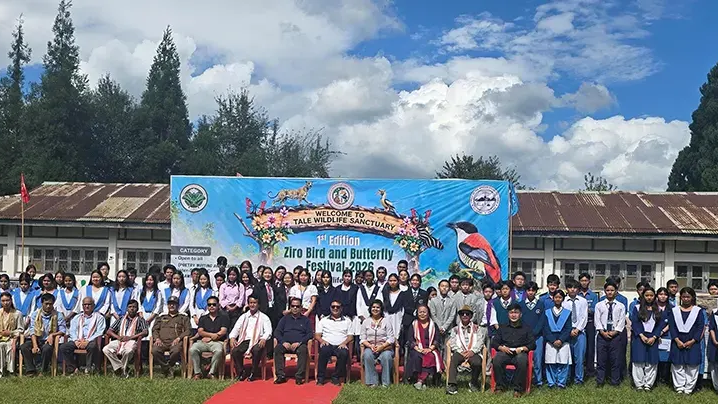
Two hundred and thirty-one students. Twelve schools. One powerful message — the forests of Arunachal Pradesh need us.
Ziro came alive with creativity and conviction on October 2 as the Hapoli Forest Division, in partnership with the Apatani Student Union, brought together students from across Lower Subansiri district for a series of inter-school and inter-collegiate literary and creative competitions. The event wasn’t just another school contest. It was a deliberate effort to shape how the next generation thinks about the wild spaces around them.
The competitions — spanning essay writing, poetry and elocution, and drawing — were organized as a lead-up to the first-ever Ziro Bird & Butterfly Festival 2026, scheduled at Pange inside the Tale Wildlife Sanctuary. They also coincided with the 72nd Wildlife Week 2026, making the timing deeply intentional.
There’s something striking about a forest department choosing pens, poems, and paintbrushes as its tools. It says a lot about how officials here understand what actually moves young people.
In the essay competition, Yangbiu Chipi of Class 10 from Love Dale Residential School, Hapoli, claimed the top spot. Toko Minia from Nime Ashram School, Old Ziro grabbed second, and Buru Hannah — also from Love Dale — rounded out the podium in third.
The poetry and elocution category saw college students step up. Bijoyta Sharma, a B.Ed student at Mudo Tamo Memorial College, Hapoli, took first place. Bomri Mary Gamlin from St Claret College, Ziro, came in second, while Rajiya Khatun, a Class 12 student from Dani Kunya Government Higher Secondary School, earned third.
On the visual arts front, Koj Monyo of Class 9 from ABYSS Institute of Science, Hapoli, won the drawing competition. Second place went to Toko Nuin of VKV, Ziro, and third to Bamin Tilling Gra from Dani Kunya Government Higher Secondary School.
The themes running through all three events — biodiversity, habitat protection, nature conservation — weren’t abstract textbook concepts here. For students growing up in the shadow of Tale Wildlife Sanctuary, these are lived realities. The forests, the birds, the butterflies — they’re part of the everyday landscape.
Hapoli Forest Division DFO Tilling Takar emphasized that student-centric initiatives like these are about more than awareness. They’re about building a sense of ownership. “Young people need to see themselves as responsible custodians of Tale Wildlife Sanctuary’s rich natural heritage,” he said — and the participation numbers back that up. With 231 students from 14 institutions turning up, the interest was clearly there.
It’s easy to plant trees on World Environment Day and call it conservation. It’s harder — and far more meaningful — to give students a stage to articulate why those trees matter, to draw the butterfly that might vanish if the forest shrinks, to recite a poem about a river that still runs clean. That’s what Hapoli’s forest officials seem to understand.
As the Ziro Bird & Butterfly Festival draws closer, the groundwork being laid here — not just in sanctuaries, but in schoolrooms and auditoriums — may matter just as much as any habitat survey. The students who competed this week might well be the conservationists, forest officers, and advocates of tomorrow.
And if the forests of Arunachal are lucky, they’ll remember what they wrote.