
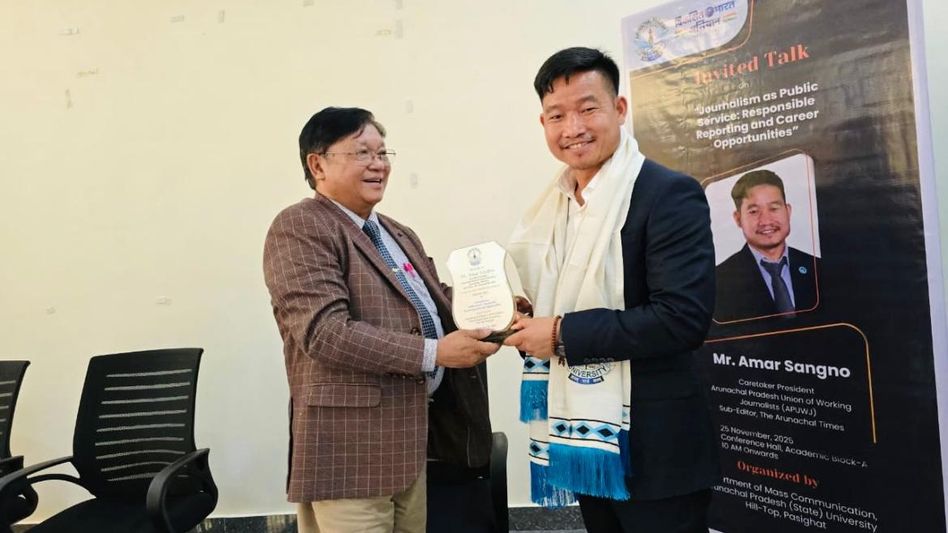
Renowned journalist and Caretaker President of the Arunachal Pradesh Union of Working Journalists (APUWJ), Amar Sangno, delivered a compelling address to students at Arunachal Pradesh State University (APSU), emphasising that journalism’s true calling lies in serving the public interest rather than amplifying power structures. Speaking on the theme “Journalism as Public Service: Responsible Reporting and Career Opportunities,” Sangno warned against the perils of misinformation in the digital age and urged aspiring journalists to cultivate curiosity, courage, and compassion as cornerstones of their profession.
The event, organised by APSU’s newly established Department of Mass Communication, marked a significant milestone with the launch of the department’s official jersey. It drew an enthusiastic audience, including students, faculty, and senior university officials, fostering an interactive dialogue on the evolving media landscape in Arunachal Pradesh.
Insights on Ethical Journalism and Misinformation
Sangno, who also serves as Sub-Editor at The Arunachal Times, began by addressing the rampant spread of falsehoods in contemporary media. He cautioned that unchecked repetition of lies can create an “illusion of truth,” eroding public trust and democratic discourse.
“Repeat a lie often enough, and it starts sounding like the truth — the illusion of truth. But journalism must rise above that,” Sangno asserted. “In an era where anyone with a lapel mic and a smartphone claims to be a journalist, our core mandate remains presenting credible, verified information to citizens.”
He highlighted the ethical dilemmas facing reporters in Arunachal, from navigating local sensitivities to countering digital disruptions like social media echo chambers. Sangno stressed that journalism should act as a watchdog, holding authorities accountable rather than serving as their mouthpiece. Congratulating APSU on launching its Mass Communication Department, he described it as a “timely initiative” that would bolster the state’s media ecosystem by producing well-rounded professionals.
The session transitioned into a lively Q&A, where students probed issues like yellow journalism, gatekeeping in newsrooms, and ethical reporting. Responding to queries on career prospects, Sangno expanded the horizon beyond traditional reporting, pointing to opportunities in public relations (PR), advertising, digital content creation, and media research. He encouraged the youth to “be part of the solution, not the noise,” urging them to prioritise fact-checking and empathy in their work.
University Leadership’s Endorsement
APSU Vice Chancellor Prof. Tomo Riba, who served as Chief Guest, reinforced the session’s message by underscoring journalism’s pivotal role in democracy. He described the media as “a mirror that reflects truth, not a tool that amplifies distortion,” and called for greater media literacy among students and faculty to discern credible information from propaganda.
“The media must remain discerning and critically aware of the information it engages with,” Prof. Riba said, expressing optimism that the new department would emerge as a powerhouse contributing to Arunachal’s media landscape.
Registrar Narmi Darang echoed these sentiments, noting that the digital media boom has amplified the need for accuracy, fairness, and accountability. “Ethical conduct is non-negotiable in an age of instant dissemination,” she remarked.
In his closing remarks, Assistant Professor Dr. Kombong Darang from the Mass Communication Department thanked Sangno for his “candid and insightful engagement,” which he said had broadened students’ perspectives on the profession. Head (In-Charge) Dr. Prem Taba highlighted the department’s deliberate focus on industry immersion from its inception.
“I wanted our students to learn from seasoned practitioners like Sangno, whose years of experience offer lessons no textbook can fully capture,” Dr. Taba stated, envisioning significant expansion for the unit in the years ahead.
The programme was also attended by Prof. P.C. Jena, Dean of Academic Affairs, heads of various departments, faculty members, Assistant Registrars, and students from multiple disciplines, reflecting broad institutional support for interdisciplinary learning.
A Step Forward for Arunachal’s Media Education
This event signals APSU’s proactive approach to bridging academia and industry, particularly in mass communication—a field poised for growth amid Arunachal’s rapid socio-economic changes. By featuring experts like Sangno, the university is equipping students not just with skills, but with a moral compass to navigate the challenges of modern journalism.
As Arunachal Pradesh continues to develop its media infrastructure, initiatives like this underscore the need for responsible reporting that empowers communities and upholds democratic values. The session left students inspired, ready to embrace journalism not as a career, but as a public service.
(Source: India Today NE)