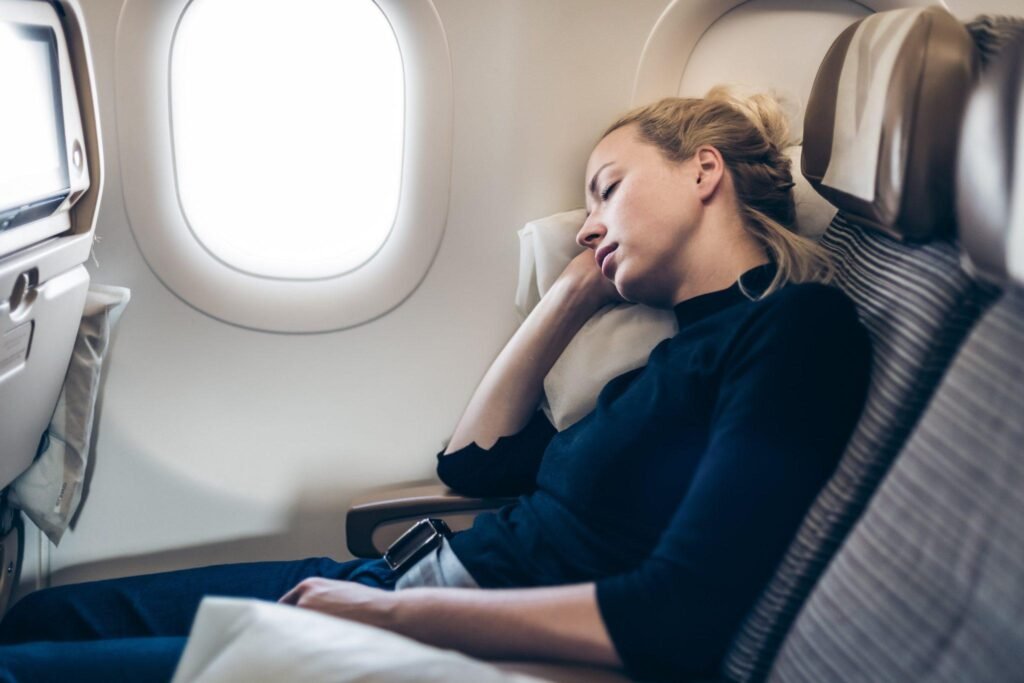
Learning how to sleep on a long flight without a neck pillow is mostly a matter of building support from things you already have in your carry-on, then setting up your seat so your body can actually relax. A neck pillow is convenient, but it is far from essential. A rolled hoodie, a scarf, a blanket, and a well-placed bag can do the same job, often more comfortably, because you can shape them to fit your body instead of fighting a stiff U-shaped pillow that pushes your head forward. With a little planning before takeoff and a simple routine once you are airborne, you can get real, useful sleep in economy, even on a flight that lasts eight hours or more.
Why Sleeping on a Plane Feels So Hard
Your body is designed to sleep lying flat, in the dark, in a quiet room, at a comfortable temperature. An airplane gives you almost the opposite of all four. You sit upright, your head bobs forward every time your neck muscles relax, the cabin lights and the glow of other passengers’ screens keep your eyes open, and announcements, engine noise, and movement keep pulling you back awake. Add a cramped seat, a seatmate who needs to get up, and air so dry it irritates your nose and throat, and it is no wonder that many travelers land feeling worse than when they took off.
Build Neck Support From a Rolled Hoodie or Jacket
A rolled hoodie or jacket is the best substitute for a neck pillow, because it is soft, adjustable, and already in your bag. Choose the thickest soft layer you have, ideally a hoodie, a fleece, or a puffy jacket. Lay it flat, fold it in half lengthwise, then roll it tightly from one end to the other until you have a firm cylinder about the width of your neck. The roll should feel supportive when you press it, not soft and flat. If it squashes easily, roll it tighter or add a second layer inside.
How to position the roll
There are two positions that work well, and the right one depends on how you prefer to sleep. If you sleep leaning against the window or the headrest, place the roll on the side your head leans toward, between your neck and your shoulder, so it fills the gap and stops your head from dropping sideways. If you tend to nod forward, place the roll at the front of your neck, under your chin, like a soft chin rest. That front position is the one most people get wrong, because they put the roll behind their neck, which actually pushes the head forward. Test both positions for a minute each before you settle, and adjust the roll until your head feels held, not pushed.
Use a Scarf as a Figure-Eight Wrap
A large scarf, a pashmina, or a sarong is one of the most versatile items you can carry on a long flight, and it makes a surprisingly effective neck support when you wrap it in a figure-eight shape. Fold the scarf lengthwise into a band about four inches wide, then wrap it around your neck once, cross it at the front, and bring the ends back around so the crossing point sits under your chin. Tuck the ends in so the wrap feels snug but never tight. The crossing at the front is what stops your chin from dropping, while the band around the back of your neck keeps your head from tipping sideways.
The advantage of a scarf over a rolled jacket is that it stays put. A roll can slip when you shift in your seat, but a wrapped scarf moves with you. It also doubles as a light blanket for your shoulders or lap once you are settled. Choose a scarf made from a soft, breathable fabric, and avoid anything scratchy or too warm, since you will be wearing it for hours. If the wrap feels too loose, fold the scarf double before you start. If it feels too tight, loosen it by a finger’s width and retuck the ends. You should be able to breathe, swallow, and turn your head easily. Comfort matters more than a perfect shape, so adjust until you forget it is there.
Support Your Lower Back With a Blanket
Most economy seats leave a gap between your lower back and the seat, which forces your spine into a curved position that aches after an hour or two. That ache is one of the main reasons people keep waking up, and it is easy to fix. Take the blanket the airline provides, or a light shawl from your bag, fold it into a thick rectangle, and place it in the small of your back, just above your waistband. Sit back against it and check that your lower back feels supported without being pushed too far forward.
If the blanket is thin, fold it twice to make it thicker. If you have an extra sweater, that works too. The goal is to fill the gap, not to add a hard lump, so the support should feel gentle and even. Once your lower back is supported, your shoulders can relax against the seat, your neck support works better, and your whole posture becomes easier to hold while you sleep. Some travelers also place a small folded item behind their neck as well as their lower back, creating two points of support that keep the spine in a more natural line.
Make a Footrest From Your Carry-On
Your feet and legs matter more for sleep than most people expect. When your feet dangle with nothing under them, blood pools in your lower legs, your knees stiffen, and the discomfort keeps pulling you awake. Raising your feet even a few inches changes the angle of your knees and takes pressure off your lower back.
Slide your personal item, a small backpack, or a packing cube under the seat in front of you and rest your feet on top of it. Your knees should bend at a relaxed angle, not sharply and not fully straight. If your bag is too tall, rest only your heels on it and let your toes point down. If it is too short, add a folded jacket on top. Avoid putting your feet up on the seat in front of you or on the armrest, which can disturb other passengers and may not be allowed. A simple footrest under the seat in front is comfortable, discreet, and easy to adjust. Get up and walk the aisle every couple of hours as well, which helps circulation and makes it easier to fall back asleep when you sit down again.
Choose Window or Aisle on Purpose
Your seat choice shapes how well you can sleep, so choose it with sleep in mind rather than leaving it to chance. A window seat is usually the best choice for sleeping, because you can lean your head against the wall of the plane, you have something solid to rest your rolled hoodie against, and nobody will climb over you to get to the aisle. Lean a small cushion or folded jacket between your head and the wall so the hard surface does not press against your ear, and you have a stable side to sleep on for hours.
Recline, But Do It Thoughtfully
Reclining your seat even a few inches makes a real difference to sleep, because it opens the angle between your torso and your thighs and lets your head rest further back. Recline after the meal service, when the cabin lights dim and most passengers are settling down. Recline slowly, so the person behind you has time to adjust, and check that your seatback does not press against their knees or tray.
Do not recline fully if it strains your neck or pushes your head forward. A partial recline, combined with good neck and lower-back support, is often more comfortable than the maximum recline. Keep your seatbelt fastened over your blanket, not under it, so the crew can see it and will not wake you to check it during the flight. That small detail saves you from being tapped awake in the middle of a good stretch of sleep, and it is the reason experienced travelers always keep the belt visible.
Block Light and Noise
Light and noise are the two things most likely to wake you just as you drift off, so block both before you try to sleep. An eye mask is small, light, and worth carrying even if you never use it at home. A contoured mask that does not press on your eyes is the most comfortable, and a silk or soft cotton mask is less likely to irritate your skin. Put it on once the cabin lights dim, and keep it on even if you wake briefly, so your eyes stay in the dark.
Eat, Drink, and Time Caffeine Carefully
What you eat and drink before and during the flight affects sleep more than most travelers realize. A heavy meal right before you try to sleep can leave you uncomfortable and restless, while going to bed hungry can also keep you awake. Eat a moderate meal a couple of hours before you plan to sleep, and choose foods that are easy to digest rather than spicy, greasy, or very rich. A light snack such as crackers, fruit, or a small sandwich is enough if you wake up hungry later.
Sip water regularly through the flight, since cabin air is very dry and a dry throat will wake you repeatedly. Alcohol may make you feel drowsy at first, but it tends to fragment sleep, so it usually leads to lighter, more broken rest. Caffeine late in the flight can keep you wide awake when you need to sleep, so stop it several hours before your planned sleep window and save it for the last hour before landing. For more on settling into sleep without medication, see How to Fall Asleep on a Plane Without Medication.
Plan Your Sleep Around Your Destination
The most effective sleep plan on a long flight is the one that matches the time at your destination. If you land in the morning, try to sleep for the middle portion of the flight so you arrive rested and ready for the day. If you land late at night, a shorter nap may be enough, and you can stay awake longer to enjoy the flight. Set your watch or phone to destination time as soon as you board, so your brain starts adjusting before you land.
Mistakes to Avoid
The most common mistake is trying to sleep with no support at all and expecting your neck to hold itself up. Your neck muscles relax as you fall asleep, so your head will drop forward or sideways no matter how determined you are. Always set up support before you get drowsy, not after. Another common mistake is overpacking your lap with items you then have to move every time you shift, which wakes you up. Keep only what you need at your seat, and stow the rest overhead. Wear loose, comfortable layers, slip off tight shoes, and give yourself a short wind-down instead of staring at a bright screen until the moment you close your eyes. Finally, do not ignore ear discomfort on descent; if your ears feel pressured or blocked, try the simple techniques in How to Stop Your Ears From Popping on a Plane rather than waiting for the discomfort to pass on its own.
Frequently Asked Questions
Can you sleep on a long flight without a neck pillow?
Yes. A rolled hoodie, a scarf wrapped in a figure-eight, or a folded blanket can support your neck just as well. The key is to fill the gap beside or in front of your neck so your head cannot drop forward or sideways.
Is a window seat better for sleeping on a plane?
Usually yes, because you can lean against the wall, you have a stable surface for your head, and nobody climbs over you. Use a folded jacket between your head and the wall for comfort.
Should I recline my seat to sleep on a long flight?
Yes, recline after the meal service when the cabin settles. A partial recline with good neck and lower-back support is often more comfortable than reclining as far as the seat will go.
How do I stop my head from falling forward when I sleep on a plane?
Place a rolled hoodie or a scarf wrap at the front of your neck, under your chin, so it stops the forward drop. A roll behind your neck alone often pushes your head forward instead of supporting it.
Do eye masks and earplugs really help on a flight?
Yes. An eye mask blocks cabin light and screen glow, while earplugs or noise-cancelling headphones muffle engine noise and conversation. Together they remove the two most common reasons people wake up mid-flight.
How much sleep can I expect on a long flight in economy?
Most travelers get two to four hours of light to moderate sleep on a long overnight flight, even with good preparation. That is enough to feel noticeably better on arrival, especially if you also plan your sleep around destination time.