
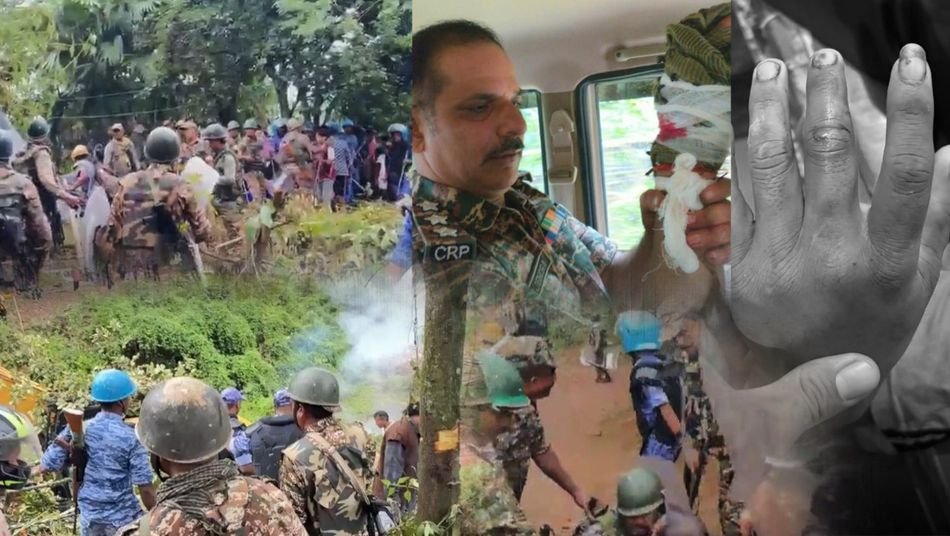
Clashes at Riga and Ugeng leave CRPF personnel — including an Assistant Commandant — and protesters seriously injured. The Siang is boiling, and not just with water.
There is something quietly devastating about watching a river community go to war to protect the very land their ancestors named. On Sunday, October 5, that quiet desperation turned into something louder — and bloodier — as protests over the proposed Siang Upper Multipurpose Project (SUMP) escalated into violent clashes between local demonstrators and Central Reserve Police Force (CRPF) personnel at two separate locations in Arunachal Pradesh’s Siang region.
The confrontations broke out at Riga and Ugeng, two areas currently seeing activity related to the ongoing Pre-Feasibility Report (PFR) survey work for the project. Several CRPF personnel were seriously injured in the clashes, among them an Assistant Commandant. Protesters were hurt too. As of now, the state government has not officially confirmed the exact number of casualties on either side, but the word coming out of the region paints a tense, deeply unsettled picture.
This was not a sudden explosion. It has been building for a while.
The SUMP — a massive proposed hydropower and multipurpose dam project on the Siang river — has been one of the most contested development proposals in the entire Northeast for years now. The Siang, for those unfamiliar, is no ordinary river. It is the lifeline of the Adi community and other indigenous people of Upper and East Siang districts. It feeds their fields, runs through their mythology, and connects their villages to generations of history that no government document can adequately capture. When people from these communities say the river is sacred, they are not speaking in metaphors.
The current phase of the conflict centers around the PFR survey activities. The Arunachal Pradesh government has repeatedly insisted that the PFR is merely an early-stage, technical assessment — a preliminary study that does not lock the state into any final commitment about actually building the dam. Officials have also called for dialogue, urging affected communities to come to the table rather than take to the streets.
But local communities are not buying that argument. And honestly, it is not hard to understand why.
For the people living in the Siang valley, each survey team that enters their land feels like another step toward an irreversible future they did not ask for and do not want. They have watched other river communities across India lose everything to big dam projects — displacement, broken promises of rehabilitation, flooded farmlands, fractured identities. The fear is not abstract. It is inherited. And when you feel that the system is not truly listening, you block the surveyors. You stand on the road. You push back. And sometimes, things get out of hand.
That is exactly what happened at Riga and Ugeng.
The protesters’ concerns are not without merit either. They have raised consistent, documented objections about what a project of this scale would mean for the region — the loss of ancestral agricultural land, the disruption of livelihoods built over centuries, the environmental impact on one of the most ecologically sensitive river corridors in Asia, the displacement of villages with no real plan for what comes after, and the destruction of biodiversity in a region that scientists and conservationists have repeatedly flagged as irreplaceable.
These are not the grievances of people who are simply against development. These are the voices of people who want to be heard before a decision is made that they will have to live with — or flee from — for the rest of their lives.
What makes this particular moment feel urgent is the fact that security forces were deployed to facilitate what the government describes as a technical survey. That choice — sending CRPF personnel alongside survey teams — will be read by local communities as a statement of intent. It signals that the state is prepared to push this project forward with or without community consent. And when that message lands in a community that is already on edge, confrontation becomes almost inevitable.
An Assistant Commandant being injured is not a small thing. Neither is a protester being hurt on their own ancestral land while trying to stop a survey they never agreed to. Both speak to a situation that has gone beyond the point where press releases and calls for dialogue are going to fix anything.
The Arunachal Pradesh government now has a genuinely difficult decision to make. It can continue sending survey teams into flashpoint areas backed by security forces, knowing that more clashes are likely. Or it can pause, step back, and engage in the kind of deep, good-faith consultation that these communities have been demanding all along — not as a PR exercise, but as an actual reckoning with the stakes involved.
The Siang has a memory. So do the people who live on its banks. And in a region where trust between the state and indigenous communities is already fragile, the image of injured bodies at Riga and Ugeng will not be forgotten easily.
A dam might eventually be built or it might not. But the relationship between the government and the people of the Siang region is already taking damage that no feasibility report can measure — and no amount of concrete will repair.