
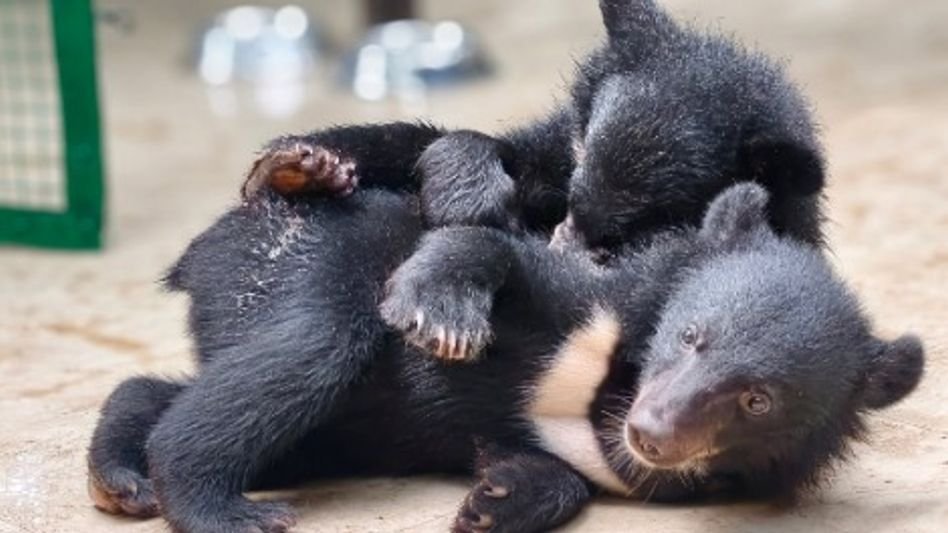
For the first time in their short lives, three young bears are going home — and it’s a journey that took months of care, patience, and a 26-kilometre trek through the forest.
Three orphaned Asiatic black bear cubs, rescued and nursed back to health in Arunachal Pradesh’s East Kameng district, have officially begun the process of returning to the wild. On September 24, the three male cubs were moved from the Centre for Bear Rehabilitation and Conservation to a pre-release site deep inside Pakke Tiger Reserve — the start of what will be a slow, careful reintegration into the forest they were always meant to call home.
This wasn’t a simple drive-and-release operation. A joint team from the Wildlife Trust of India (WTI) and the Arunachal Pradesh Environment, Forest and Climate Change Department escorted the cubs on a 26-km journey to the release site — traveling partly on foot, partly by elephant. You have to stop and appreciate that image for a moment: conservationists walking alongside elephants, carrying three young bears toward freedom, somewhere in the thick green heart of Pakke. There’s something quietly extraordinary about that.
Pakke Tiger Reserve DFO Dhawan Kumar Rawat summed it up simply. “From rescue to rehabilitation, these young bears are now taking an important step towards returning to the wild,” he said. It’s a short sentence, but it carries the weight of everything that went into getting these cubs to this point.
The process, however, is far from over. Dr Panjit Basumatary of WTI made clear that the cubs won’t just be let loose and left to figure it out. They will spend the next five to six months exploring the forest under expert supervision, building the instincts and skills they’ll need before anyone considers them truly ready to live independently. This is what’s called a soft-release — giving the animals a gradual transition, not a sudden one. No shock. No abandonment. Just a slow, guided return to nature.
It’s a method that matters deeply when dealing with young animals that were orphaned before they could learn survival skills from their mothers. Bears, like many wild animals, learn by watching. Without that maternal guidance, rehabilitation centres have to step in and fill that role — and then, carefully, step back.
The Asiatic black bear is listed under Schedule I of the Wildlife (Protection) Act, 1972, making it one of India’s most protected species. Poaching, habitat loss, and human-wildlife conflict have put pressure on their populations across the region. Every successful rehabilitation and release, then, isn’t just a heartwarming story — it’s a small but meaningful pushback against those pressures.
Pakke Tiger Reserve, nestled in the East Kameng district, is one of Arunachal Pradesh’s most celebrated wildlife sanctuaries, known for its biodiversity and conservation success stories. That these three cubs will now roam its forests feels right.
For months, they were fed, monitored, and slowly prepared. Now, for the first time, the trees around them are real — and nobody is bringing them their next meal. In five or six months, if all goes well, they won’t need anyone to. That quiet moment of full independence, when it comes, will be the real homecoming.