
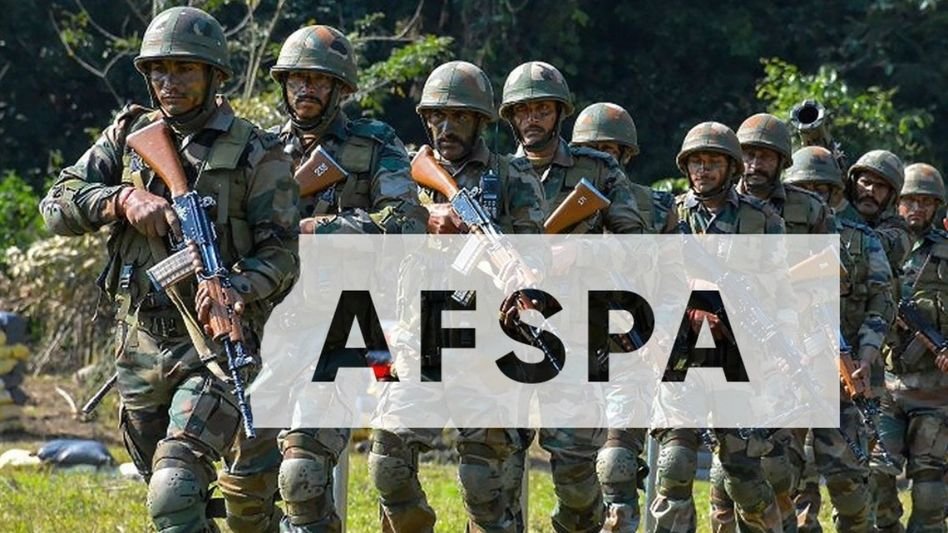
For the people living under its shadow, there is no such thing as a routine renewal. On September 25, the Central government quietly issued Gazette notifications extending the Armed Forces (Special Powers) Act, 1958 — better known as AFSPA — across specified areas of Manipur, Nagaland, and Arunachal Pradesh for another six months, effective October 1. Another half-year. Another extension. And for many communities across these three states, another reminder that normalcy remains a distant dream.
The decision, the Home Ministry said, came after a fresh review of the law and order situation in the three northeastern states. That phrase — “review of the law and order situation” — has appeared so many times in official notifications over the decades that it almost reads like a template. But what it actually means on the ground is deeply human, and deeply complicated.
In Manipur, the notification extends the declaration of the entire state as a “disturbed area” — with one important carve-out. Thirteen police stations spread across five districts are excluded from AFSPA’s reach. These fall under Imphal West, Imphal East, Thoubal, Bishnupur, and Kakching districts. In practical terms, most of the Imphal valley’s urban core has some breathing room. The hills, however, don’t. The extension there comes against the backdrop of ethnic violence that first erupted in May 2023 and has never really stopped. Over three years of conflict, and the Centre’s answer to the question of security continues to be the same legislation.
Nagaland’s extension covers nine full districts — Dimapur, Niuland, Chumoukedima, Mon, Kiphire, Noklak, Phek, Peren, and Meluri — and 21 police station areas across Kohima, Mokokchung, Longleng, Wokha, and Zunheboto. Nagaland has been fighting to have AFSPA revoked for years. Civil society groups, tribal bodies, and successive state governments have demanded it. The peace talks with NSCN-IM have dragged on for three decades. And yet, here we are again.
Arunachal Pradesh sees the law extended in the volatile districts of Tirap, Changlang, and Longding — the so-called “triangle of insurgency” — along with specific police station areas in Namsai district, which shares a border with Assam. These areas have long been haunted by cross-border militant activity, and the Centre has consistently flagged them as requiring the kind of authority that only AFSPA grants to the armed forces.
That authority — the power to search, arrest, and use force without a warrant — is precisely what makes AFSPA so contested. Under Section 3 of the Act, the Central government can declare any area “disturbed” when it believes armed forces are necessary to restore public order. Critics argue that this open-ended provision has led to abuse and impunity over the decades. Human rights organisations have documented cases of alleged custodial deaths and forced disappearances. The Supreme Court has at various points pushed for accountability. And still the Act endures.
The government’s position has always been that security conditions in these regions are not yet stable enough to lift it. That may well be true in parts. But after more than sixty years on the books in the Northeast, perhaps the more urgent question is this: at what point does a temporary emergency measure become a permanent state of exception?
The clock resets to October 1. Six more months. The Northeast waits.