
The BJP in Arunachal Pradesh didn’t just hold a meeting on Tuesday — it held a mirror up to itself.
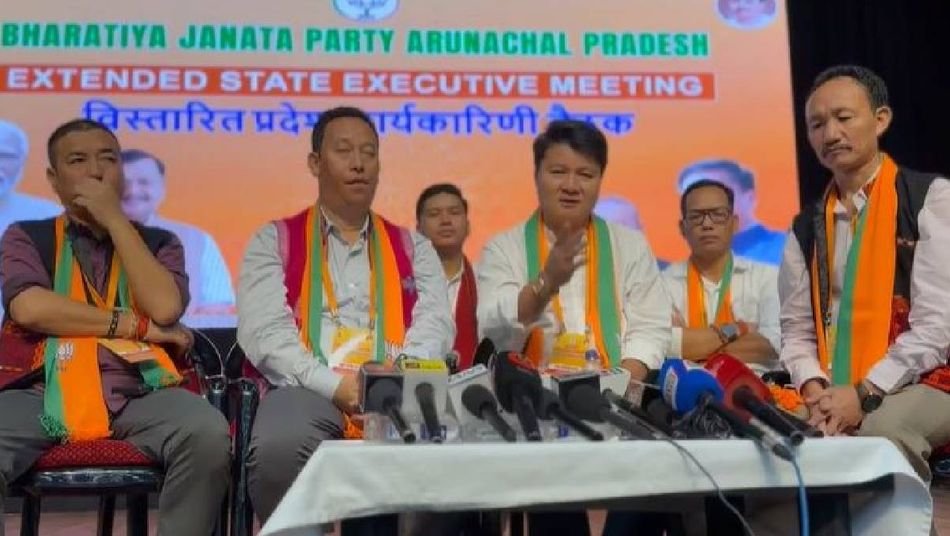
The Bharatiya Janata Party’s Arunachal Pradesh unit convened an extended State Executive Meeting at the D.K. Convention Hall in Itanagar on September 22, pulling together a who’s who of state politics under one roof. Chief Minister Pema Khandu was there. So was Deputy Chief Minister Chowna Mein, BJP state president Kaling Moyong, Union ministers Kiren Rijiju and Kirti Vardhan Singh, Rajya Sabha MP Tai Tagak, and a string of state ministers and MLAs. BJP’s Northeast Coordinator Sambit Patra flew in to address the gathering too. That’s a lot of heavyweights in one hall — and it signals that this wasn’t just a routine get-together.
The core agenda? Looking inward. Reviewing what’s working, what isn’t, and who’s doing what at the party’s grassroots level.
In a state as geographically vast and organisationally complex as Arunachal Pradesh, keeping a political machine well-oiled across every district, mandal and village unit is genuinely hard work. Mountains, remoteness, poor connectivity — these aren’t just logistical challenges, they are ongoing tests of political will. The BJP clearly knows this, and Tuesday’s extended executive meet was a deliberate attempt to tighten those loose threads.
District presidents, Morcha leaders, Mandal presidents, district in-charges and a wide range of other organisational functionaries made the trip to Itanagar from across the state. That kind of participation — right from the top of the pyramid down to the ground-level operators — tells you something important. The party isn’t just talking about grassroots strengthening, it’s physically bringing the grassroots into the room.
The discussions revolved around improving coordination between different organisational units and ensuring that programmes and responsibilities assigned to party workers are actually being followed through. It sounds straightforward, but anyone who has watched state-level political organisations will tell you — execution at the field level is where most parties quietly fail. Decisions taken in air-conditioned halls don’t always translate into action on the ground. This meeting was at least an acknowledgment of that gap.
Senior leaders took time to interact directly with party workers — not just address them from a podium, but engage with them. Party spokespersons and MLAs later briefed the media on the resolutions passed during the session, though specific details of those resolutions weren’t laid out in full public detail.
What’s also worth noting is the context. This extended executive meet is part of a broader series of organisational programmes the BJP has been rolling out in Arunachal to reinforce coordination between its state, district and grassroots units. It isn’t a one-off event. There’s a pattern here — one of deliberate, sustained internal consolidation. The presence of national-level figures like Kiren Rijiju and Sambit Patra suggests this isn’t just a state-level concern; central leadership is watching and involved.
Arunachal Pradesh has been a BJP stronghold, and the party clearly intends to keep it that way. But strongholds, as history has shown repeatedly, don’t maintain themselves. They need constant tending. A party that reviews itself, reassigns responsibilities and holds its own workers accountable is one that takes its political durability seriously.
Tuesday’s meeting was a reminder that staying in power is never accidental — it’s organisational.