

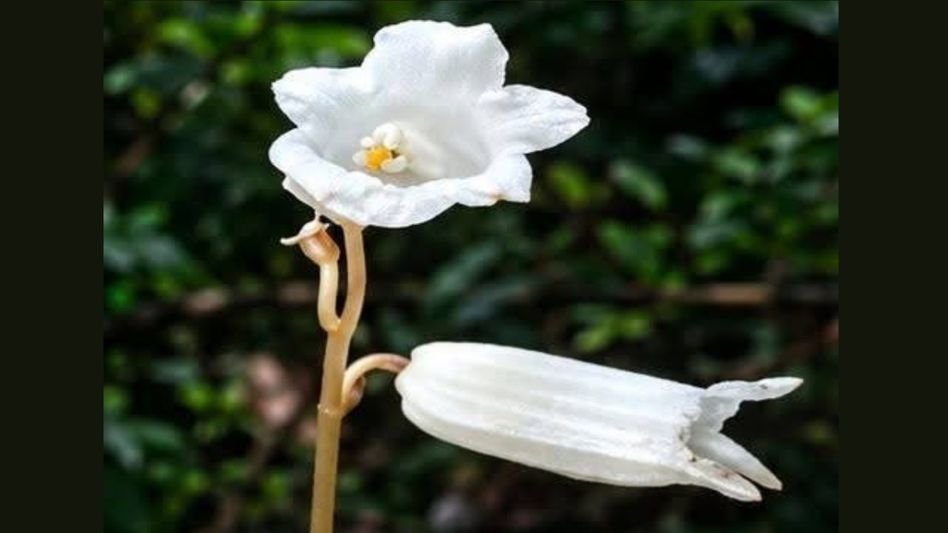
Deep inside a remote gorge in Arunachal Pradesh, where bamboo groves swallow the sunlight and rotting leaves carpet the forest floor, scientists have stumbled upon something that almost shouldn’t exist — a flowering plant that has no leaves, no chlorophyll, and essentially no business being alive by the rules of conventional botany.
Meet Gastrodia keyiensis. Or as the Nyishi people of the region have always called it — Oram Opuh. The Ghost Flower.
Scientists identified the rare leafless orchid species along a remote gorge of the Keyi River in Arunachal Pradesh’s Keyi Panyor district, and the discovery has quietly sent ripples through India’s botanical community. The find was no accident of luck either. Researchers were conducting a dedicated botanical survey of the area when they came across just five flowering individuals of this ghostly plant — five, in the entire site. That number alone tells you how elusive this thing really is.
The orchid was found at an elevation of around 1,000 metres, growing in deep shade among thick layers of decaying leaf litter in bamboo groves on the right bank of the Keyi River. If you’re picturing some dramatic, towering specimen bursting with colour — think again. This plant is a quiet anomaly. It reaches about 35 centimetres in height and produces just one to three flowers, pale white to bluish, with a distinctive yellow curved portion at its centre.
What makes Gastrodia keyiensis genuinely extraordinary is how it survives. Unlike ordinary plants that use photosynthesis to produce food, this orchid has neither leaves nor chlorophyll. Instead, it obtains nutrients through its association with fungi in the soil — a process known as holomycotrophy. In other words, it feeds off fungi rather than sunlight. It lives underground for most of its life, surfaces briefly to flower, and then disappears again. Like a ghost. The local name is fitting in more ways than one.
The findings were formally published in the international taxonomic journal Phytotaxa on September 9, authored by Madhusudhan Khanal, Dipankar Borah, Shuvadip Sarkar, Neelam Gap, Santosh Kumar Rai, and Devendra Kumar — researchers affiliated with institutions including the GB Pant National Institute of Himalayan Environment, Sikkim University, Kaliabor College, and the Botanical Survey of India.
There is, however, reason for concern alongside the excitement. Gastrodia keyiensis is currently known only from the single location where it was discovered, with its area of occupancy estimated at around four square kilometres. Because its broader population and geographical range remain unknown, the species has been placed in the Data Deficient category, with researchers recommending further surveys and long-term monitoring. Its short flowering window makes detection during routine surveys nearly impossible — which raises an uncomfortable question: how many species like this one are still hiding in Arunachal’s forests, unseen and unrecorded?
Deputy Chief Minister Chowna Mein welcomed the discovery, calling it an addition to Arunachal Pradesh’s natural heritage and underlining the need for continued research and conservation of its fragile ecosystems.
Arunachal Pradesh is already home to around 600 documented orchid species and is widely regarded as an “Orchid Paradise.” The Ghost Flower is now among them — and its discovery is less a celebration than a reminder. A reminder that Arunachal’s forests are still telling us their secrets, one quiet, leafless miracle at a time.