
MANCHAL, Sept 19: A practical demonstration on oyster mushroom cultivation in Manchal has put a simple agricultural idea in the spotlight — one that could help rural families turn small spaces and farm waste into an additional source of income.
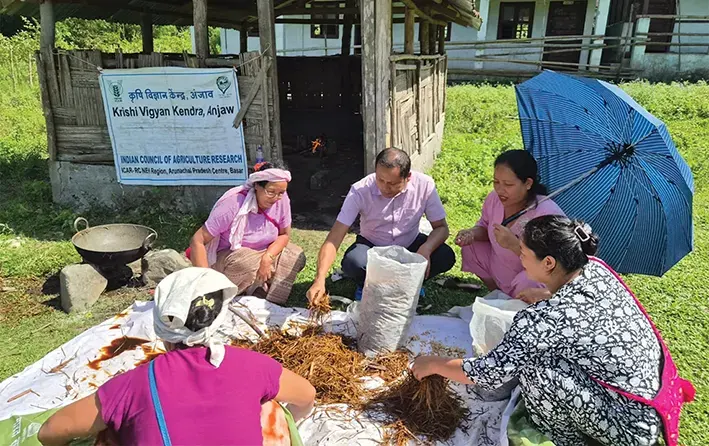
The Anjaw Krishi Vigyan Kendra (KVK) organised the hands-on programme on Saturday with the aim of encouraging year-round mushroom production and creating new livelihood opportunities for rural households. The session brought together agriculture experts, local representatives and members of a self-help group for a closer look at how oyster mushrooms can be cultivated using locally available resources.
The demonstration was led by agriculture economics expert Dr S Peter Singh along with the KVK staff. The Manchal ZPM and four members of a local self-help group were also present during the programme.
Rather than keeping the session limited to theory, the KVK team focused on practical techniques that participants could understand and apply themselves. They were introduced to the different stages of oyster mushroom production, from selecting and preparing the growing substrate to maintaining the right moisture, spawning, preparing cultivation bags, incubation, fruiting and finally harvesting.
For rural households, that practical side could be especially important. Mushroom cultivation does not necessarily require large areas of land, making it an option for families who may not have enough space for conventional farming activities. The KVK also highlighted the relatively low investment required to begin cultivation and its potential as a supplementary income-generating activity.
Dr Singh stressed that oyster mushroom cultivation can support livelihood diversification, particularly among self-help groups and rural households. The possibility of producing mushrooms throughout the year could give families another agricultural activity that is less dependent on traditional field space.
One of the more interesting aspects of the programme was the focus on agricultural residues. Materials that are often treated as farm waste can potentially be used as substrates for mushroom cultivation, giving them a productive second use. In that sense, the initiative connects income generation with better utilisation of resources already available in rural areas.
The latest demonstration also reflects a wider effort by Anjaw KVK to promote mushroom cultivation in the district. Similar training and demonstration programmes have been conducted in other villages, while earlier farm-level trials explored the use of different agricultural materials for growing oyster mushrooms.
For many rural families, new livelihood opportunities do not always begin with large investments or expensive technology. Sometimes, they begin with learning how to make better use of what is already around them. The Manchal demonstration is another step in that direction, showing how a small cultivation activity can potentially grow into a meaningful source of income and rural enterprise.