
The Northeast has always played by its own rules. Its hills are steep, its farms are small, and its farmers have survived for generations on instinct and tradition. Now, one minister wants science to finally catch up to them — on their terms.
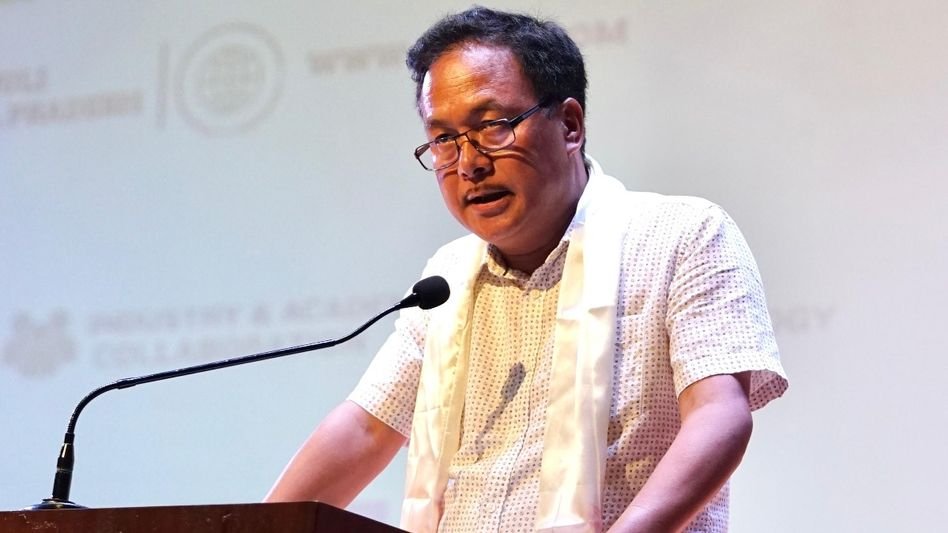
Speaking at the valedictory ceremony of EARITA 2026 at the North Eastern Regional Institute of Science and Technology (NERIST) on October 1, Arunachal Pradesh Agriculture and Allied Departments Minister Gabriel D Wangsu delivered what many in the room called a timely reality check. Agricultural technology, he said plainly, is only as good as its ability to reach the farmer standing knee-deep in a terraced field.
“Technology in agriculture must ultimately serve the farmer,” Wangsu told researchers, scientists, students, and innovators gathered at the conference. The event, organised by NERIST’s Department of Agricultural Engineering, brought together minds working on artificial intelligence, drones, robotics, sensors, remote sensing, and digital platforms — all being explored for their potential role in transforming how the region farms.
But Wangsu wasn’t there to be dazzled by prototypes. His message was grounded.
He pointed out clearly that the Northeast is not a flat, mechanised farming belt. Small landholdings, rugged terrain, wildly diverse agro-climatic zones, and deeply rooted traditional practices make this region unlike anywhere else in India. Copying models built for Punjab’s plains or Maharashtra’s large farms simply won’t work here. Any technology worth adopting, he argued, must be affordable, easy to use, and built for the actual conditions farmers face every single day.
He touched on something that often gets ignored in these high-minded innovation conversations — the climate crisis knocking at the Northeast’s door. Glacier retreat, shifting rainfall, soil erosion, permafrost changes. These aren’t abstract concerns. They directly threaten water security, crop health, and the long-term survival of farming communities across the region. Smart irrigation, IoT-based water management, and hydrological modelling, he said, could make a real difference — if implemented right.
On mechanisation, Wangsu pushed back against a narrow definition of progress. Automation alone isn’t the goal. The goal is to make farming less backbreaking, safer, and more dignified. That’s a different conversation. And it’s one that deserves more attention.
He was equally pointed about the digital divide. AI tools, he warned, cannot become luxuries available only to farmers with fast internet, expensive gadgets, or technical degrees. He welcomed research on edge-AI and low-bandwidth solutions specifically designed for smallholder farmers — the kind of quiet, practical innovation that doesn’t make headlines but changes lives.
Post-harvest losses also came up. Machine-vision grading, AI-based quality assessment, improved drying systems — Wangsu sees these as genuine opportunities to cut waste and create rural entrepreneurship. “The farmer of the future should not only be a producer,” he said. “They should also have the opportunity to become a processor, entrepreneur and value creator.”
He ended with a challenge to the researchers in the room. Don’t let EARITA’s ideas die in conference halls or research papers. Take them to the fields. Test them. Let the farmers themselves use the technology, see it, and tell you what’s wrong with it.
That last part is worth sitting with. In a world obsessed with innovation metrics, Wangsu is essentially asking: have you asked the farmer yet?
If the Northeast’s agricultural revolution is going to mean anything real, it has to start with exactly that question.